CRE marketing guide
How to write an offering memorandum for commercial real estate
What goes into a commercial real estate offering memorandum, in what order, and how to write each section so buyers can check it.
What an offering memorandum is
An offering memorandum (OM) is the document a listing broker sends to qualified buyers or tenants once they have shown real interest in a commercial property. It is longer and more detailed than a teaser or a marketing brochure: where a brochure sells the opportunity, the OM lets a buyer underwrite it.
A good OM answers the questions a buyer’s analyst, lender and lawyer will ask, in the order they will ask them, and shows where every figure came from. It is usually shared after a confidentiality agreement is signed, and it never replaces the buyer’s own due diligence.
Before you write: assemble the property file
Most OM problems start before the first page is written. Collect the source documents first and keep a note of where each fact came from:
- Legal description, PIN or roll number, site area and frontage (from the survey, title search or municipal records).
- Building facts: gross and rentable area, year built, clear height, loading, power, construction, recent capital work.
- Zoning by-law designation and the permitted uses that matter to likely buyers, plus any official plan designation.
- Servicing: water, sanitary, storm, hydro and gas, with sizes where they are known.
- Income and expenses: the rent roll, lease abstracts, operating costs, property taxes and recoveries.
- Photos, aerials and the site plan, in the highest resolution you have.
- Asking price or the offering process (for example, an offer date or “unpriced”).
If a fact can’t be confirmed, leave it out or mark it as approximate. A missing line is better than a wrong one.
The standard structure of an OM
There is no single legal format, but most commercial real estate OMs follow a similar sequence. Buyers expect to find things in roughly this order:
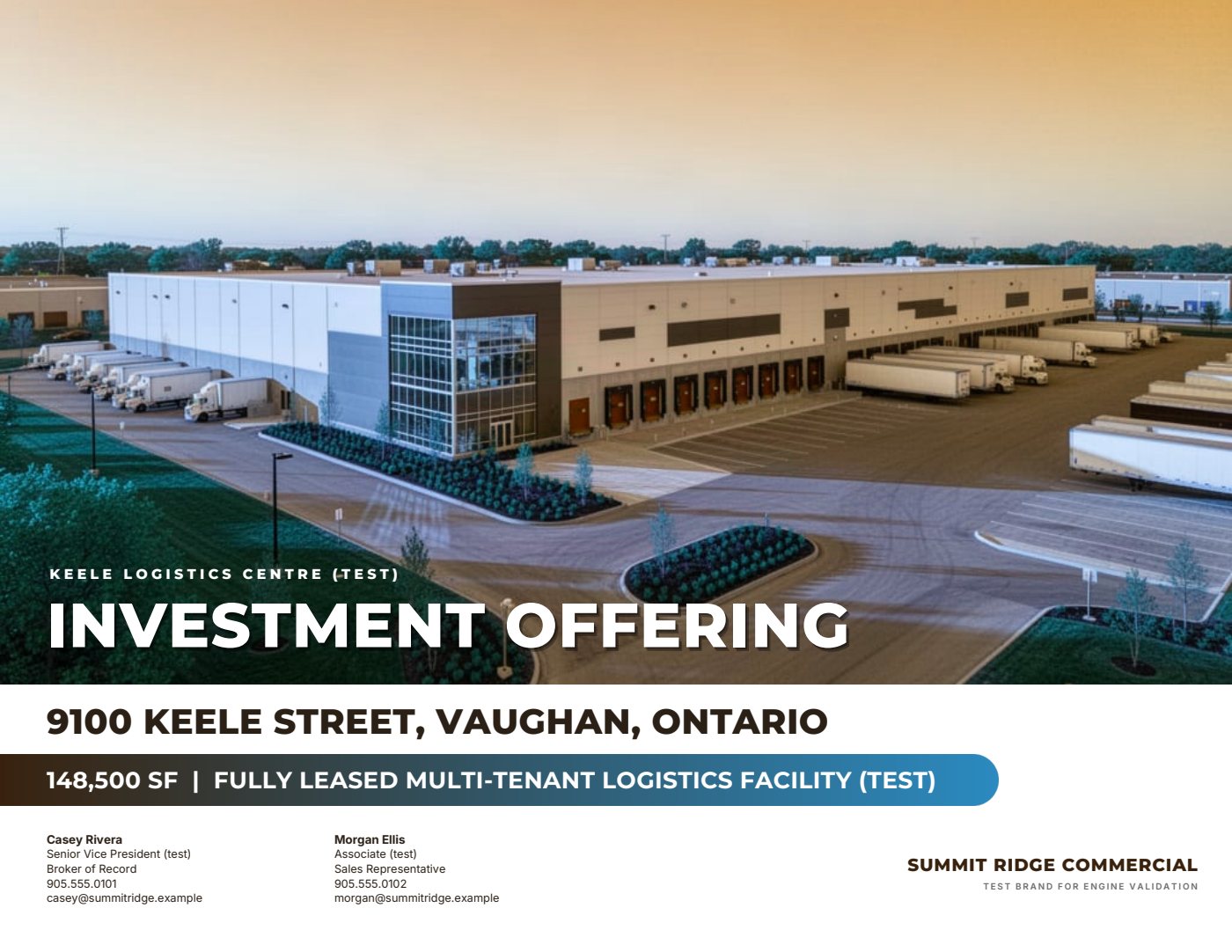
- Cover: property name or address, the transaction (for sale, for lease, investment), a strong photo and the listing team.
- Confidentiality and disclaimer page.
- Executive summary and investment highlights.
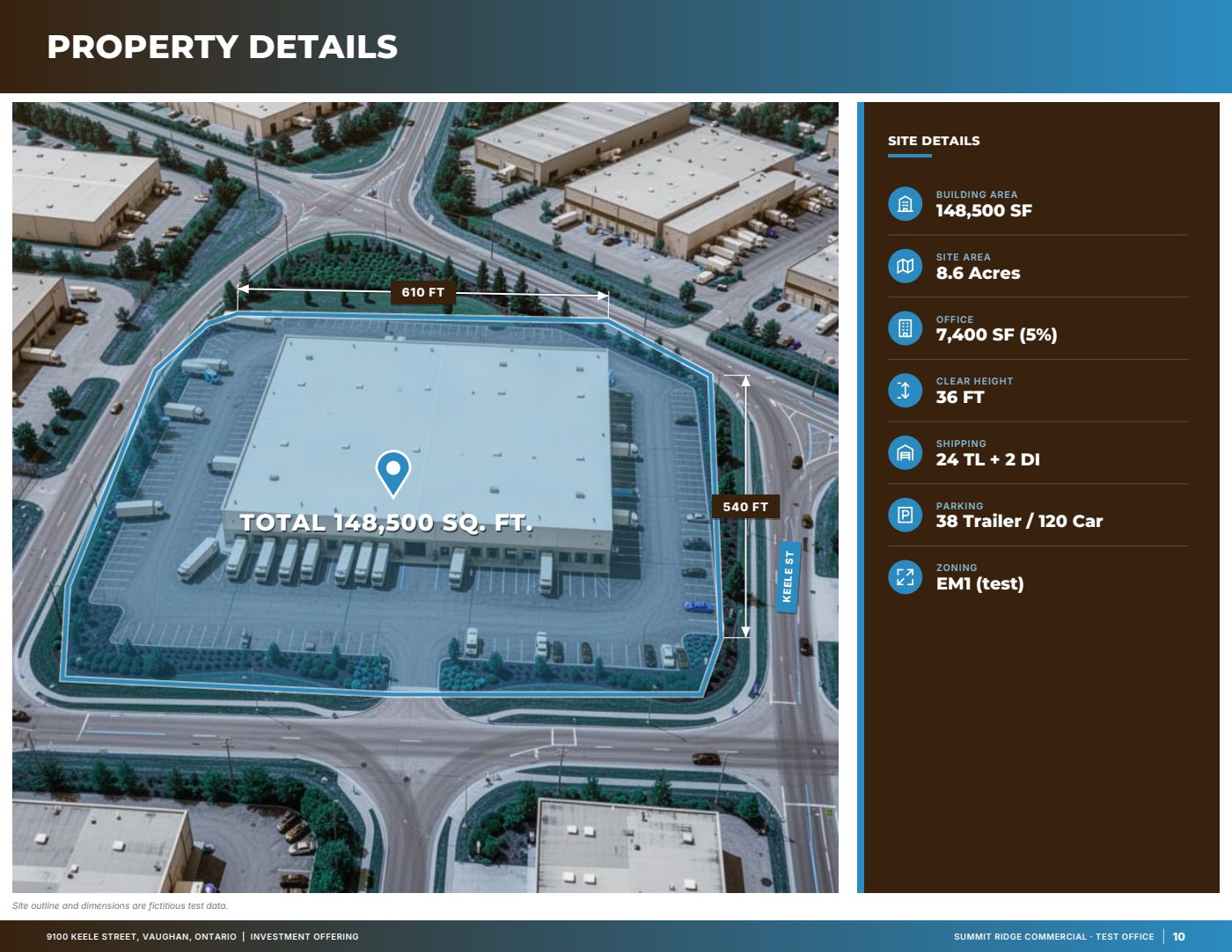
- Property details: site, building and specifications, often over an aerial with the parcel outlined.
- Zoning, permitted uses and servicing.
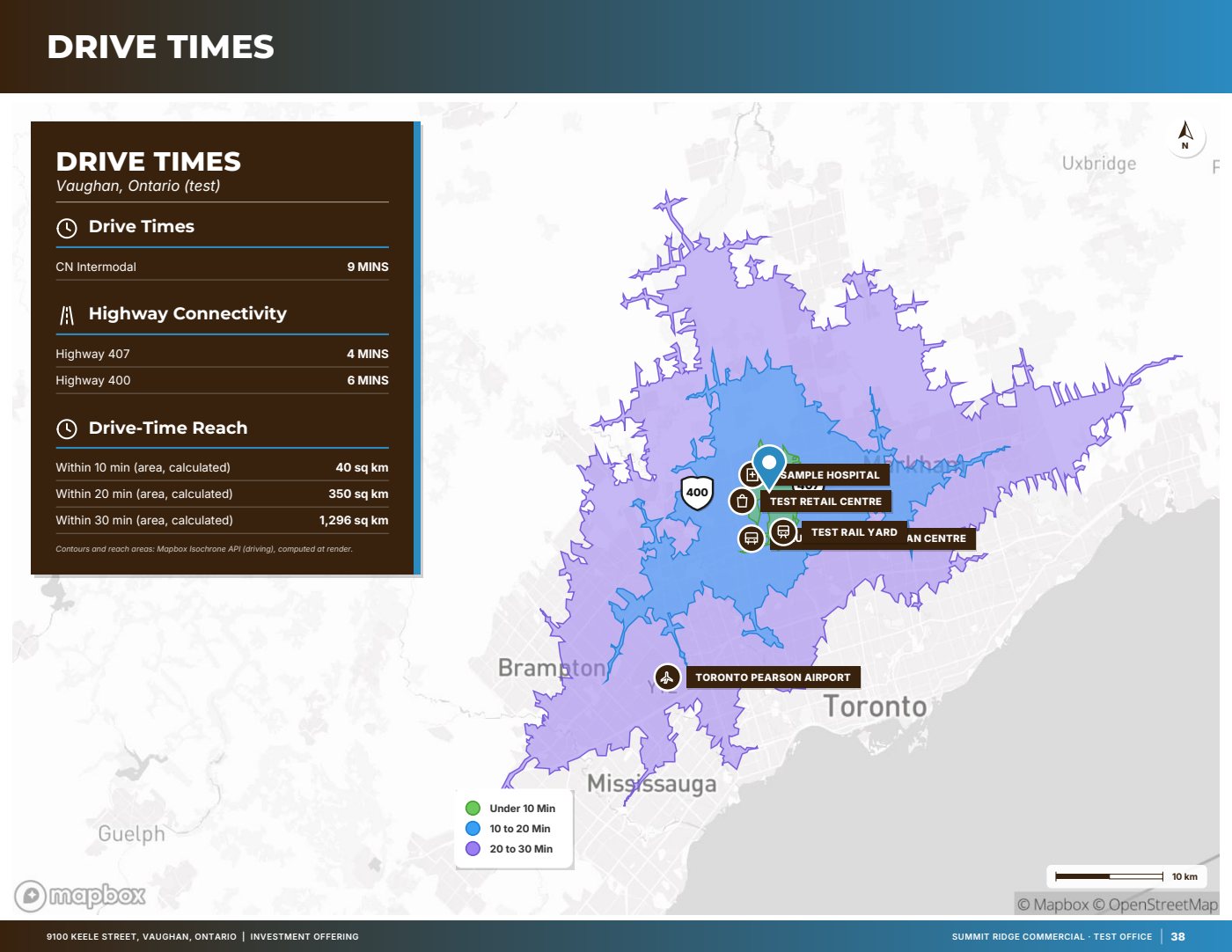
- Location: regional context, drive times, highway access, transit and neighbouring occupiers.
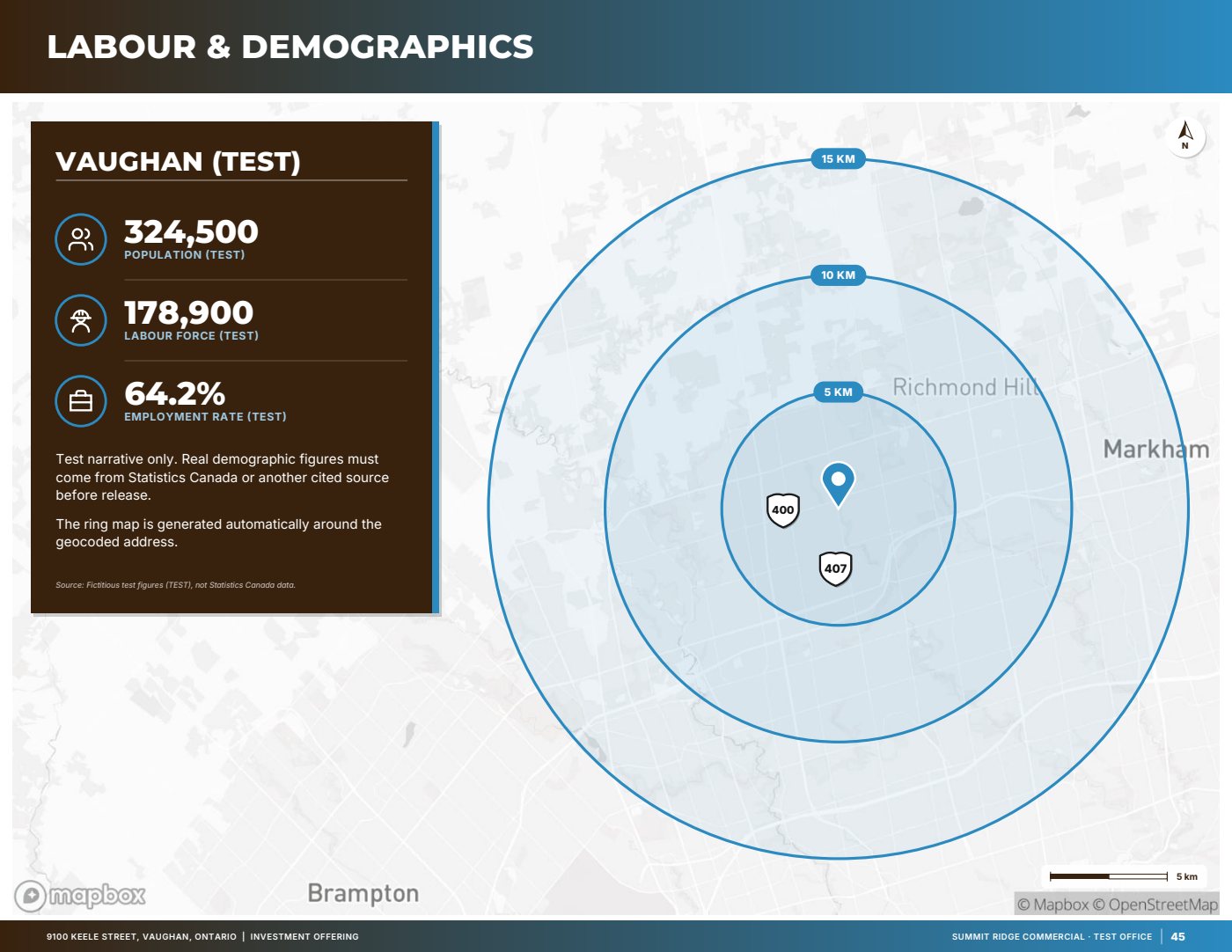
- Market and demographics: population, labour force and employment around the site.
- Financial analysis: rent roll, income and expenses, net operating income and pricing metrics.
- Photos, site plan and floor plans.
- Offering process and contacts.
Land and development OMs swap the rent roll for servicing, planning status and concept plans. Single-tenant investment OMs add a tenant profile and a lease abstract.
Write the executive summary last
The executive summary is the page most people read, so write it after everything else is settled. In a few short paragraphs it should state what is being offered, where it is, the key physical facts and the headline numbers.
Investment highlights
Highlights are the reasons to buy, written as short, specific statements. “Minutes from Highway 401” is weaker than the actual drive time to the nearest interchange; “strong tenant” is weaker than the tenant’s name, the remaining lease term and the rent escalations. Every highlight should be something a buyer can verify elsewhere in the document.
Avoid superlatives you can’t support (“best”, “rare”, “unmatched”). Specific facts read as more confident than adjectives.
Property details, zoning and servicing
Present the physical facts in a consistent table or specification column: site area (in acres and hectares or square feet and square metres), building area, coverage, clear height, shipping doors, power, sprinklers, parking and year built. Use the same units and rounding everywhere in the document.
For zoning, quote the zone code and the by-law it comes from, then list the permitted uses that matter to the likely buyer pool rather than copying the whole by-law. Note the date you checked it. If a use depends on a variance or a site-specific exception, say so plainly.
Servicing matters most for land and for industrial users with heavy water or power needs. State what is at the lot line and what would need to be extended, and name the source (municipal servicing maps, a consultant’s report or the vendor).
Location: maps, drive times and demographics
Buyers want to understand the site in its context quickly. The pages that do this best are visual:
- An annotated aerial with the parcel outlined and nearby roads, highways and landmarks labelled.
- Drive-time areas (isochrones) for 10, 20 and 30 minutes, with the nearest highway interchanges and their distances.
- Neighbouring occupiers and amenities, shown on a map with leader lines rather than a long list.
- Population, labour force and employment within a drive time or radius, each figure with its source and year.
Date every location figure and name its source, for example a census year or a traffic count programme. Round counts down rather than up, and don’t mix figures from different years in the same table without saying so.
Financials: show the work
For an income property the financial section is where an OM earns trust. Start with the rent roll (tenant, unit, area, lease start and expiry, current rent, escalations and recovery structure), then the operating statement.
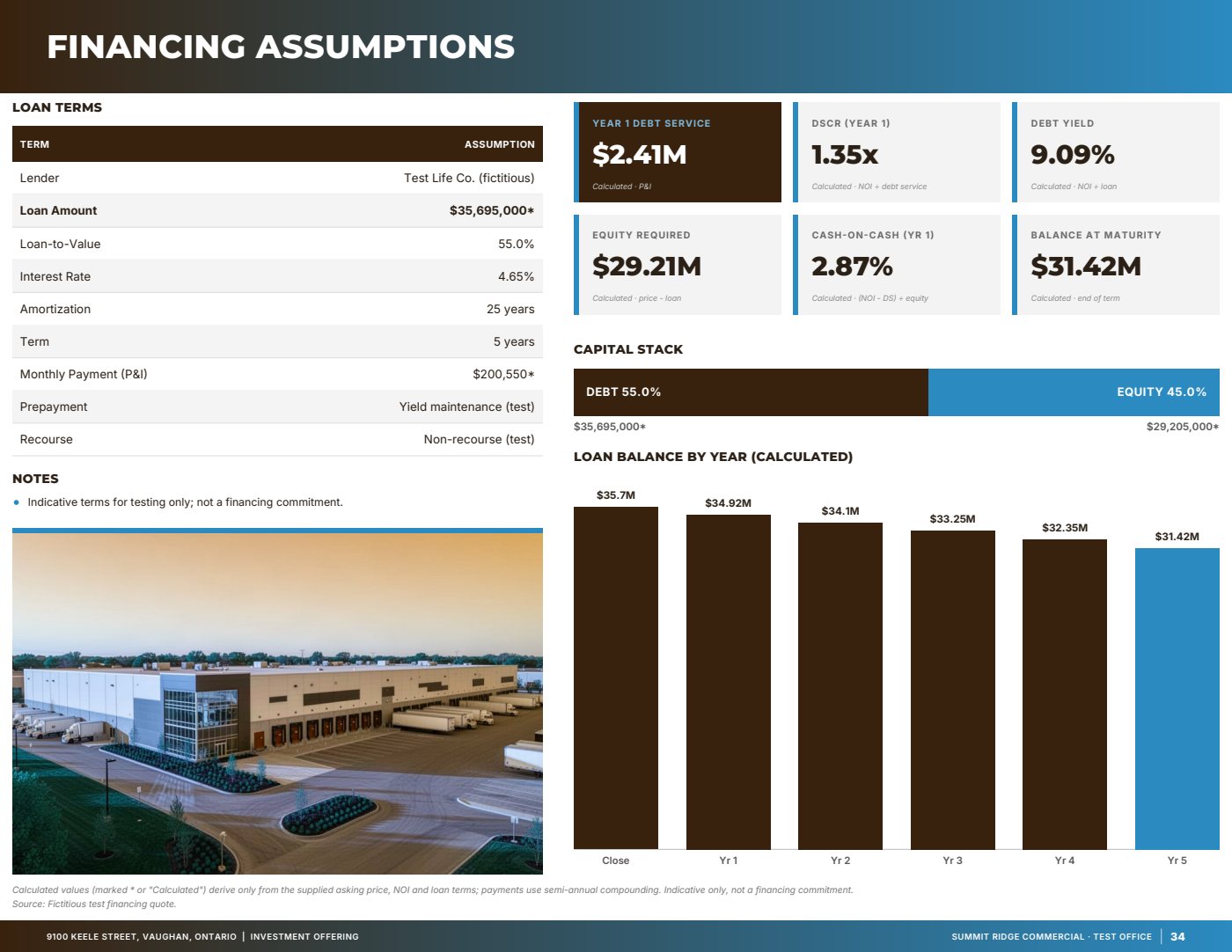
Net operating income (NOI) is effective gross income minus operating expenses, before debt service and capital costs. The capitalisation rate is NOI divided by the price. If you show a cap rate, price per square foot or debt service coverage, label it as calculated, show the inputs, and say whether NOI is actual, in-place or projected.
Never present an assumption as a fact. If market rents, vacancy or financing terms are assumptions, put them in a clearly titled assumptions table so the reader can change them in their own model.
Photos and visuals
Lead with the strongest exterior or aerial image, then show the property the way a buyer would tour it: approach, frontage, loading, interiors, then the surroundings. Correct colour and exposure, but never alter what the property looks like. Remove photos that are blurred, out of date or show something that has changed.
Keep the design consistent: one colour palette, one heading style, and the same map styling throughout. A clean, consistent document reads as better prepared.
Confidentiality, disclaimers and accuracy
Most OMs open with a confidentiality statement and a disclaimer that the information comes from sources believed reliable but is not guaranteed, and that buyers must do their own due diligence. Use your brokerage’s approved wording; it is not something to improvise.
Advertising by registrants is regulated. In Ontario, check your brokerage’s policies and RECO’s guidance under the Trust in Real Estate Services Act, 2002 (TRESA) before you distribute anything. A licensed professional should review every OM before it goes out.
OM, brochure or teaser?
A teaser is a short, often unbranded or lightly branded summary used to gauge interest, typically a few pages. A marketing brochure is a designed document of roughly ten to fifteen pages that presents the property and its location. The full OM adds the detail a buyer needs to underwrite: financials, leases, zoning detail and the offering process. Many listings use all three, built from the same property file.
Offering memorandum checklist
- Every figure has a source, a date or a “calculated” label.
- Units and rounding are consistent from cover to back page.
- Highlights are specific and verifiable elsewhere in the OM.
- Zoning cites the by-law and the date checked.
- Maps show the parcel clearly and are dated.
- Financial assumptions are separated from actuals.
- No blank boxes, “TBD” or “N/A”: missing sections are removed.
- Confidentiality and disclaimer wording is your brokerage’s approved text.
- A licensed professional has reviewed the final PDF.
How OfferingStack helps
OfferingStack builds the teaser, brochure and full OM from one property file. You upload a fact sheet or start from an address, answer only the questions the chosen pages need, and review the pages before you buy. Location data carries its source, calculated values are labelled, and pages without data are left out instead of showing empty boxes. You still check and approve everything before it is distributed.
What these pages look like
Sample pages are generated by the product from a fictitious test listing (9100 Keele Street, "Summit Ridge Commercial" test brand). Figures marked (test) are not real.
Related
Last updated 2026-10-13. General information for commercial real estate professionals, not legal advice.
Start with the fact sheet you already have.
Upload it, answer only what’s missing for the output you choose, and review a watermarked preview before you buy anything.