Trust
Security and data, described plainly.
What we actually do today to protect your account, your payments and your listing files, and the limits you should know about.
Accounts
You sign in with your email and password, or with "Continue with Google". Passwords are stored only as one-way bcrypt hashes, so nobody (including us) can read them. Your session is kept in your browser until you sign out or it expires. Password resets are sent by email from noreply@offeringstack.com.
Who can see your listings
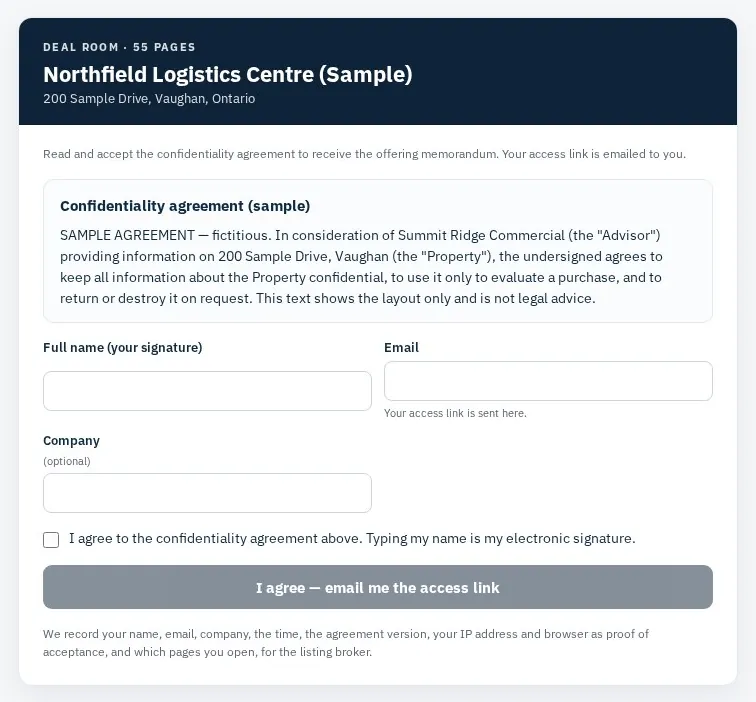
Your listings and documents are open to your own account and to team members you add to your plan. Buyers you invite to a deal room see that room’s documents only after accepting your confidentiality agreement.
A small number of OfferingStack administrators can open accounts to give support. Administrator roles are set on our servers and can’t be given to an account from the app. When an administrator views an account or opens or changes a listing, it is recorded in an audit log; we are still extending that log to every admin tool.
Payments
Card details are entered into Square’s own payment form and go straight to Square; they never reach our servers. We keep the payment status and Square reference numbers. Every payment request carries a unique key so a retry can’t charge you twice, and payment notifications from Square are checked against Square’s signature before we act on them.
Checks on our servers
Whether you can download a clean PDF is decided on our servers, not in your browser. The free preview is watermarked into the page images on the server, so there is no overlay to remove.
Your files
- Uploaded images and generated PDFs are stored on our hosting provider’s storage at long, hard-to-guess web addresses. Anyone with the exact address can open a file, so share links with care.
- For each listing we keep the most recent 20 PDFs; older ones are deleted automatically.
- Deleting a listing deletes its stored PDFs.
Keys and secrets
The secret keys we use to connect to payment, email and other services are kept in our hosting platform’s secret store, not in our code. Card numbers are never stored by us at all.
How long we keep data
- Free preview images: deleted automatically after 7 days.
- Generated PDFs: the stored file is removed 90 days after it was made. We email you about 7 days before; the listing itself stays in your account.
- Drafts on accounts without a purchase or plan may be deleted after 30 days of inactivity.
- Deal room records on a free room trial: deleted about 24 hours after the trial ends without payment.
From your account page you can download a copy of your account data and ask us to delete your account. The Privacy Policy sets out every retention period.
How we release changes
Every update passes automated checks before it goes live: type checks, an automated test suite, test renders of sample documents, then a check of the live site. Each release has a restore point, so a release that causes a problem can be rolled back to the previous version. Updates to our database only add to it; they don’t remove your data.
Data sent to other services
To build your documents, some data leaves our platform. By category:
- Hosting, database, file storage and email delivery: our hosting platform (Floot) and, where configured, an email delivery provider.
- Payments: Square.
- Sign-in: Google, only if you choose “Continue with Google”.
- AI features, only when you use them: OpenAI, reached through our hosting platform Floot, receiving only the content that feature needs.
- Maps and geocoding: Mapbox, which receives the property’s address or coordinates.
- Research, when you ask for it: web search, with queries that include the property address.
- Public data sources: OpenStreetMap services, Wikidata and Wikimedia Commons (business logos), Statistics Canada, the US Census Bureau, the US Bureau of Labor Statistics, FEMA flood maps and municipal open-data portals. They receive only a location or area, never your name or account.
Our Privacy Policy lists our service providers.
AI and your data
Some features use an AI model: pulling facts from your fact sheet, web research about a property address, drafting copy and suggesting where photos go. They run only when you use them, through our hosting platform Floot, and the model is provided by OpenAI. Only the content the feature needs is sent.
- Training: we don’t use your content to train models, and we haven’t asked any provider to use it for training. OpenAI states that data sent to its API is not used to train or improve its models unless the customer opts in.
- At the provider: OpenAI states that its API abuse-monitoring logs are kept for up to 30 days by default.
- Where your listings live and who can open them: see “Your files” and “Who can see your listings” above.
- You stay in charge: AI assists you; it doesn’t replace your professional judgment. You decide what goes into each document, and you review AI-drafted text, extracted figures and suggested images before you share, print or publish an output.
- Other people’s details: only enter personal information about tenants, buyers, clients or co-brokers that you have consent, or another lawful basis, to use.
The full wording is in our Privacy Policy (sections 5 and 6) and Terms of Service (section 9).
In transit
Connections to the website, the app and its services use HTTPS.
What we don’t claim
We don’t currently claim any third-party security certification. If your organization needs specific assurances, contact us before uploading confidential material.
Report a security issue
Call (519) 400-4667 or email marketing@offeringstack.com. Please give us reasonable time to fix an issue before disclosing it.
Questions? See the contact page.