Offering memorandum
Offering memorandum (OM) in commercial real estate: what it is, what goes in it and how to make one
What a commercial real estate offering memorandum is, who gets it and when, the sections buyers expect, and how to build an accurate OM from a fact sheet.
What is an offering memorandum?
In commercial real estate, an offering memorandum (OM) is the detailed marketing and information package a listing broker prepares for a property that is for sale. It brings together everything a qualified buyer needs to decide whether to pursue the property and at what price: the investment summary, the property and its specifications, the tenancy and leases, the operating income and expenses, zoning, the location and market, photos and plans, and the terms of the offering process.
Brokers sometimes call it an OM, an offering memo, an investment offering or an offering package. Whatever the name, its job is the same: to present the opportunity clearly and accurately enough that a buyer can underwrite it, while keeping the details that matter to the seller under the control of the listing team.
An OM in real estate is not a securities offering memorandum
The same phrase is used in securities law for a different document. In that sense an offering memorandum is a disclosure document used to sell securities without a prospectus; in Canada, for example, National Instrument 45-106 includes an “offering memorandum exemption” with its own required form and statutory rights for investors. In the United States, a similar private-placement document is usually called a private placement memorandum (PPM).
A commercial real estate OM for a property sale is a marketing document prepared by the listing brokerage, usually released after a buyer signs a confidentiality agreement. If an offering involves selling interests in a fund, a syndicate or a company rather than a property itself, securities rules may apply and a lawyer should be involved. OfferingStack makes property marketing documents, not securities disclosure documents.
Who receives the OM, and when
Most property sales follow a familiar sequence. A short teaser goes out widely to gauge interest without giving away sensitive figures. Interested parties sign a confidentiality agreement (CA, or NDA). Qualified buyers then receive the full OM, and serious ones get access to a data room with the leases, reports and statements behind it. Offers follow on the timetable set out in the offering process.
- Teaser: a few pages, wide distribution, headline facts only.
- Confidentiality agreement: protects the seller’s information before detail is released.
- Offering memorandum: the full story and the numbers, for qualified buyers.
- Data room: source documents for due diligence.
- Offers: on the dates and terms the listing team sets.
Some listings, especially smaller user sales and leases, skip the full OM and use a marketing brochure instead. Our comparison of OMs, brochures and teasers explains which to use when.
What goes in a commercial real estate OM
There is no single legal format for a property OM, but buyers expect to find certain sections, roughly in this order. Include a section only when you have reliable information for it; an empty heading looks worse than a missing one.
1. Cover and executive summary
The property name or address, the transaction, the listing team and a one-page summary of the opportunity: asking price or pricing guidance, size, occupancy, and the handful of facts that make the property worth a buyer’s time. The investment highlights belong here, written as specific, checkable statements.
2. Property overview and specifications
Site area, building area and rentable area (with the measurement basis), year built and renovations, construction, parking, and the specifications that matter for the asset class: clear height and loading for industrial, floor plates and elevators for office, frontage and signage for retail.
3. Tenancy, rent roll and leases
For income properties, the rent roll is the core of the OM: each tenant, area, term, rent and recoveries, plus lease expiry dates and any options. Tenant profiles and short lease abstracts help buyers understand the quality of the income.
4. Financial analysis
An operating statement with income, vacancy, operating expenses and net operating income (NOI), with in-place and pro forma columns clearly labelled. Pricing metrics such as the cap rate on the asking price and price per square foot should show how they were calculated.
5. Zoning, servicing and site
The zone, the permitted uses relevant to likely buyers, key zoning controls and the source by-law, plus servicing at the lot line for land and development sites. Site plans, surveys and floor plans support this section.
6. Location and market
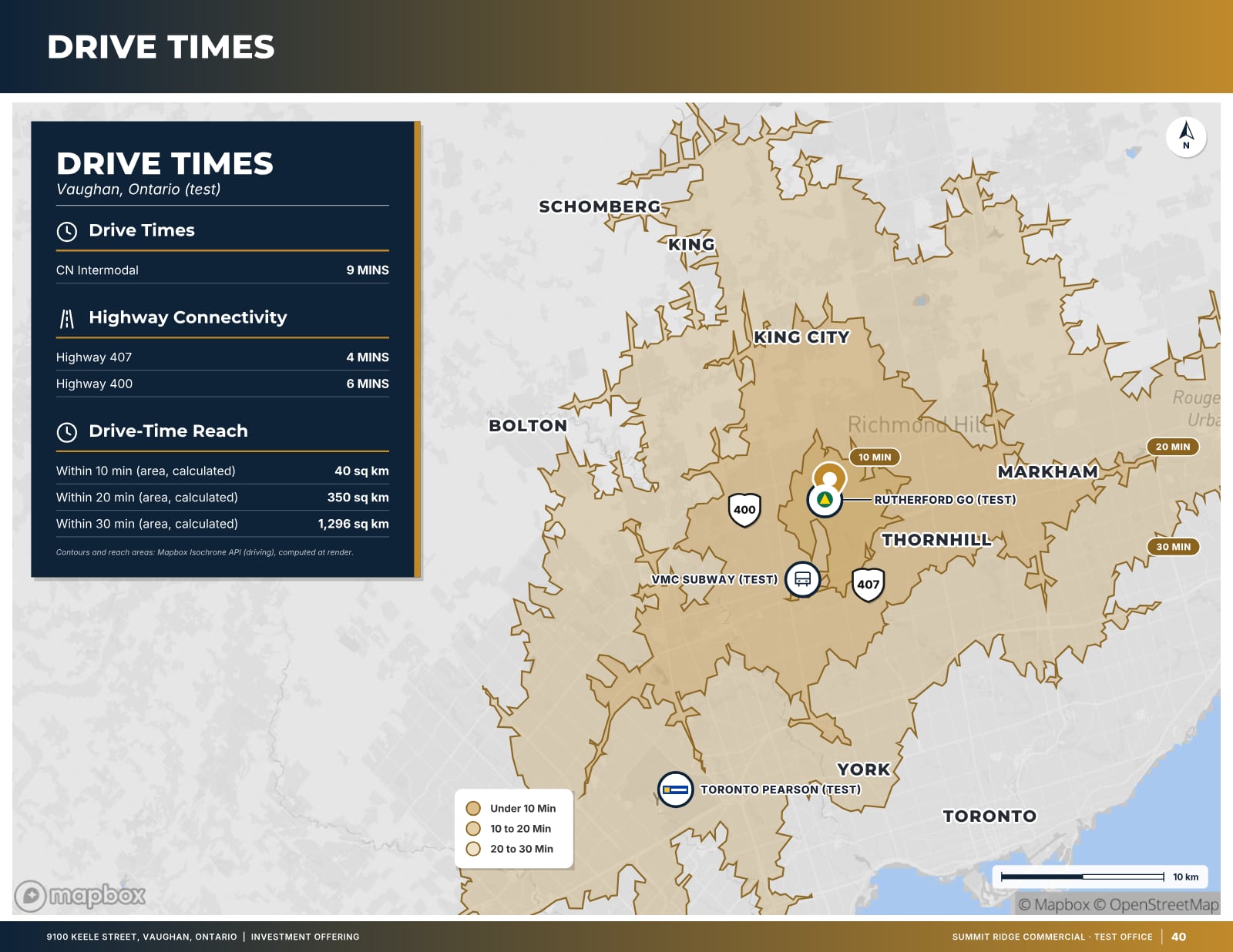
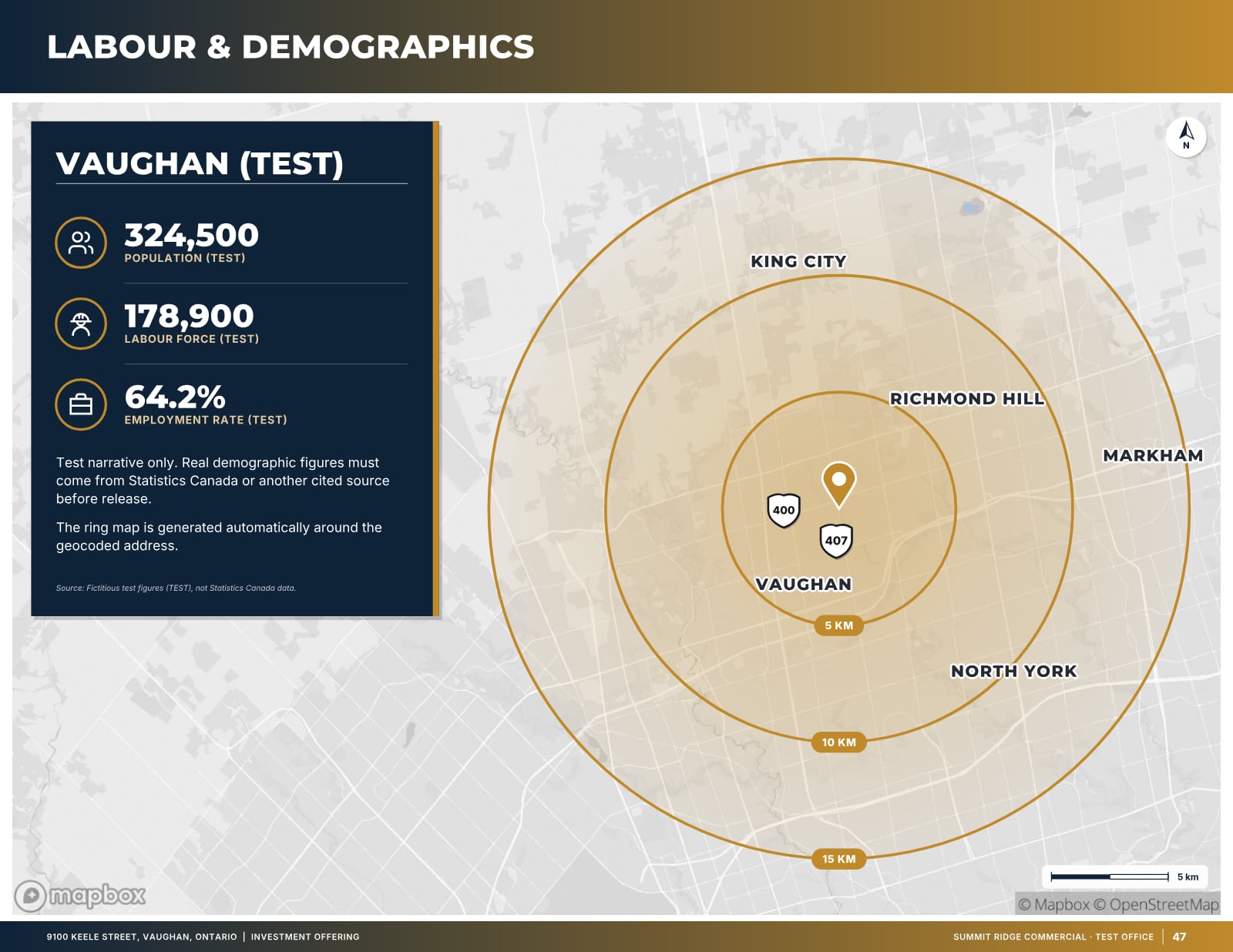
Maps that answer the buyer’s questions: highway and transit access, drive-time areas, neighbouring occupiers, nearby amenities, and population and labour force from official sources, each with a source and date.
7. Photos, offering process and disclaimers
Current photos, the offering process (how and when to submit offers, tours, data room access), the listing team’s contacts, and the confidentiality and disclaimer language your brokerage requires.
How long should an offering memorandum be?
As long as the information requires and no longer. A single-tenant building with a simple lease may be well served by 20 to 30 pages; a multi-tenant investment with a long rent roll, several buildings and a detailed market section can run past 50. Length is not a quality signal on its own. Buyers notice padding, and they notice gaps.
A practical test: every page should either answer a question a buyer would otherwise email you about, or support a figure that appears elsewhere in the document.
Accuracy: the part buyers actually test
An OM carries the brokerage’s name, and buyers will check it during due diligence. The most common problems are mismatched areas between sections, NOI figures that mix in non-operating items, pro forma numbers presented as in-place, and location claims that cannot be traced to a source. A few habits prevent most of them:
- Take every figure from a document you can point to, and keep a note of the source.
- Label calculated figures as calculated and show the formula once.
- Keep in-place and pro forma numbers in separate, clearly headed columns.
- Date third-party data (census, drive times, traffic counts) and say where it came from.
- Have someone other than the author check the numbers before release.
The financial pages buyers check first
On an income property, experienced buyers often turn straight to the numbers and only then read the story. They are looking for whether the figures reconcile with each other, not just whether they are attractive. Before release, walk the financial pages in the order a buyer’s analyst will:
- Rent roll to income: the annual base rent on the operating statement should equal the sum of the rent roll for the same date, and recoveries should follow the lease terms (net, semi-gross or gross).
- Operating statement: income, vacancy allowance, operating expenses and NOI, with in-place and pro forma columns headed and dated. Mortgage payments, depreciation and one-off capital work stay out of operating expenses.
- Pricing metrics: the cap rate shown is the stated NOI divided by the asking price, and the price per square foot uses the same area basis as the property overview.
- Sensitivity: a short table of value at several cap rates lets a buyer see the range without the OM implying a valuation opinion.
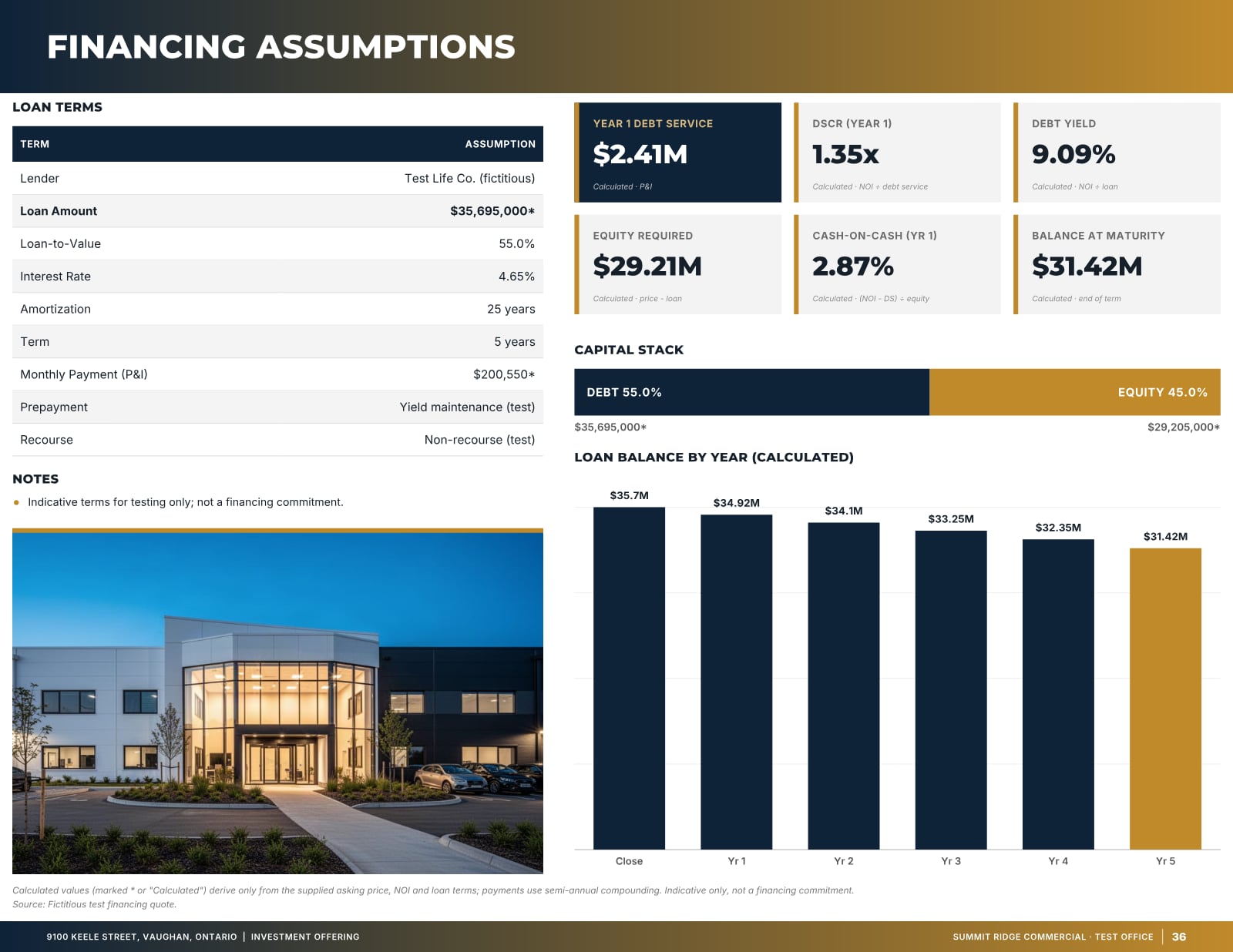
- Financing, if shown: loan-to-value, rate and its compounding basis, amortization, annual debt service, debt service coverage ratio (DSCR) and debt yield, labelled as illustrative unless a lender has committed. Say whether an existing mortgage can be assumed.
If one figure changes, such as a renewal that lifts the rent, every page that depends on it changes too. Free calculators for cap rate, NOI and mortgage/DSCR are linked below for checking the arithmetic. In OfferingStack the Financial Overview, Pricing & Valuation and Financing Assumptions pages are calculated from the same inputs, so the NOI, cap rate table, debt service, DSCR and debt yield stay consistent with each other.
What changes by property type
The core of the OM stays the same, but the emphasis shifts with the asset. Plan the document around the questions the likely buyer will ask first.
- Multi-tenant industrial: rent roll and lease expiries, building specifications (clear height, loading, power), site coverage and yard, highway access and the labour force within reach.
- Retail plaza: tenancy and co-tenancy, lease terms and recoveries, traffic and visibility, parking, and the population and households in the trade area.
- Office: occupancy, tenant profiles and lease expiries, building systems and recent capital work, transit access and the surrounding office market.
- Single-tenant net lease: the tenant’s profile and covenant, the remaining term, rent steps, renewal options and who is responsible for which costs.
- Development land: zoning and official plan designation, servicing, site area and frontage, surveys and any concept plans, and the development context nearby.
Whatever the asset, put the information a buyer needs to make a first decision in the first few pages, and keep the supporting detail behind it.
Writing and design that help the OM do its job
Write for a reader who is comparing your listing with several others on the same day. Short paragraphs, specific headings and label–value tables for figures make the document easy to scan. Use the same terms and units throughout: if the rent roll uses rentable area, the summary should too, and say so.
Design should make the content easier to read, not decorate it. Consistent page layouts, a restrained colour palette in the brokerage’s brand, large current photos and maps that are legible at print size go further than elaborate graphics. Landscape pages suit OMs well because aerials, maps and photo spreads read better wide.
Finally, keep the OM consistent with everything else in the market: the teaser, the brochure, the MLS listing and any listing website should show the same facts. When a figure changes, update every version on the same day.
How to make an offering memorandum
The traditional way is to gather the facts, write the copy, commission maps and charts, and lay everything out in a design tool, usually over several days for a full OM. The work is mostly assembly: the same facts appear in the teaser, the OM, the brochure and the listing website, and every change has to be made in each of them.
OfferingStack is built to remove that assembly step. You upload a fact sheet or start from an address, answer only the questions the chosen pages need, and the engine lays out the pages from your data: a 4-page teaser, a 10–13 page brochure, or a full OM with every page your data supports. Location pages are built from sourced map and census data, researched facts need your acceptance before they appear, calculated values are labelled, and pages without data are left out instead of showing empty boxes. The full OM can include a fillable confidentiality agreement. Every account gets one free, watermarked preview of its own document before paying, and you review and approve every page before anything is distributed.
Frequently asked questions
What is an offering memorandum in real estate?
It is the detailed information package a listing broker prepares for a commercial property for sale, covering the property, tenancy, financials, zoning, location and the offering process, usually released to qualified buyers after they sign a confidentiality agreement.
What is the difference between an OM and a brochure?
A brochure is a shorter designed marketing piece (often 10–13 pages) that sells the opportunity. An OM is the complete package with the rent roll, operating statement and detail a buyer needs to underwrite the property.
Who prepares the offering memorandum?
The listing brokerage, using information from the seller and third-party sources. The seller reviews it, and the brokerage is responsible for its accuracy and its disclaimers.
Is a real estate OM the same as a securities offering memorandum?
No. A securities offering memorandum is a legal disclosure document for selling securities under a prospectus exemption. A property OM is a marketing document for the sale of real estate.
Should an offering memorandum include financing?
Often, for income properties: buyers want to know whether an existing mortgage can be assumed and how the NOI covers a typical loan. Show loan-to-value, rate basis, amortization, debt service and DSCR, and label the figures as illustrative unless a lender has committed to them.
Can I make an OM without a designer?
Yes. OfferingStack builds the OM pages from your facts and photos, and you can see a watermarked preview of your own document for free before deciding to buy the clean PDF.
What these pages look like
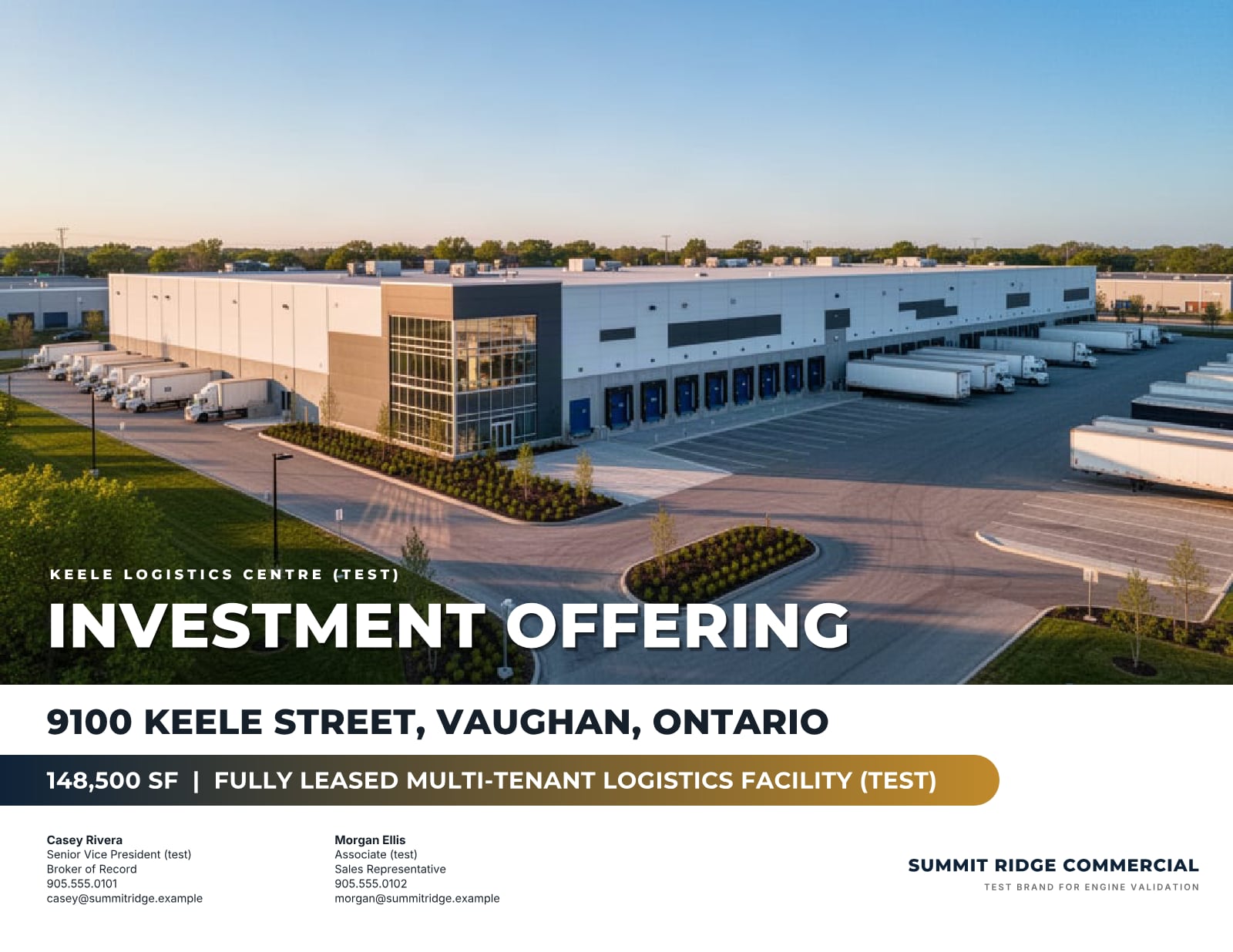
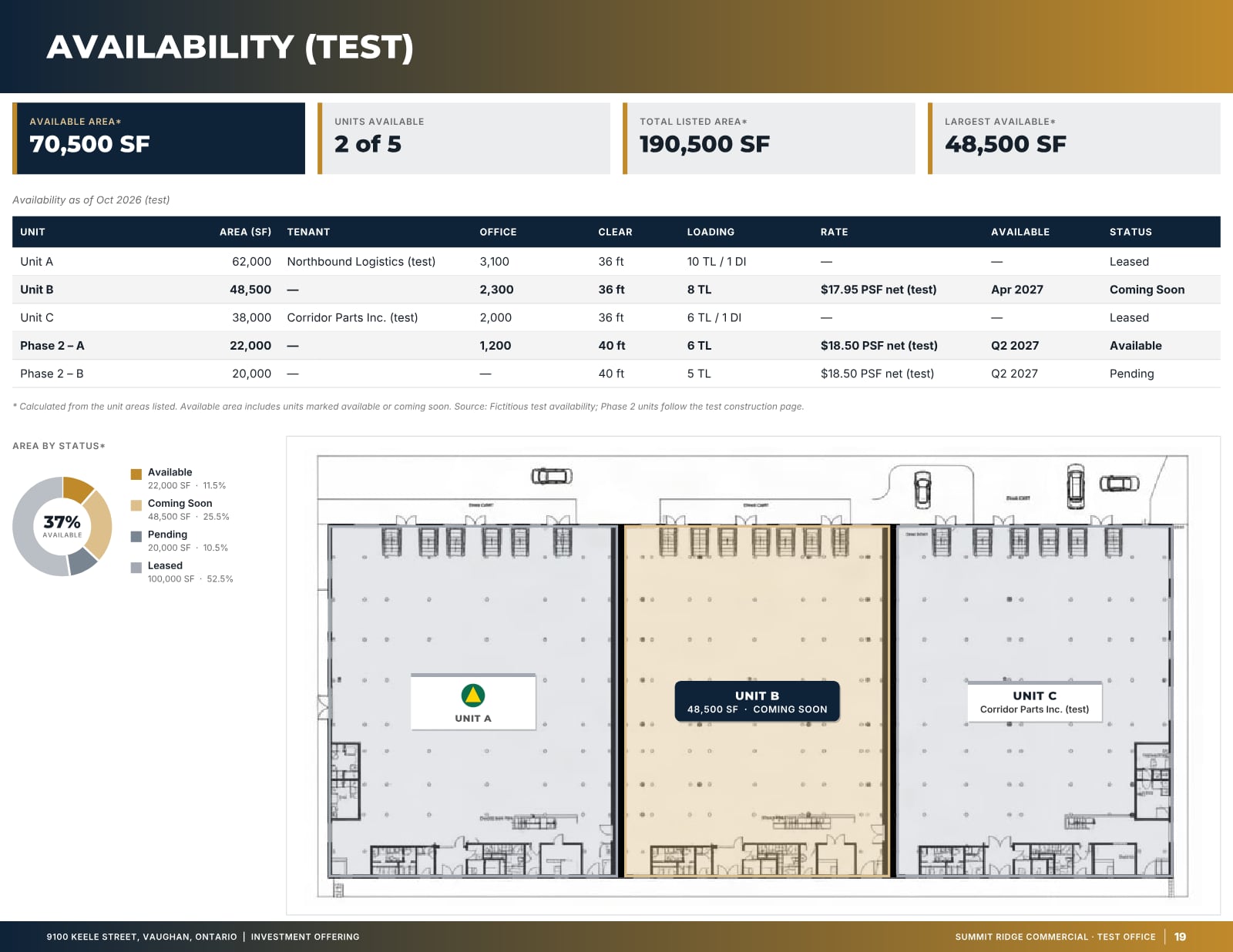
Sample pages are generated by the product from a fictitious test listing (9100 Keele Street, "Summit Ridge Commercial" test brand). Figures marked (test) are not real.
Related
Last updated 2026-10-14. General information for commercial real estate professionals, not legal advice.
Start with the fact sheet you already have.
Upload it, answer only what’s missing for the output you choose, and review a watermarked preview before you buy anything.