CRE marketing guide
How to write investment highlights and an executive summary for a CRE listing
How to write the executive summary and investment highlights of a commercial real estate OM or brochure: specific, verifiable and in the right order.
The page everyone reads
Most people who open an offering memorandum or brochure read the cover, the executive summary and the investment highlights, and decide from those whether to read on. A buyer’s analyst may read every page; their investment committee may read only the summary. These pages therefore carry more weight than their length suggests.
They are also the easiest pages to get wrong, because the temptation is to fill them with adjectives. This guide covers what to put in them and how to write them so a sceptical reader is persuaded rather than put off.
What the executive summary must cover
The executive summary is a short factual overview, usually a few paragraphs and a table. It should let a reader answer five questions without turning the page:
- What is being offered: the property type, the interest (freehold, leasehold, a share) and the transaction (sale, lease, investment).
- Where it is: the address, municipality and the one location fact that matters most, such as the nearest highway interchange.
- What is there: site area, building area and the key specifications for this property type.
- The headline numbers: asking price or the pricing guidance, and for an income property the net operating income, occupancy and weighted remaining lease term.
- How to proceed: the offering process, any offer date and who to contact.
Write it last, once every number elsewhere in the document is final, and check that each figure in the summary matches the detailed page it comes from.
The offering summary table
Many OMs put the headline facts in a compact table beside the summary text. Keep it to the facts a buyer will put into their own model: price, price per square foot or per acre, NOI, capitalisation rate, occupancy, weighted average lease term, site area, building area and year built, as they apply.
Calculated values such as the cap rate or price per square foot should be labelled as calculated, and the NOI should say whether it is in-place, in-place adjusted or projected, and for which period. If there is no asking price, leave the price-based metrics out rather than inventing a range.
Writing investment highlights
Investment highlights are the reasons to buy, usually four to eight short statements, each with a bold lead-in and one or two sentences of support. Good highlights share three qualities:
- Specific: they name the tenant, the lease term, the drive time, the zoning or the number, rather than describing it.
- Verifiable: every claim is supported somewhere else in the document, so a reader can check it.
- Relevant: they speak to what this buyer pool cares about, whether that is income stability, redevelopment potential or an owner-user’s operations.
Weak versus strong
Compare “Excellent highway access” with “About four minutes to the Highway 401 interchange at a nearby arterial road (routed drive time, typical traffic)”. Or “Strong tenancy” with the tenant’s name, the remaining term and the rent escalation schedule. The second version of each is more persuasive precisely because it can be checked. Avoid superlatives such as “best”, “rare” or “trophy” unless you can back them up, and do not use them as a substitute for facts.
Highlights by property type
- Single-tenant investment: tenant identity and covenant, remaining term, rent escalations, recovery structure, renewal options.
- Multi-tenant: occupancy, diversity of tenants, lease expiry profile, in-place rents compared with what you can support about market rents.
- Industrial owner-user: clear height, shipping, power, yard, zoning permissions and access.
- Land: site area, zoning and official plan designation, servicing status, planning approvals in hand, and access.
- Retail: frontage, traffic and visibility, co-tenancy and parking, with each count sourced and dated.
Order matters
Lead with the highlight that would matter most to the most likely buyer. For an income property that is usually the income: tenant, term and yield. For land it is usually zoning and servicing. Location highlights often come next, then the physical attributes. Put anything that is conditional, such as redevelopment potential that depends on an approval, after the facts that are certain, and say clearly what it depends on.
Keep the format consistent: a short bold lead-in of a few words, then one or two sentences of support. Use the same units, rounding and terms as the rest of the document, so “clear height” on the highlights page is the same figure, in the same units, as on the specifications page. If a highlight needs a paragraph to explain, it probably belongs on its own page, with a one-line summary in the highlights.
A worked example
Take a fictitious single-tenant industrial building offered for sale. A weak summary might read: “A rare opportunity to acquire a best-in-class industrial asset in a prime location with excellent tenancy.” Every word of that could describe a hundred buildings, and none of it can be checked.
A stronger version states the building area, clear height and number of truck-level doors; names the tenant and the remaining lease term; gives the in-place NOI and the asking price with the calculated cap rate labelled as calculated; and states the routed drive time to the nearest highway interchange with the method. The highlights then expand on each of those facts in turn, starting with the lease because that is what an investor buyer underwrites first.
The second version is no longer than the first, but it gives the reader something to act on, and it signals that the rest of the document will be just as precise.
Accuracy and compliance
Investment highlights are advertising, and in Ontario advertising by real estate registrants must not be false or misleading. Phrases such as “guaranteed returns” or a projected yield presented as current income can create real problems. Keep projections in a clearly labelled section with their assumptions, and use your brokerage’s approved disclaimer. Have a licensed professional review the final text before it is distributed.
A useful self-check is to read each highlight and ask where in the document a buyer would confirm it. If the answer is nowhere, either add the supporting page or remove the highlight.
Common mistakes
- Highlights made of adjectives with no facts behind them.
- Numbers in the summary that differ from the detailed pages.
- Projected NOI presented without saying it is projected.
- Price-based metrics shown for an unpriced offering.
- Ten or more highlights, so the important ones get lost.
- Conditional upside presented before the certain facts.
Executive summary checklist
- Answers what, where, what is there, the headline numbers and how to proceed.
- Every number matches its detailed page.
- Calculated values labelled; NOI type and period stated.
- Four to eight specific, verifiable highlights, ordered by what matters to the buyer.
- Projections and conditional upside clearly separated and labelled.
- Approved disclaimer and a licensed professional’s review.
How OfferingStack helps
For a property offered for sale, OfferingStack adds an investment summary page with the price, NOI, cap rate, occupancy and lease term you provide, labelling calculated values and leaving out any metric without the data behind it. The copy check flags figures in your summary and highlights that do not match the data in your property file. You review and edit every word before anything is generated.
What these pages look like
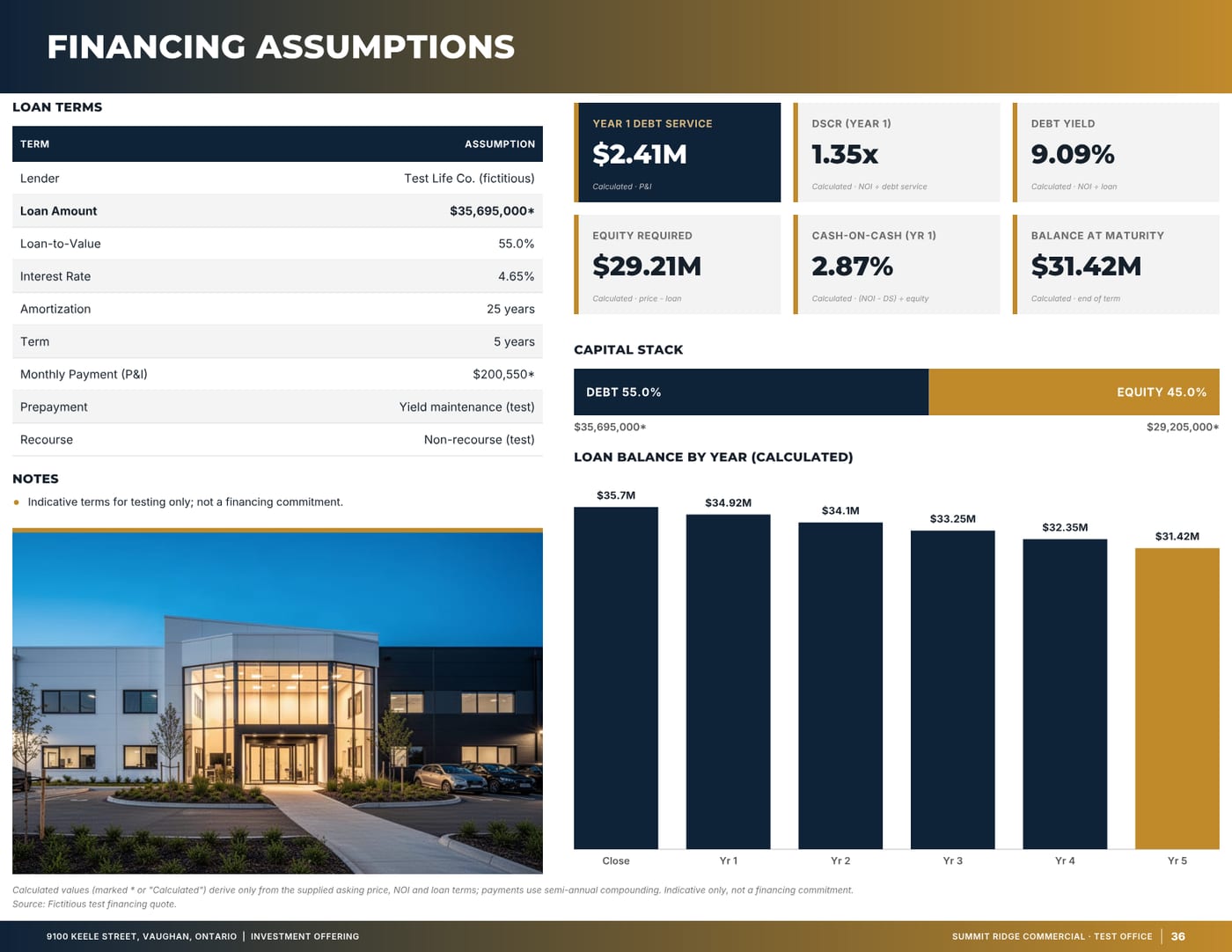
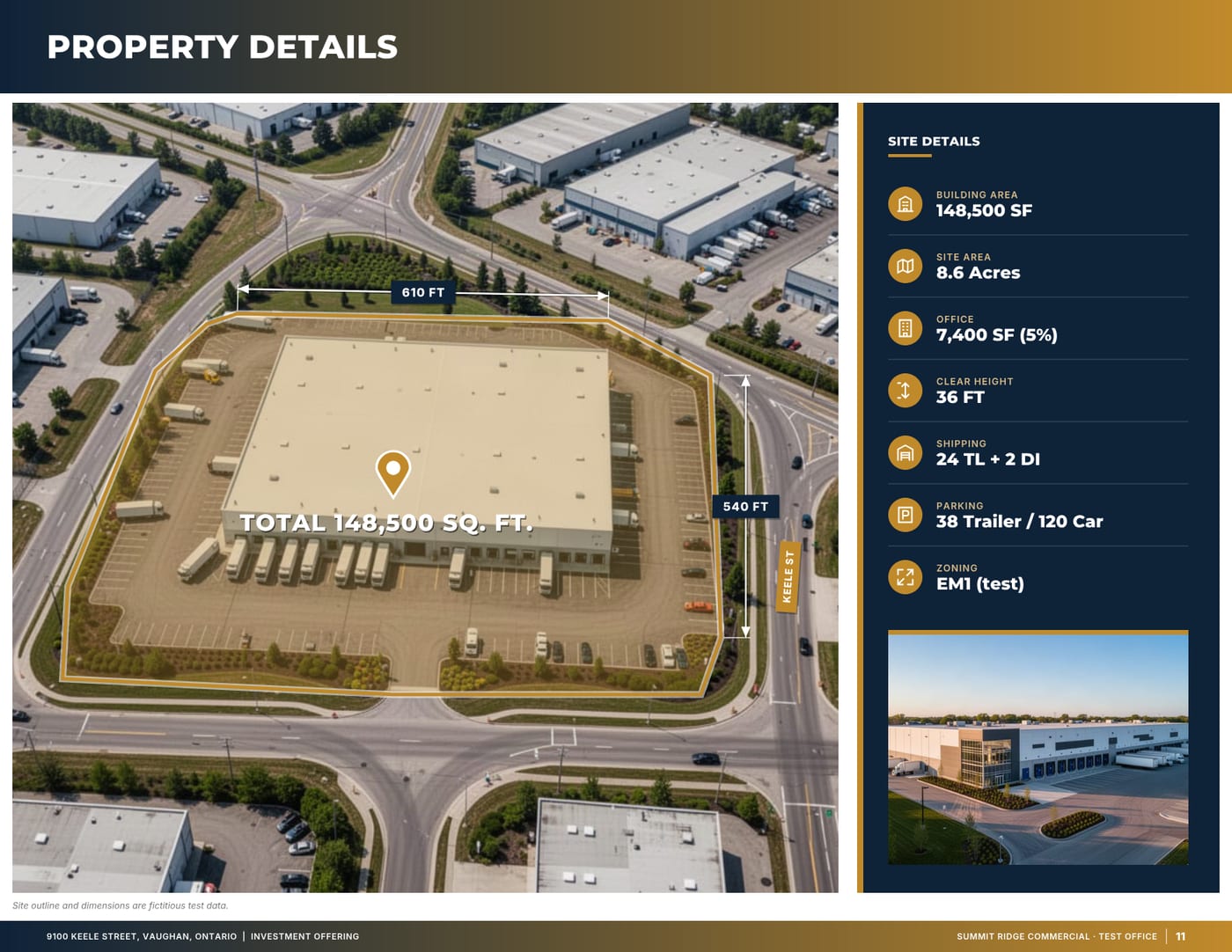
Sample pages are generated by the product from a fictitious test listing (9100 Keele Street, "Summit Ridge Commercial" test brand). Figures marked (test) are not real.

Related
Last updated 2026-10-14. General information for commercial real estate professionals, not legal advice.
Start with the fact sheet you already have.
Upload it, answer only what’s missing for the output you choose, and review a watermarked preview before you buy anything.