CRE marketing guide
Offering memorandum vs brochure vs teaser: which one does your listing need?
How a teaser, a marketing brochure and a full offering memorandum differ in purpose, length, audience and content, and when to use each one.
Three documents, three jobs
Commercial listings are usually marketed in stages. A short teaser gets attention, a designed brochure presents the property, and an offering memorandum gives a serious buyer what they need to make an offer. The three overlap, which is why they are often confused, but each answers a different question for a different reader.
- Teaser: “Is this worth a closer look?” Read in a minute or two by a wide list of prospects.
- Brochure: “What is this property and why does it suit me?” Read by interested buyers, tenants and cooperating brokers.
- Offering memorandum (OM): “What exactly am I buying, and what is it worth to me?” Read by qualified buyers, their analysts, lenders and lawyers.
Getting the order right matters. Sending a full OM to a cold list gives away detail before anyone has signed a confidentiality agreement; sending only a teaser to a buyer who is ready to underwrite slows the deal down.
The teaser
A teaser is short, typically one to four pages. Its job is to create enough interest that a prospect asks for more. It is often sent by email to a broad list, posted on a listing service or handed out at an event, so assume it will be forwarded.
What a teaser usually includes
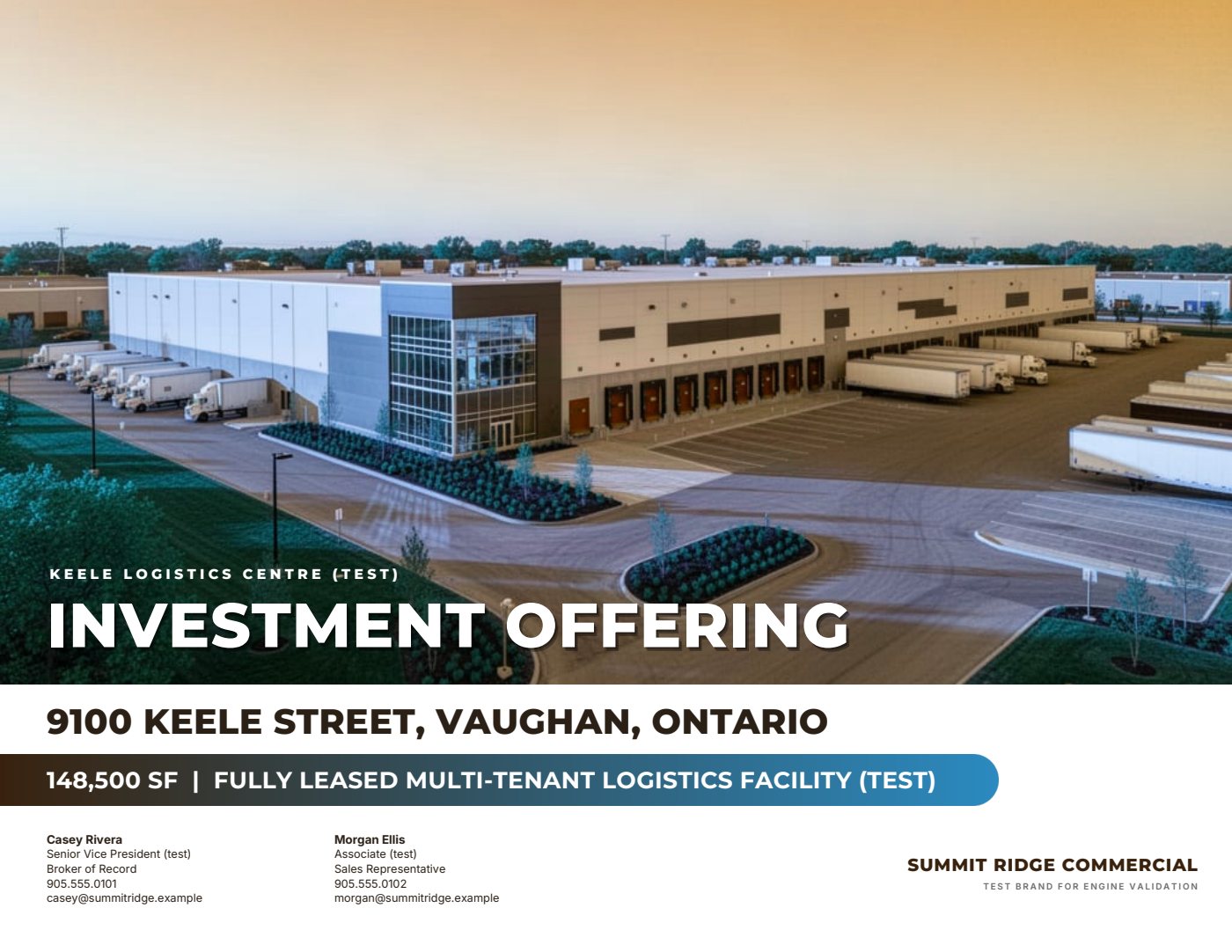
- A cover with one strong photo or aerial and the transaction type (for sale, for lease, investment opportunity).
- Three to six highlights: size, location advantages, zoning, income or tenancy in one line each.
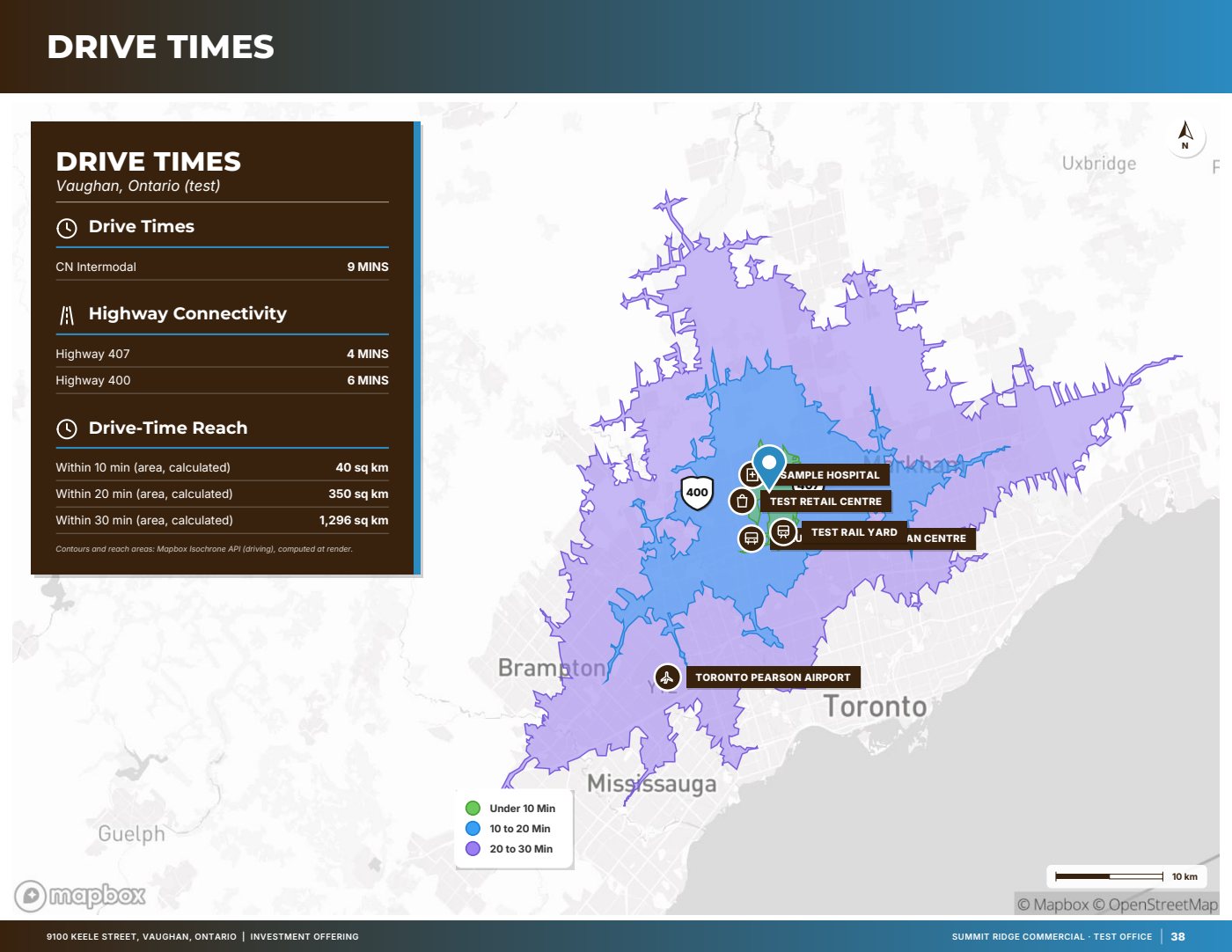
- A small location map or a short drive-time summary.
- The listing team’s contact details and the next step, for example “sign the confidentiality agreement to receive the OM”.
Some teasers are deliberately anonymous: they describe the property type, size and general area without naming the address or the tenant, so that the owner’s plans stay private until a buyer has signed a confidentiality agreement. Decide this with the client before the first draft.
Keep the teaser factual and brief. If a figure needs a paragraph of explanation, it belongs in the brochure or the OM.
The marketing brochure
A brochure is the designed, visual presentation of the property, usually around ten to fifteen pages. It is the document most cooperating brokers will forward to their clients, so it has to stand on its own without the listing broker there to explain it.
A typical brochure sequence
- Cover with the property, the transaction and the listing team.
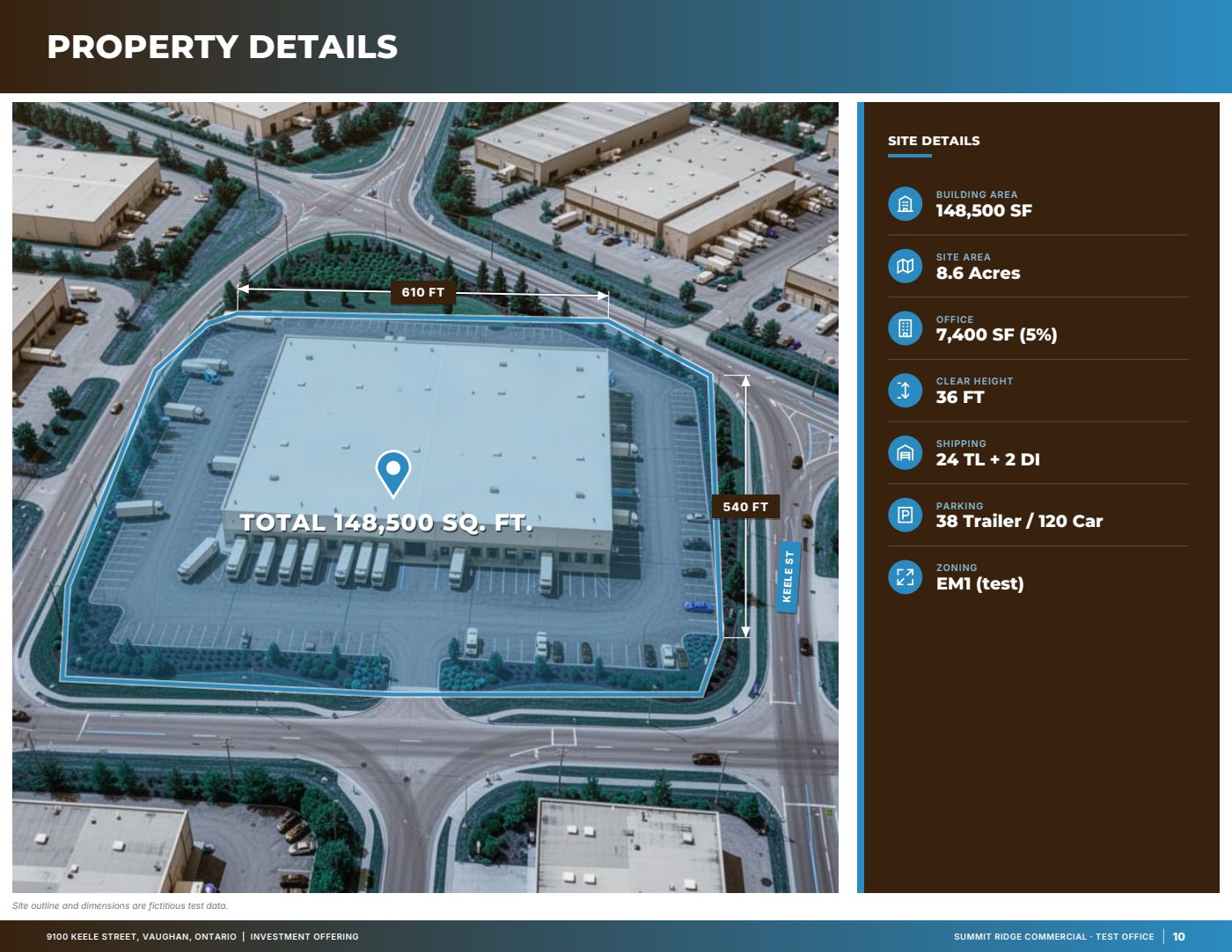
- An opening narrative page, often over an annotated aerial showing the parcel and nearby roads.
- Property details: site and building specifications in one consistent table.
- Zoning and permitted uses.
- Connectivity: drive times, highway interchanges and transit.
- Neighbouring occupiers and amenities.
- Labour force and demographics around the site, with sources.
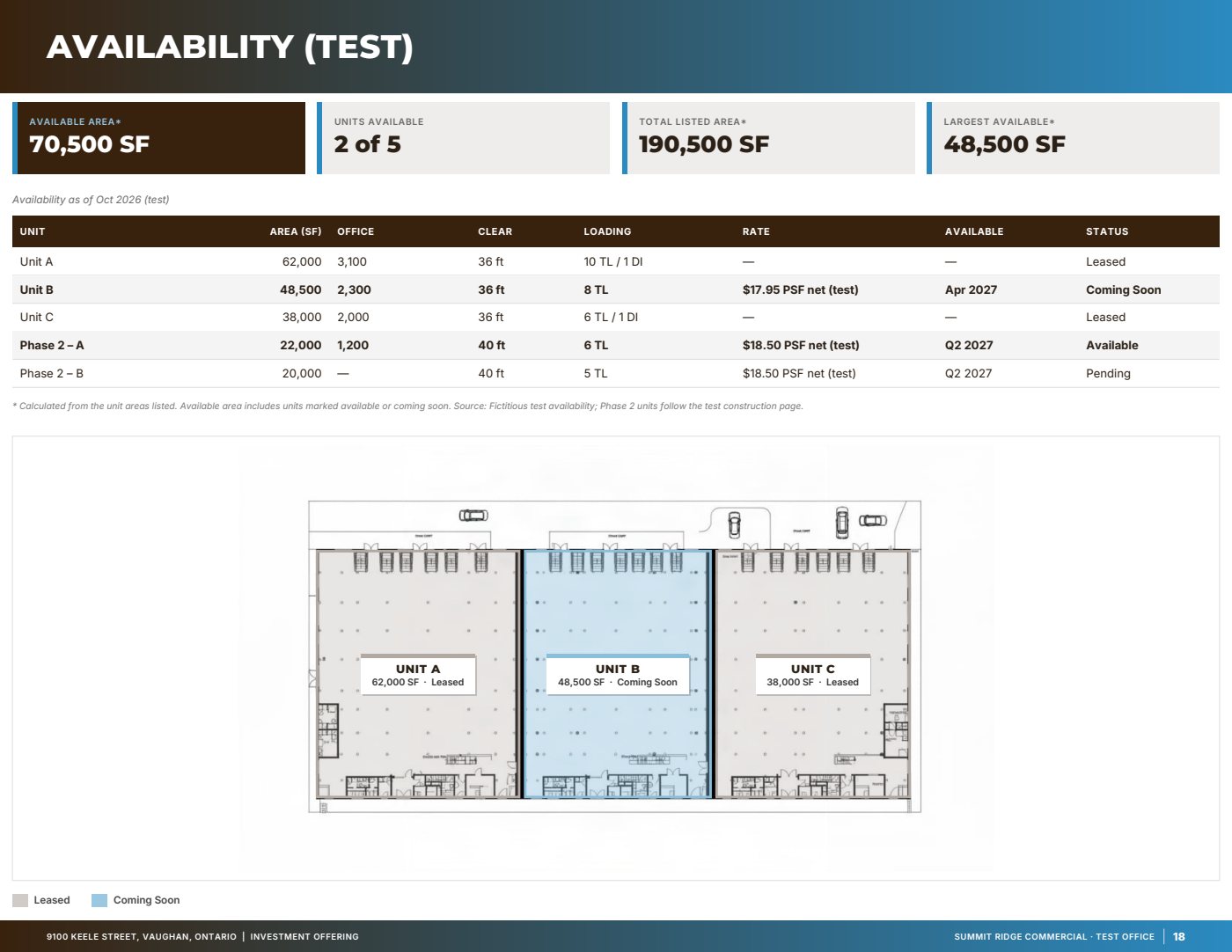
- Servicing (for land), site photos, the site plan and floor plans.
- About the listing team and a back cover with contacts.
A brochure sells the opportunity, but it should still be accurate enough that nothing in it has to be corrected later in the OM. Every figure that appears in both documents should match.
The full offering memorandum
The OM is the complete document. It contains everything in the brochure plus the detail a buyer needs to underwrite the property: rent roll and lease summaries, income and expenses, net operating income, pricing metrics, zoning detail, servicing, environmental and building reports where they exist, and the offering process.
Because it contains confidential information about tenants, rents and the owner’s plans, the OM is normally released only after a confidentiality agreement is signed. It often runs from twenty to sixty pages or more, depending on the property and the number of tenants.
An OM is read differently from a brochure. Analysts jump straight to the financials and check the numbers; lenders look for the rent roll and lease terms; lawyers look at title, zoning and the disclaimers. Clear section headings, consistent units and a source for every figure make that reading faster.
Side by side
Purpose
Teaser: generate interest. Brochure: present the property and its location. OM: support a decision and an offer.
Length
Teaser: one to four pages. Brochure: roughly ten to fifteen pages. OM: as long as the property needs, often twenty pages or more.
Audience and distribution
Teaser: a broad list, often by email or a listing service. Brochure: interested parties and cooperating brokers. OM: qualified parties under a confidentiality agreement.
Financial detail
Teaser: a headline figure at most, such as the asking price or the in-place income. Brochure: usually limited to the asking price or rate and key terms. OM: full rent roll, operating statement, NOI and calculated metrics, each labelled.
Design
All three should share the same brand, colours and map style so that a buyer recognises them as one campaign. The brochure carries the most design effort; the OM carries the most content.
Which one does your listing need?
Most listings benefit from more than one, but the right mix depends on the property and the transaction:
- Small lease listings (a single industrial or retail unit): a teaser or a short brochure is often enough. A full OM is rarely needed.
- Owner-user sales: a brochure that explains the building, the site and the location in detail, with a teaser for the first email.
- Investment sales with tenants: all three. The teaser goes out first, the brochure supports the conversation, and the OM is released under a confidentiality agreement.
- Land and development sites: a brochure that leads with the aerial, zoning, servicing and connectivity, and an OM with the planning status, concept plans and any studies.
- Confidential or off-market sales: an anonymous teaser, then the OM directly to qualified parties.
If in doubt, start from the full property file and decide what to leave out for each audience, rather than writing three documents from scratch.
Build all three from one property file
The most common error in listing marketing is inconsistency: the teaser says one site area, the brochure another, and the OM a third, because each was typed separately. Buyers notice, and it costs credibility.
Keep one source of truth for the property facts, the photos and the location data, and generate each document from it. When a fact changes, change it once. Date the location figures, keep the sources with them, and label anything that was calculated rather than measured.
Leave out what you don’t have. A teaser without a tenancy line, or a brochure without a servicing page, is better than one with empty boxes, “TBD” or “N/A”.
A note on accuracy and approvals
Whichever document you send, it is advertising by a registrant. In Ontario, check your brokerage’s policies and RECO’s guidance under the Trust in Real Estate Services Act, 2002 (TRESA), use your brokerage’s approved confidentiality and disclaimer wording, and have a licensed professional review the final PDF before it is distributed.
How OfferingStack handles this
In OfferingStack you choose the output (teaser, brochure or full OM) after the property facts are in, and you can switch or produce more than one from the same listing. You answer only the questions the chosen pages need, add, remove or reorder pages, and review every page before you buy. Pages without data are left out rather than shown empty, and calculated values are labelled.
What these pages look like
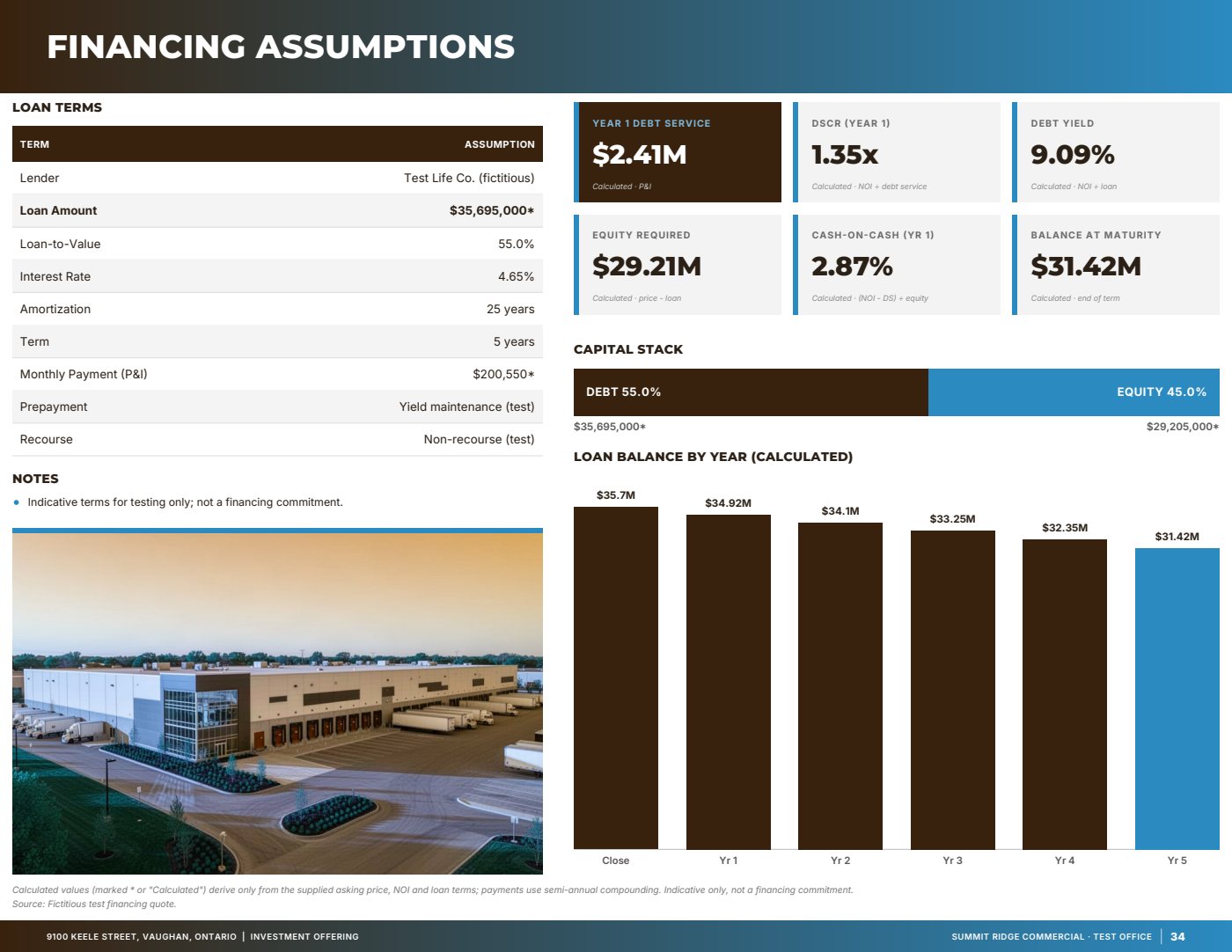
Sample pages are generated by the product from a fictitious test listing (9100 Keele Street, "Summit Ridge Commercial" test brand). Figures marked (test) are not real.
Related
Last updated 2026-10-14. General information for commercial real estate professionals, not legal advice.
Start with the fact sheet you already have.
Upload it, answer only what’s missing for the output you choose, and review a watermarked preview before you buy anything.