CRE reference
Commercial real estate glossary: terms used in OMs and brochures
Plain-English definitions of the terms that appear in commercial real estate offering memorandums and brochures in Canada, from cap rate to FSI.
How to use this glossary
These are the terms that come up most often in commercial real estate marketing documents in Canada. The definitions are general: leases, by-laws and lender requirements define terms in their own way, and the document that governs a deal always wins. When you use one of these terms in an OM or brochure, use it the same way throughout, and show the inputs for anything calculated.
Documents and process
- Offering memorandum (OM): the detailed document given to qualified buyers so they can evaluate and make an offer on a property.
- Marketing brochure: a designed presentation of a property and its location, usually ten to fifteen pages, used to generate and support interest.
- Teaser: a short summary, often one to four pages and sometimes anonymous, used to gauge interest before the OM is released.
- Confidentiality agreement (CA) or non-disclosure agreement (NDA): the agreement a prospective buyer signs before receiving confidential information such as the rent roll.
- Letter of intent (LOI): a non-binding letter setting out the main terms a buyer or tenant proposes, used before a binding agreement is drafted.
- Agreement of purchase and sale (APS): the binding contract for the sale of the property.
- Broker opinion of value (BOV): a broker’s written opinion of the likely price or value range of a property, prepared for an owner. It is not an appraisal.
- Offer date: the date by which offers are to be submitted in a structured sale process.
- Data room: an online folder of due diligence documents shared with qualified buyers.
Income, value and returns
- Rent roll: a table of every tenant with unit, area, lease start and expiry, current rent, escalations and recovery terms.
- Gross potential income: the rent the property would earn if every unit were leased at its current or market rent.
- Effective gross income (EGI): gross potential income less vacancy and credit loss, plus other income.
- Operating expenses: the costs of running the property, such as property taxes, insurance, maintenance, utilities and management.
- Net operating income (NOI): effective gross income minus operating expenses, before debt service, income tax and capital costs.
- Capitalization rate (cap rate): NOI divided by the price or value. A property with an NOI of 500,000 dollars priced at 10 million dollars has a cap rate of 5 percent. State whether the NOI used is actual, in-place or projected.
- Price per square foot: the price divided by the building area (or, for land, price per acre). State which area is used.
- Debt service coverage ratio (DSCR): NOI divided by annual debt payments; lenders use it to size loans.
- Weighted average lease term (WALT or WALE): the average remaining lease term across tenants, weighted by rent or area. State which.
Leases and recoveries
- Net lease: a lease in which the tenant pays its share of the property’s operating costs in addition to base rent.
- Triple net (NNN) or absolutely net: the tenant pays all, or nearly all, operating costs including taxes, insurance and maintenance; definitions vary, so the lease governs.
- Gross lease: the landlord pays the operating costs out of a single, higher rent.
- Additional rent: the tenant’s share of operating costs and taxes, paid on top of base rent.
- TMI: taxes, maintenance and insurance, a common Canadian shorthand for the additional rent per square foot on a net lease.
- Escalations: scheduled increases in base rent during the term.
- Tenant improvements (TI): work to fit out the space for a tenant, and any allowance the landlord pays toward it.
- Gross leasable area (GLA) and rentable area: the floor area on which rent is charged. Measurement standards differ, so state the standard where it matters.
Buildings and specifications
- Clear height: the usable height inside a warehouse, measured from the floor to the lowest obstruction such as joists or sprinklers.
- Truck-level (dock-level) doors: loading doors at the height of a truck bed, usually with a dock leveller.
- Drive-in doors: grade-level doors that vehicles can drive through.
- Shipping doors: the total of truck-level and drive-in doors, usually listed separately.
- Power: the electrical service, usually stated in amps and volts (for example 600 volts), as confirmed by the vendor or an electrician.
- Sprinklers: the fire suppression system; ESFR (early suppression, fast response) systems are common in modern warehouses.
- Mezzanine: an intermediate floor within a taller space; state whether it is included in the building area.
- Office component: the share of the building finished as office space, as an area or a percentage.
- Building footprint: the area covered by the building at ground level.
Land, zoning and planning
- Zoning by-law: the municipal by-law that sets permitted uses and building standards for each zone.
- Official plan: the municipality’s long-term land use policy document; zoning must conform to it.
- Employment area: lands designated in the official plan for industrial and related uses, often protected from conversion to other uses.
- Industrial zones (for example M1, M2): zone codes for industrial uses. The same code can mean different things in different municipalities, so always quote the permitted uses from the applicable by-law.
- Lot coverage: the share of the site covered by buildings, usually capped by the by-law.
- Floor space index (FSI) or floor area ratio (FAR): total building floor area divided by the site area.
- Setbacks: the minimum distances between a building and the lot lines.
- Minor variance: permission from the committee of adjustment for a small departure from the zoning standards.
- Site plan approval: the municipal review of a development’s layout, access, servicing and landscaping before a building permit is issued.
- Consent (severance): permission to divide a lot into separate parcels.
- Servicing: municipal water, sanitary sewer and storm water, together with hydro and gas; “fully serviced” should be explained, not assumed.
- Frontage: the length of the lot line along a road.
- PIN: the property identifier number used in Ontario’s land registry; other provinces use their own identifiers.
Location and market data
- Drive-time area (isochrone): the area reachable from the site within a given drive time, such as 10, 20 or 30 minutes.
- Interchange: the nearest highway on-ramps and off-ramps, usually given with distance and drive time.
- Traffic count: the number of vehicles passing a point. An annual average daily traffic (AADT) figure is different from a short count taken over a day or a week; say which.
- Labour force: people aged 15 and over who are employed or looking for work, as defined by Statistics Canada.
- Census subdivision (CSD): a municipality or equivalent area used by Statistics Canada for census figures.
- Vacancy rate: the share of space in a market that is vacant, as reported by a named source for a named period.
- Absorption: the net change in occupied space in a market over a period.
Writing these terms into your documents
Define unusual terms the first time you use them, use the same units throughout, and attach a source and a date to every market or location figure. Anything you calculate, such as a cap rate or a price per square foot, should be labelled as calculated, with its inputs shown, so a reader can check it.
How OfferingStack helps
OfferingStack keeps the property facts, the sources and the dates together, labels calculated values, and leaves out pages that have no data. The same property file produces the teaser, brochure and full OM, so a term or a figure means the same thing in all three.
What these pages look like
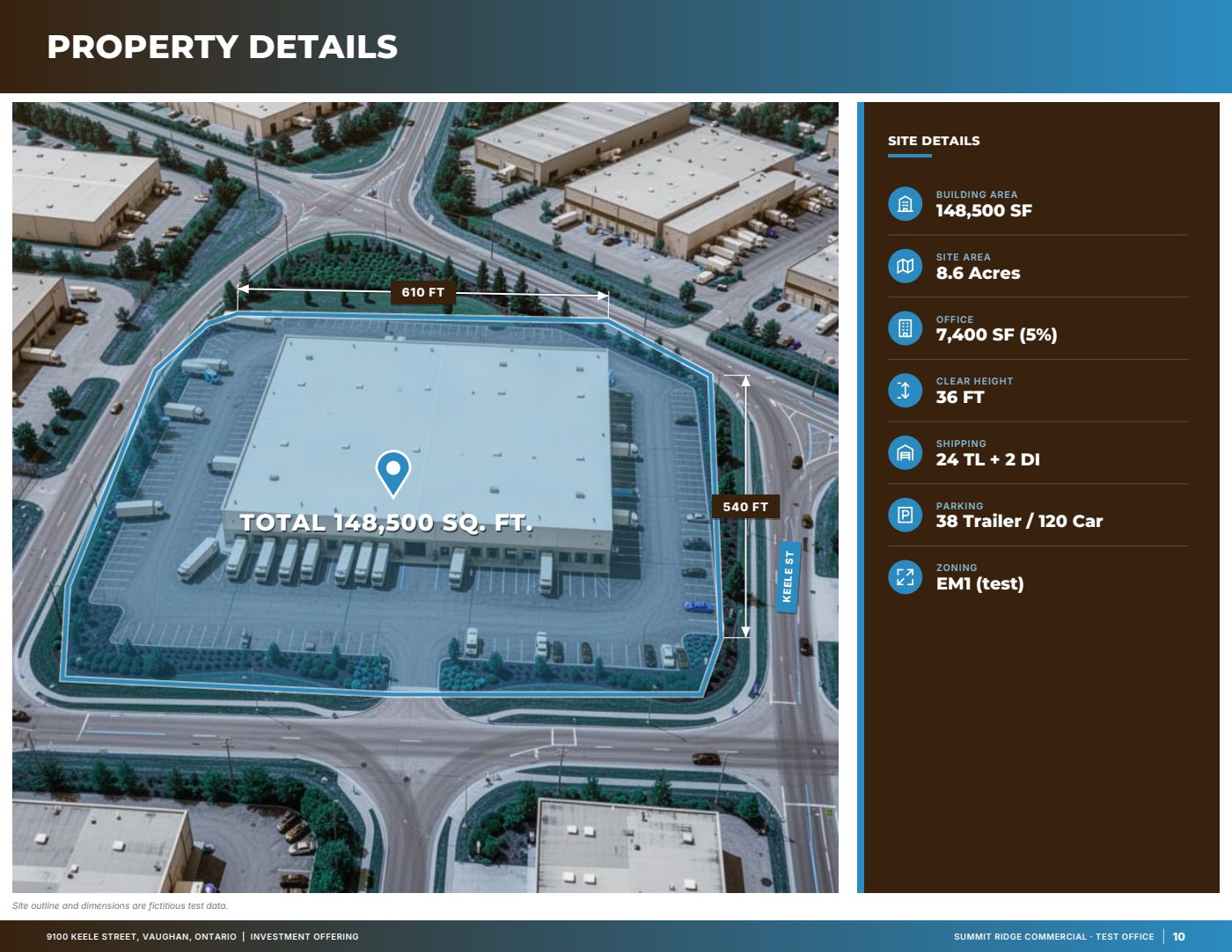
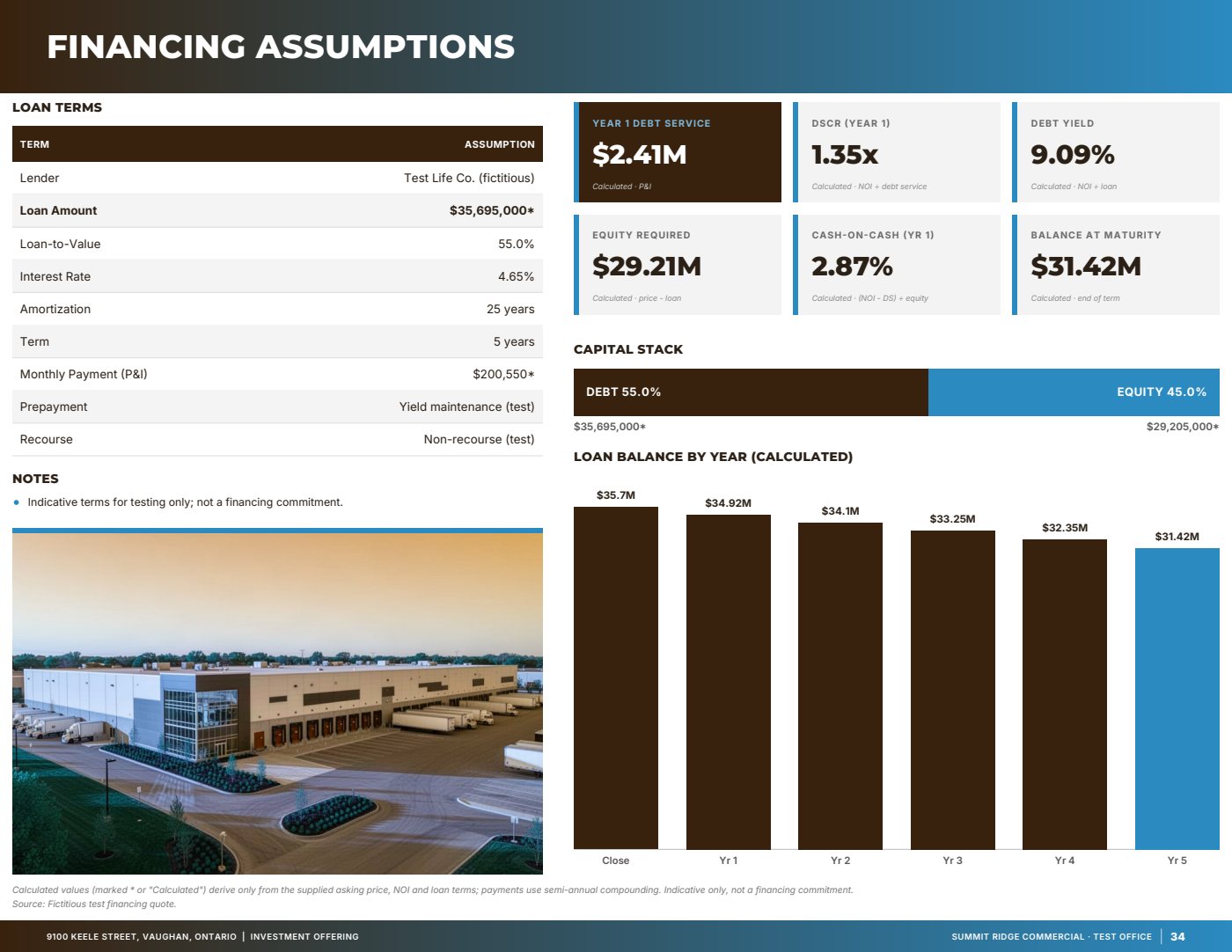
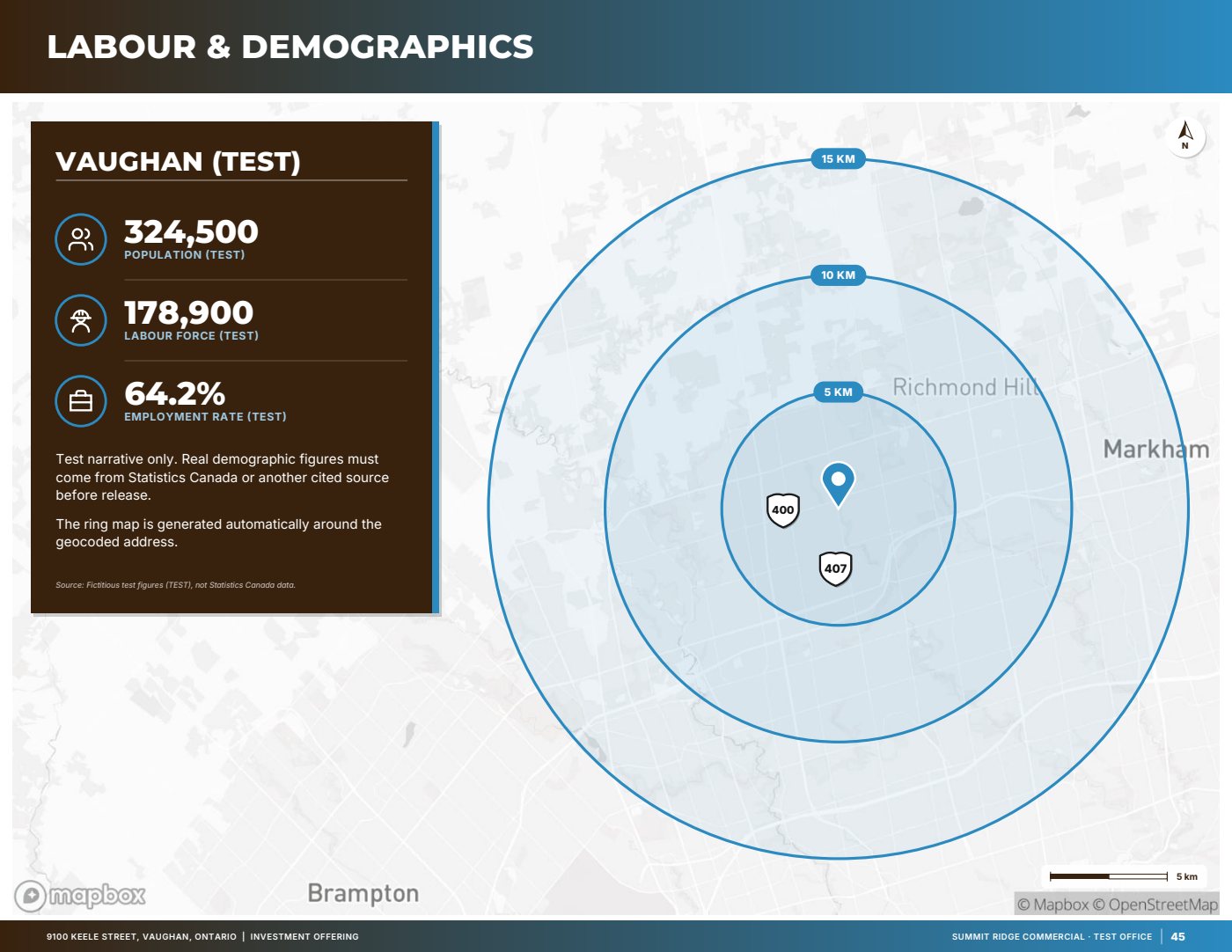
Sample pages are generated by the product from a fictitious test listing (9100 Keele Street, "Summit Ridge Commercial" test brand). Figures marked (test) are not real.
Related
Last updated 2026-10-14. General information for commercial real estate professionals, not legal advice.
Start with the fact sheet you already have.
Upload it, answer only what’s missing for the output you choose, and review a watermarked preview before you buy anything.