CRE marketing guide
HST on commercial real estate in Ontario: a plain-language overview
What “plus HST” means in a commercial listing, when a buyer self-assesses, how HST applies to commercial rent, and what to check. Not tax advice.
Read this first
This guide is a general, plain-language overview for brokers preparing marketing materials. It is not tax or legal advice. GST/HST on real property has many rules and exceptions, and the right treatment depends on the facts of each transaction. Vendors and buyers should get advice from an accountant or lawyer, and the Canada Revenue Agency (CRA) publishes detailed guidance on real property in its GST/HST memoranda series.
The basics
In Ontario the federal GST and the provincial sales tax are combined into the Harmonized Sales Tax (HST), at a combined rate of 13% at the time of writing. HST is administered by the CRA under the Excise Tax Act.
As a general rule, a sale of commercial real property, such as an industrial building, a retail plaza, an office building or vacant land intended for commercial use, is a taxable supply for GST/HST purposes. That is why commercial listings and agreements of purchase and sale commonly state that the price is “plus HST, if applicable”.
Residential property follows different rules, and many sales of used residential property are exempt. Mixed-use property, land sold by an individual that was not used in a business, farmland and some other cases have their own rules, which is one reason professional advice matters.
Who pays and who remits
For most taxable sales of commercial real property, the buyer bears the HST. How it is accounted for depends largely on whether the buyer is registered for GST/HST:
- If the buyer is registered (and the property is not residential property being bought by an individual), the buyer generally self-assesses the HST and reports it directly to the CRA, instead of paying it to the vendor. A buyer that will use the property in commercial activities may be able to claim an offsetting input tax credit.
- If the buyer is not registered, the vendor generally collects the HST from the buyer on closing and remits it to the CRA.
Because of this, agreements commonly include a clause in which the buyer warrants its GST/HST registration number and indemnifies the vendor. The lawyers handle the paperwork; the broker’s role is to make sure the listing and the agreement describe the price consistently.
HST on commercial rent
Commercial rent is generally a taxable supply, so landlords who are registered charge HST on base rent and on additional rent such as the tenant’s share of taxes, maintenance and insurance. Leasing brochures usually quote rents “plus HST”. When you show a total occupancy cost per square foot, say whether it includes HST; most commercial tenants recover HST through input tax credits, so the figure before HST is usually the useful one, but the wording should leave no doubt.
What to write in marketing materials
- State prices and rents as “plus HST, if applicable” unless the vendor’s advisor tells you otherwise.
- Do not describe a property as “HST-exempt” or “no HST” without written confirmation from the vendor’s accountant or lawyer.
- Keep the wording identical across the teaser, brochure, offering memorandum, web page and listing services.
- For mixed-use properties with residential units, flag that HST treatment may differ for different parts of the property, and leave the detail to the advisors.
- Do not include HST in calculated metrics such as price per square foot or capitalization rate; calculate them on the price before tax and label them as calculated.
Land and development sites
Vacant land is a frequent source of confusion. Land bought or sold by a business, or land that has been subdivided or developed, is usually treated differently from a farm or a parcel an individual has held privately for years. A developer buying a site generally expects the price to be plus HST and plans to self-assess, while some vendors of long-held land may be making an exempt sale. Because the answer can change the buyer’s cash needed on closing, raise it before the land brochure is finished, and keep the wording neutral until the vendor’s advisor confirms it. Development charges, parkland fees and other municipal levies are separate from HST and should be described separately where you mention them at all.
Questions to ask the vendor early
- Is the vendor registered for GST/HST, and has the property been used in a commercial activity?
- Is any part of the property residential, or has its use changed recently?
- Has the vendor’s accountant or lawyer given guidance on how HST should be described in the listing?
- For a leased property, are rents in the rent roll stated before or after HST?
Raising these questions at listing time avoids a correction after the brochure has gone out, and makes the agreement of purchase and sale smoother.
Assignments, leases and other special cases
Several situations come up often enough in commercial practice that brokers should recognise them and refer them to the advisors early:
- Assignment of an agreement of purchase and sale before closing, which can have its own HST consequences.
- Sale of a property together with an operating business, where the parties may consider a joint election that can change how HST applies to the transaction.
- Land severances and partial sales, where the use of the retained and sold parts may differ.
- Buildings that have been converted between residential and commercial use.
- Sales by a non-resident vendor, where other tax withholding rules also apply on closing.
In each case the broker’s job is not to give the answer but to spot the question, make sure the vendor knows it needs advice, and keep the marketing wording neutral (“plus HST, if applicable”) until the advisors have confirmed the treatment.
Commission and other fees
Real estate commissions and most professional fees are themselves taxable services, so brokerages charge HST on commission. Listing agreements and co-operating broker terms usually state commissions “plus HST”. Make sure the commission terms in the marketing package match the listing agreement.
Common mistakes
- Showing a price with no mention of HST in one document and “plus HST” in another.
- Calling a sale “HST included” without the vendor’s written instruction.
- Assuming residential rules apply to a mixed-use building, or the reverse.
- Including HST in a cap rate or price per square foot.
- Quoting a rent roll that mixes figures before and after HST.
Where to read more
The CRA’s GST/HST memoranda on real property, its guidance on self-assessment by purchasers of real property, and the Excise Tax Act itself are the primary sources. Many Canadian law and accounting firms also publish plain-language notes on HST in commercial real estate. Rates and rules change, so check the current guidance and the date of anything you rely on.
How OfferingStack helps
In OfferingStack you record how HST applies to the asking price once in the property file (plus HST, included, exempt, or “consult your advisor”), as a label your client’s advisor has confirmed; OfferingStack never calculates tax. Because the teaser, brochure and offering memorandum are built from the same file, the wording stays consistent. Calculated metrics are labelled as calculated, the documents carry your brokerage’s disclaimer, and you review and approve everything before it is distributed.
What these pages look like
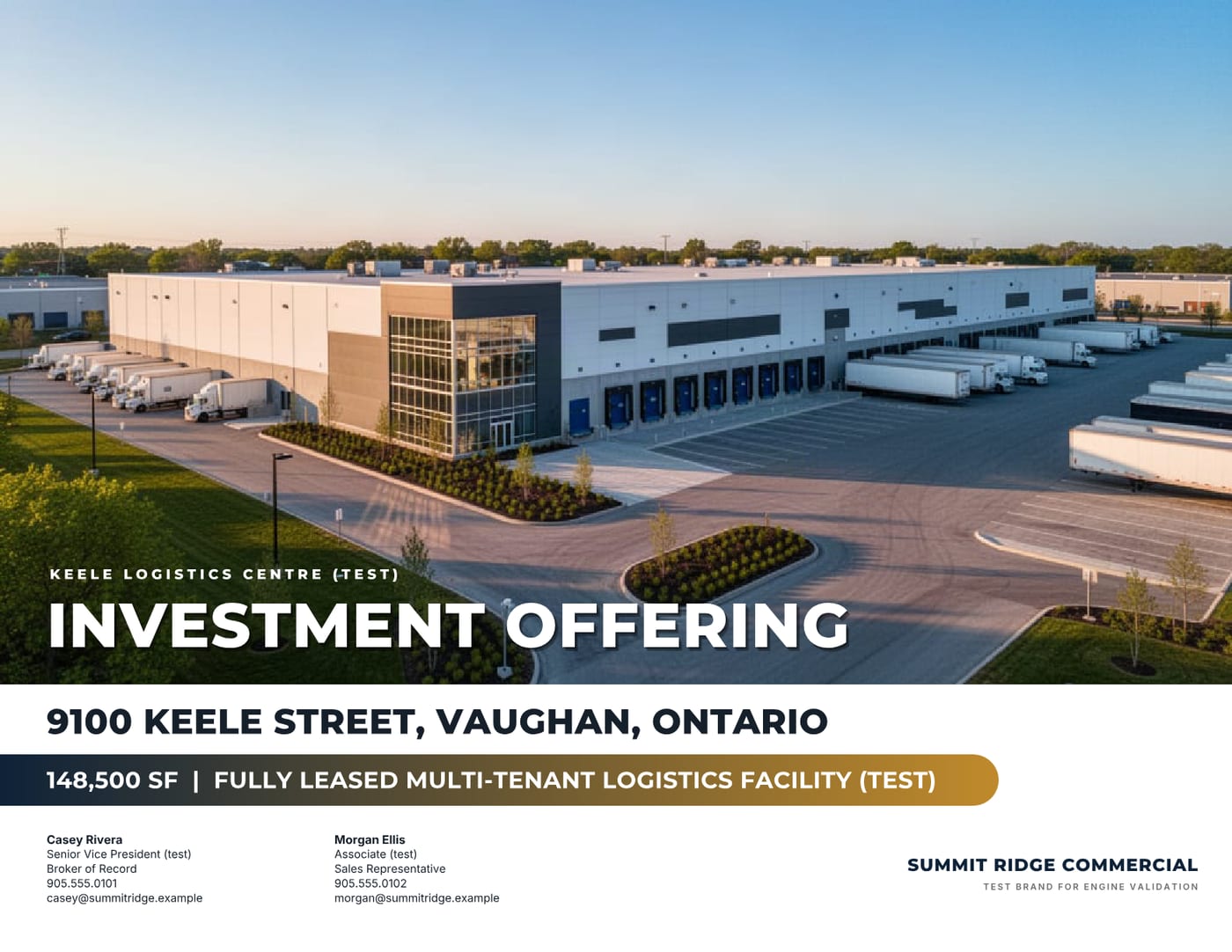
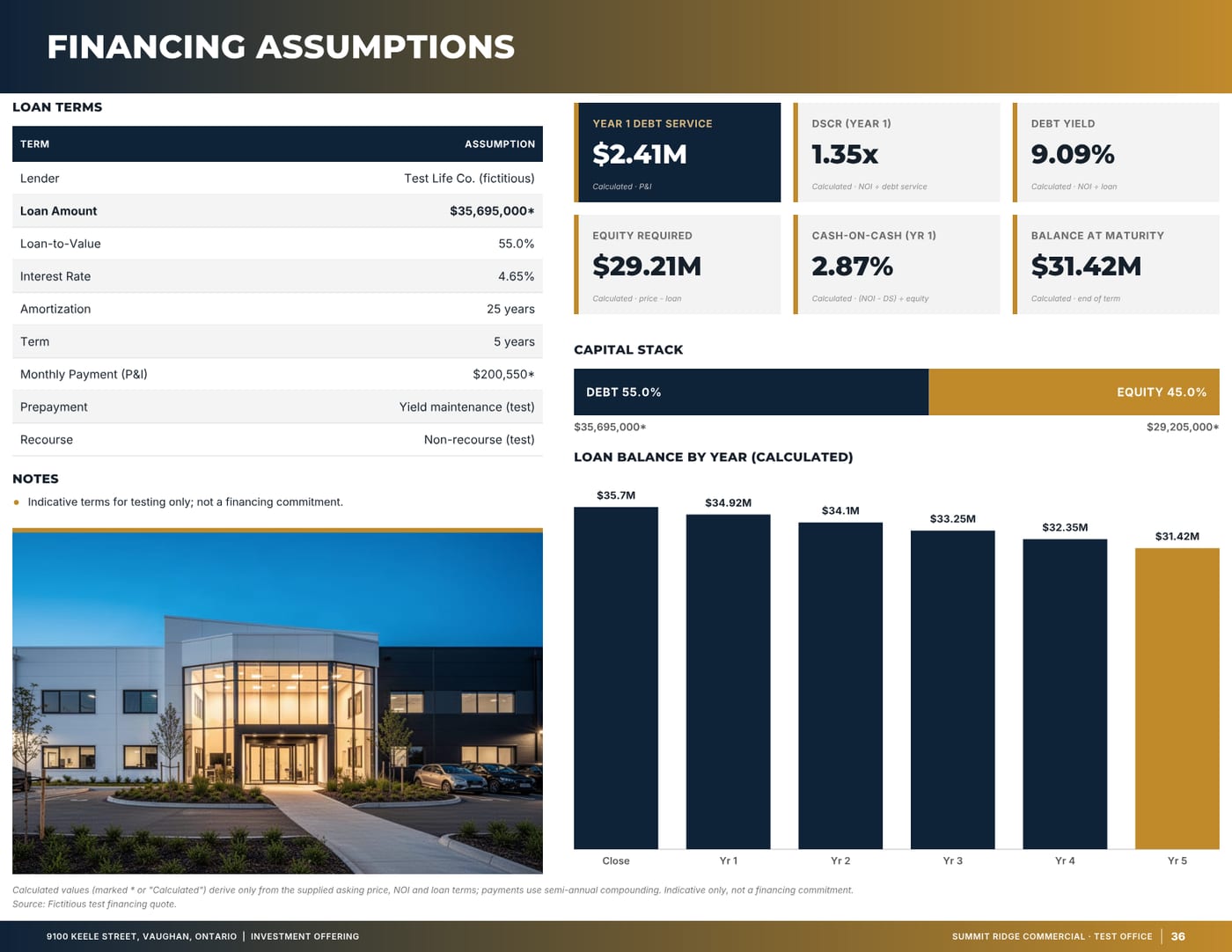
Sample pages are generated by the product from a fictitious test listing (9100 Keele Street, "Summit Ridge Commercial" test brand). Figures marked (test) are not real.
Related
Last updated 2026-10-14. General information for commercial real estate professionals, not legal advice.
Start with the fact sheet you already have.
Upload it, answer only what’s missing for the output you choose, and review a watermarked preview before you buy anything.