CRE marketing guide
Broker opinion of value (BOV): what it contains and how to prepare one
What a broker opinion of value for commercial real estate includes, how it differs from an appraisal, and how to show comparables and a value conclusion.
What a BOV is
A broker opinion of value (BOV) is a written estimate, prepared by a commercial real estate broker, of what a property would likely sell or lease for in the current market. Owners ask for one when they are thinking about selling, refinancing, settling an estate or simply checking where they stand. For the broker, a well-prepared BOV is often the document that wins the listing.
A BOV is an opinion based on the broker’s knowledge of the market and the evidence assembled. It is not an appraisal.
BOV vs appraisal
An appraisal is prepared by a qualified appraiser (in Canada, typically a member of the Appraisal Institute of Canada holding an AACI or CRA designation) following professional standards, and is what lenders, courts and tax authorities generally rely on. A BOV is quicker, usually free or low-cost to the owner, and focused on marketing: what price strategy will attract buyers, and why.
Make the distinction explicit in the document. A short statement that the BOV is not an appraisal, is prepared for the owner’s information, and should not be relied on for financing or legal purposes protects both the owner and the brokerage. Use your brokerage’s approved wording.
What a BOV contains
- Cover and a short letter to the owner stating the purpose and the effective date of the opinion.
- Property summary: address, legal description, site area, building area, year built, key specifications and photos.
- Condition notes: recent capital work, known deferred maintenance, anything that affects value.
- Zoning and permitted uses, and any planning context that could add or limit value.
- Income summary for an investment property: rent roll highlights, operating costs, net operating income.
- Market overview: what is happening in the submarket, with named, dated sources.
- Comparable sales (and, for leasing assignments, comparable leases), both completed and currently on the market.
- Value conclusion: a range, the approach used, and the reasoning.
- Recommended marketing strategy, pricing approach and timeline.
- The broker’s or team’s relevant experience, stated factually.
Choosing comparables
Comparables carry most of the weight of a BOV, so choose them carefully and show your work. Good comparables are similar in use, size, age and location, and recent enough to reflect the current market. Where the evidence is thin, it is better to use fewer, closer comparables and explain the adjustments than to pad the table with distant ones.
Completed sales
For each sold comparable, show the address, sale date, price, building and site area, price per square foot (labelled as calculated), and, for investment properties, the capitalization rate if it is known from a reliable source. Note anything unusual: a vacant building, a sale-leaseback, a related-party transaction or a property needing major work.
Active listings
Properties currently on the market show the competition the owner will face. Label asking prices as asking prices, not values, and note how long each has been listed if you know it.
Adjustments
Explain in plain language why the subject property should trade above or below each comparable: larger site, better clear height, shorter remaining lease term, weaker exposure. Buyers will make the same comparisons; the owner should see them first.
Gathering the information
A BOV is only as good as the facts behind it, and the owner is the best source for many of them. Ask early for the survey or a reference plan, the latest property tax bill, a current rent roll and copies of the leases for an investment property, operating cost statements for the last two years, any building condition or environmental reports, and a list of capital work with dates and costs. Walk the property, take your own photos and note anything the documents do not mention.
Public sources fill in the rest: the municipality’s zoning by-law and official plan, the assessment roll, and land registry records for comparable sales where you have access. Record where every figure came from and the date you checked it. If the owner tells you something you cannot confirm, such as a pending lease or a planning discussion, note it as information provided by the owner.
Valuation approaches
Most commercial BOVs rely on one or both of two approaches:
- Direct comparison: the value indicated by recent sales of similar properties, usually expressed per square foot of building or per acre of land.
- Income approach (direct capitalization): net operating income divided by a capitalization rate supported by comparable sales. Used for leased investment properties.
For land, value is usually expressed per acre or per buildable square foot, which depends on zoning and servicing. For owner-user buildings, direct comparison usually leads. Whichever approach you use, show the inputs so the owner can follow the arithmetic.
Presenting the value conclusion
A range is more honest than a single number, and owners understand it. Explain where in the range you expect the property to trade and what would move it up or down: a lease renewal, a zoning change, market conditions, the marketing timeline. If you recommend an asking price above your expected value, say why and what the risk is.
Avoid inflating the value to win the listing. Owners compare BOVs from several brokers, and the one that is well reasoned is more persuasive than the one that is simply highest. An unrealistic asking price also tends to cost the listing broker time and credibility later.
The marketing recommendation
Owners usually ask for a BOV because they want to know what would happen if they sold. The value conclusion answers half of that question; the marketing recommendation answers the other half. Explain who the likely buyers are, whether you would price the property or run an unpriced process with an offer date, how long you expect marketing to take, and what materials you would produce. Tie each recommendation to the evidence: if the comparables show strong demand from owner-users, say how the marketing will reach them.
Be clear about what the owner needs to do before launch, such as resolving a lease renewal, completing a repair or gathering missing documents. A short, realistic timeline is more convincing than a promise of a quick sale.
Keeping it confidential
A BOV often contains rents, lease terms and the owner’s plans. Treat it as confidential: address it to the owner, mark it as confidential, and do not reuse its contents in marketing without permission. Comparable sales data from paid services may have licence limits on how it can be shared; check before including it in a document that will be forwarded.
Common mistakes
- Comparables without dates or sources.
- Mixing asking prices and sale prices in one table without labels.
- Market statistics quoted without a source.
- Calculated metrics that cannot be reproduced from the figures shown.
- No statement that the BOV is not an appraisal.
- A generic marketing plan copied from another property.
How OfferingStack helps
OfferingStack can produce a BOV from the same property file as the brochure and offering memorandum. It lays out the property summary, location pages with sources, a comparables table with sold and active properties labelled separately, and your value conclusion and reasoning, which you write and approve. Calculated values such as price per square foot are labelled, and the document carries your brokerage’s disclaimer. See the pricing page for the current cost of a BOV.
What these pages look like
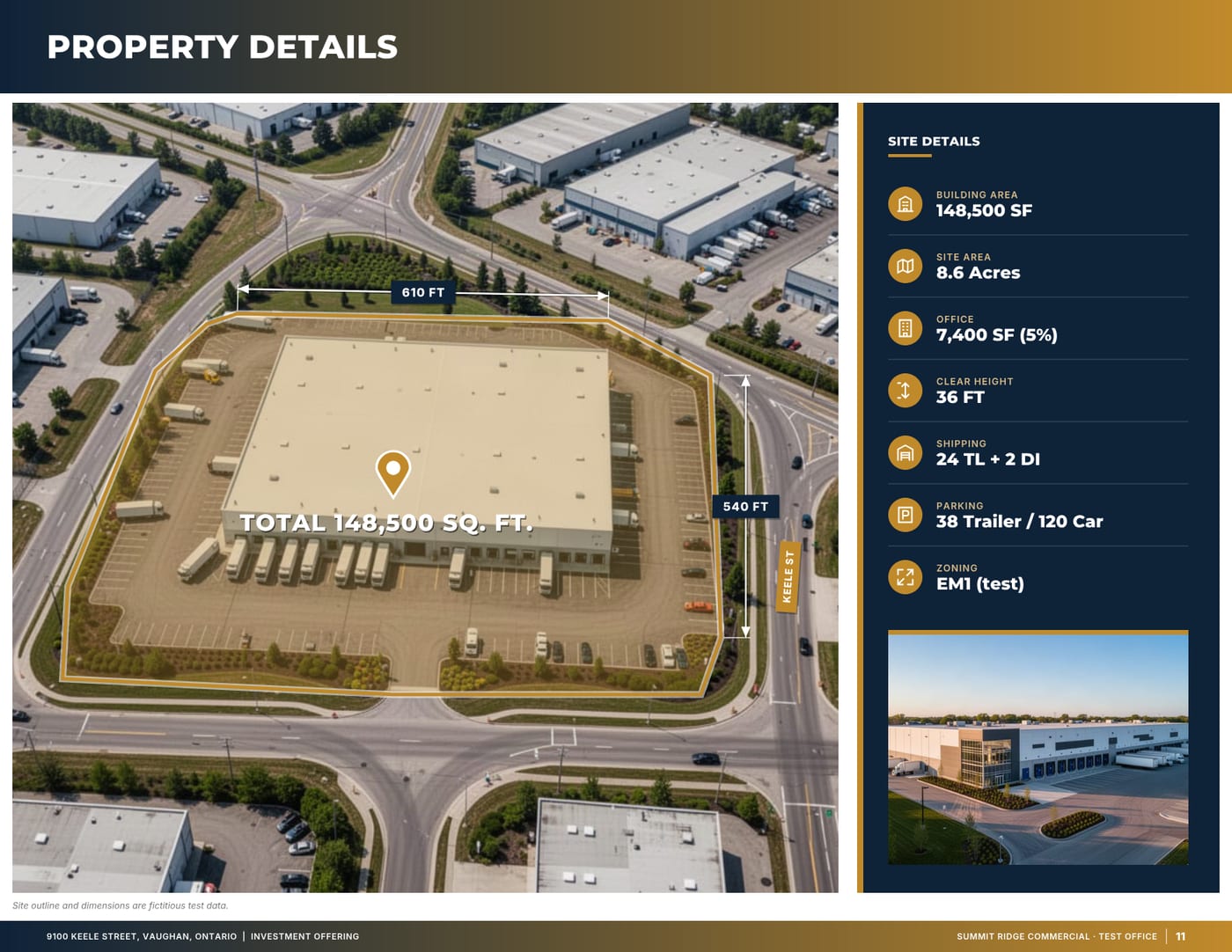
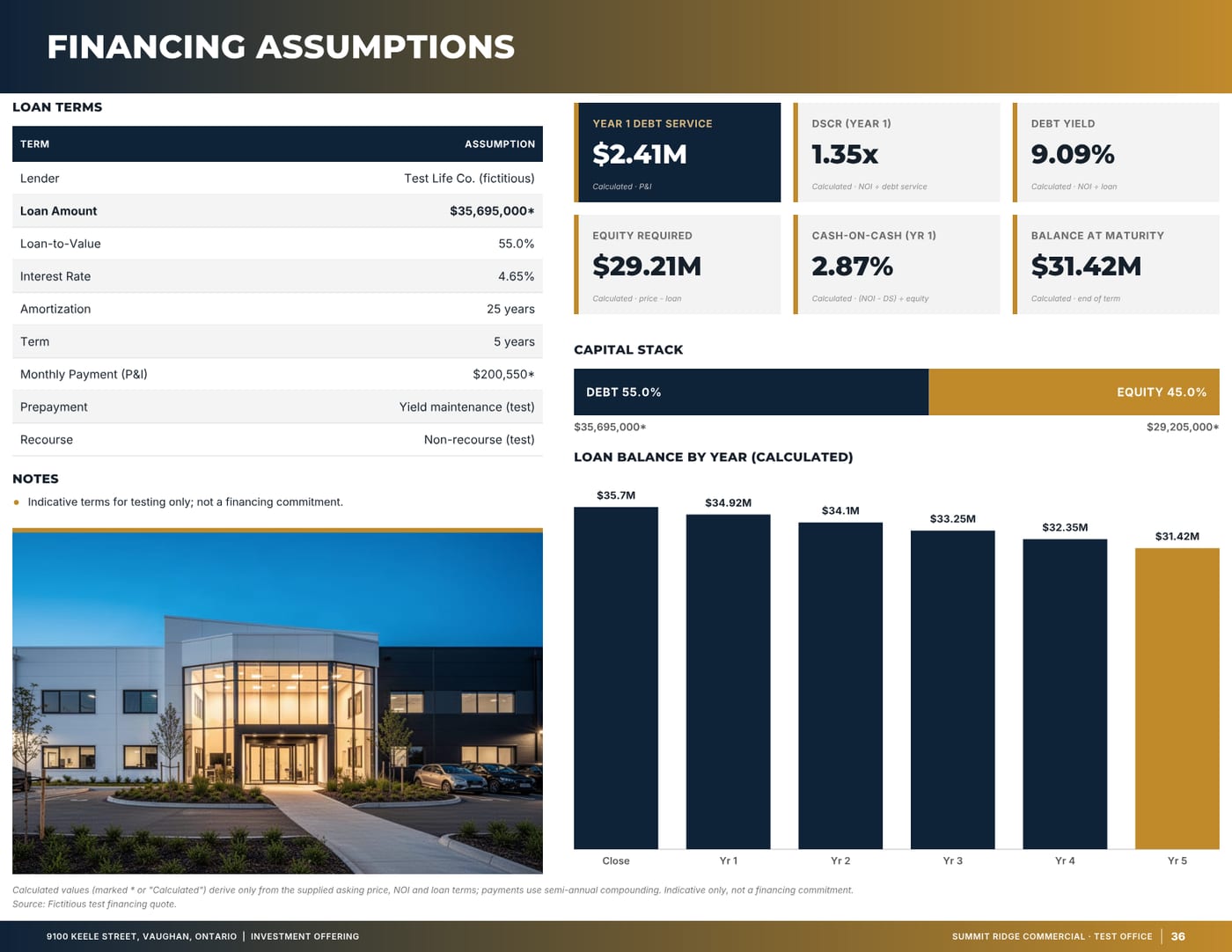
Sample pages are generated by the product from a fictitious test listing (9100 Keele Street, "Summit Ridge Commercial" test brand). Figures marked (test) are not real.

Related
Last updated 2026-10-14. General information for commercial real estate professionals, not legal advice.
Start with the fact sheet you already have.
Upload it, answer only what’s missing for the output you choose, and review a watermarked preview before you buy anything.