CRE marketing guide
A marketing plan for a commercial real estate listing
How to plan and launch the marketing for a commercial listing in Canada: the materials, the sequence, the channels and the checks before anything goes out.
Why a listing needs a plan
Commercial listings are won on the pitch and sold on the marketing. Once the listing agreement is signed, the vendor expects the property in front of the right buyers quickly, and every week without activity makes the conversation harder. A short written plan agreed with the vendor at the start sets expectations, avoids rework and makes it obvious what is happening when.
The plan does not need to be long. It needs to say who the likely buyers or tenants are, what materials will be produced, which channels will be used, in what order, and how interest will be handled.
Start with the buyer pool
Everything else follows from who is likely to buy or lease the property. An industrial building suits owner-users, investors and developers in different proportions depending on its size, condition, tenancy and zoning. A retail plaza appeals to private investors and, for larger centres, institutions. Land appeals to developers and end users who plan years ahead.
Write down the two or three most likely buyer types and what each will care about first. An investor wants the income and the lease terms; an owner-user wants the specifications, the zoning and the access; a developer wants the planning permissions and the servicing. Those priorities decide which pages lead the brochure, which facts go in the teaser and which questions you need answered before launch.
Gather the facts before the design
Most delays happen when the design is done and a fact turns out to be wrong. Collect and confirm the property file first: legal description, areas, specifications, zoning and permitted uses, servicing, the rent roll and leases for an income property, operating costs and taxes, photos and plans. Note the source and date for each figure.
Agree with the vendor what can be disclosed publicly and what only goes into the confidential offering memorandum. Tenant names, rents and financial statements are often kept for the OM, released after a confidentiality agreement is signed.
The materials, in order
- Teaser: a short summary, sometimes without the exact address, to gauge interest and drive confidentiality agreements.
- Marketing brochure: the designed document that presents the property and its location, usually ten to fifteen pages.
- Confidentiality agreement: the brokerage’s standard form, ready to send or sign online.
- Offering memorandum: the full document with financials, leases, zoning detail and the offering process, released after the confidentiality agreement.
- Data room: leases, reports, surveys, environmental and building condition reports, organised and dated.
- Supporting pieces: a one-page tear sheet, a property web page, social posts and signage, all consistent with the brochure.
Build everything from one property file, so a change to an area, a price or a tenant updates every piece. Inconsistent numbers between the teaser and the OM are one of the quickest ways to lose a buyer’s trust.
Pricing and the offering process
Decide early whether the property will be marketed with an asking price, with pricing guidance, or unpriced with an offer date. Each choice changes the materials. A priced listing can show price-based metrics such as the price per square foot or the cap rate, labelled as calculated. An unpriced listing should leave those metrics out and explain the process instead: when offers are due, what they should include, and how the vendor will respond.
Whatever the approach, write the offering process down in the OM and keep it consistent everywhere. Buyers who feel the process is unclear or changing tend to hold back their best offer.
Channels
Choose channels that reach the buyer pool you identified:
- Direct outreach to known buyers and tenants from your own and your brokerage’s contacts, usually the most productive channel for commercial property.
- Email campaigns to opted-in lists, with the teaser or brochure attached or linked.
- Listing services and the local real estate board’s systems, where your brokerage uses them for commercial property.
- Signage on the property, with a clear phone number and a short web address.
- A property web page and social posts that point back to the brochure and the confidentiality agreement.
- Co-operating brokers, with the commission terms stated clearly.
Commercial electronic messages in Canada are subject to Canada’s Anti-Spam Legislation (CASL), which generally requires consent, identification of the sender and a working unsubscribe mechanism. Check your brokerage’s policy before sending email campaigns.
The launch sequence
A common sequence is a soft launch to a short list of the most likely buyers, then the full launch a few days later. That lets you test the materials on people who will give honest feedback, and gives top prospects a head start, which vendors often appreciate.
- Week before launch: materials approved by the vendor and reviewed by a licensed professional; data room ready; confidentiality agreement tested.
- Soft launch: personal calls and emails to the top prospects.
- Full launch: email campaign, listing services, signage, web page and social posts on the same day.
- First weeks: follow up every confidentiality agreement within a day; track tours and questions.
- Before any offer date: a reminder to everyone who signed a confidentiality agreement, and a call to the most active.
Handling interest
Keep a simple log of every enquiry: who, when, which buyer type, whether they signed the confidentiality agreement, whether they toured, and what they asked. Answer questions in writing where you can, and if the same question comes up more than once, add the answer to the data room or a frequently asked questions page so every buyer gets the same information.
Report to the vendor on a fixed schedule, for example weekly, using the log. Vendors value a clear picture of activity more than optimistic adjectives, and the log makes price conversations easier if the market response is weaker than expected.
After the deal
When the property is sold or leased, update every channel the same day: mark the listing as sold or leased, take down or change the signage, and close the data room. A short note to everyone who signed a confidentiality agreement is a courtesy that buyers remember for the next listing. Keep the final materials and the enquiry log on file; they are the best starting point for the next similar property.
Pre-launch checks
- Every figure matches across teaser, brochure, OM, web page and signage.
- Every figure has a source and date; calculated values are labelled.
- Photos are current, honestly edited and high enough resolution for print.
- Zoning and servicing statements are sourced and dated.
- Confidential information appears only in materials released after a confidentiality agreement.
- Disclaimer wording is the brokerage’s approved text.
- Email campaigns comply with CASL and your brokerage’s policy.
- A licensed professional has reviewed everything before it is distributed.
How OfferingStack helps
OfferingStack builds the teaser, the brochure and the full OM from one property file, so the figures stay consistent across all three, and it can also produce tear sheets, social images and a listing web page from the same data. Location pages are pulled from the address with their sources, calculated values are labelled, and pages without data are left out. You review and approve everything before it is distributed.
What these pages look like
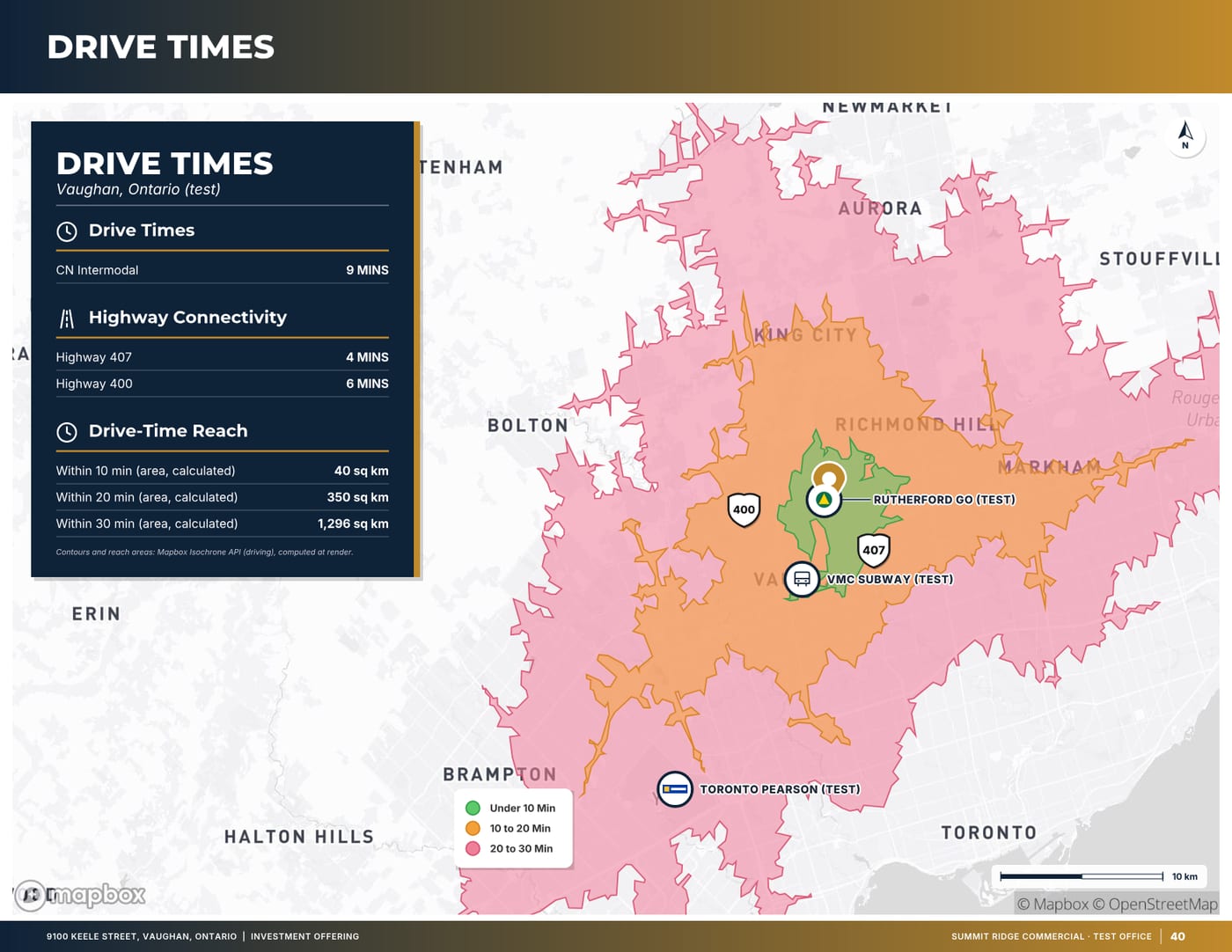
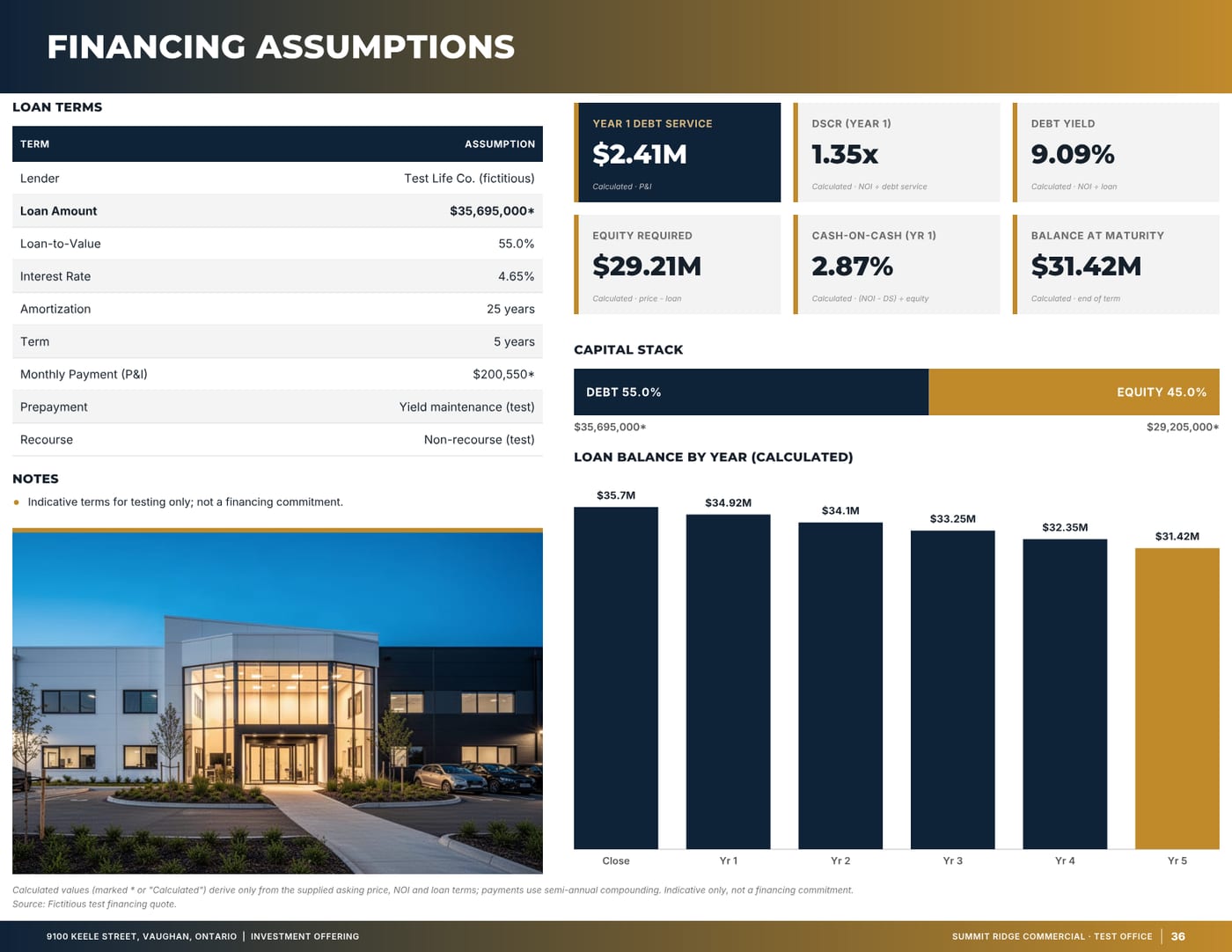
Sample pages are generated by the product from a fictitious test listing (9100 Keele Street, "Summit Ridge Commercial" test brand). Figures marked (test) are not real.

Related
Last updated 2026-10-14. General information for commercial real estate professionals, not legal advice.
Start with the fact sheet you already have.
Upload it, answer only what’s missing for the output you choose, and review a watermarked preview before you buy anything.