CRE marketing guide
Presenting the operating statement and NOI in an offering memorandum
How to set out income, recoveries, vacancy, operating expenses and NOI in an offering memorandum so buyers can follow the numbers to the cap rate.
What the financial pages are for
Buyers price an income property from its net operating income. The financial pages of an offering memorandum exist so a buyer’s analyst can rebuild that NOI quickly, see which numbers are actual and which are assumed, and decide what they would pay. A clear operating statement shortens that work; an unclear one invites the buyer to assume the worst.
The goal is not to sell with the numbers but to make them checkable. Every line should trace back to a lease, a tax bill, an invoice or a stated assumption.
The standard order of lines
Most commercial operating statements follow the same order, and buyers read them faster when you keep it:
- Base rent (from the rent roll).
- Recoveries: tenants’ shares of property taxes, insurance and common area maintenance (TMI or additional rent).
- Other income: parking, signage, storage, rooftop or telecom licences.
- Potential gross income (subtotal).
- Vacancy and credit loss allowance.
- Effective gross income (subtotal).
- Operating expenses, line by line: realty taxes, insurance, repairs and maintenance, snow and landscaping, utilities, management, administration.
- Net operating income.
Keep mortgage payments, income taxes, depreciation and one-off capital work out of the operating statement. If you show a structural or capital reserve, put it below NOI or label it clearly, because buyers treat it differently.
In-place, pro forma, or both
In-place NOI uses the leases and costs as they stand today. Pro forma NOI shows what the property could earn after a stated change: leasing a vacant unit, a rent reset at renewal, or a recoverable cost the current landlord isn’t billing. Both are legitimate, as long as they are labelled and the assumptions are written down next to the table.
A two- or three-column layout works well: for example actual for the last full year, the current in-place figure, and a pro forma column. Say what each column means in its heading, not only in a footnote. Buyers will rebuild the pro forma with their own assumptions, so show yours plainly: “Unit 4 leased at $14.50/sq ft net from month 6” is more useful than “stabilized”.
Recoveries and net leases
Under a net lease, tenants reimburse their share of operating costs. Show recoveries as income and the full costs as expenses, so a buyer can see what the building actually costs to run and how much comes back. If some costs aren’t recoverable (often part of the management fee, structural repairs or costs attributable to vacant space), the difference shows up naturally in the NOI.
Check that recoveries match the leases. A recovery line that equals total expenses on a building with vacancy is a signal to a buyer that something is wrong.
Gross and semi-gross leases need a sentence of their own. Where the landlord pays some or all of the operating costs out of a higher rent, there is little or nothing to recover, and the NOI depends on how well the landlord controls those costs. Say which leases are gross, which costs the landlord carries, and whether any of them can be passed through on renewal.
Vacancy allowance and expense checks
Apply a vacancy and credit-loss allowance and say what it is based on. A fully leased building with long leases might carry a small allowance; a building with near-term expiries deserves more. Lenders and buyers apply their own, so the point is transparency, not precision.
Before publishing, run three quick checks: expenses per square foot against the building’s own history, the expense ratio (operating expenses as a share of effective gross income), and property tax against the current assessment and tax bill. Large swings from one year to the next need a one-line explanation.
A worked example
Here is how the lines fit together for a fictitious multi-tenant building, with illustrative numbers that are not benchmarks:
- Base rent $520,000 from the rent roll, plus TMI recoveries of $185,000 billed to tenants under their net leases, plus $6,000 of other income from parking and signage: potential gross income of $711,000.
- A 5% vacancy and credit-loss allowance of $35,550, reflecting one lease that expires in the next 18 months: effective gross income of $675,450.
- Operating expenses of $214,000: realty taxes $98,000, insurance $22,000, repairs and maintenance $58,000, management $20,000, utilities $12,000 and other costs $4,000.
- Net operating income of $461,450, with an expense ratio of about 31.7% of effective gross income.
Notice what the example leaves out: the mortgage, the owner’s income tax and the roof replacement planned for next year. A buyer will want to know about the roof, so mention it in the property description or the capital expenditure notes, but keep it below the NOI line. If this building were offered at $7,500,000, the in-place NOI would represent a cap rate of about 6.15%.
Questions a buyer’s analyst will ask
Anticipating the questions saves a round of emails and makes the OM look prepared. The most common ones are:
- Which figures are actual and which are budgeted or estimated, and for what period?
- Do the recoveries reflect what the leases allow, and are there any caps, base years or gross-up provisions?
- Is the management fee recoverable, and is it charged at a market rate?
- Are there free-rent periods, rent steps or tenant inducements that change the income over the next two years?
- Which tenants are on month-to-month or holding over, and which leases expire before a typical loan term ends?
- Has the property tax been appealed, or is a reassessment expected?
- What capital work has been done recently, and what is coming due?
You don’t need to answer every one in the OM, but the financial pages should make it easy to see where the answers will come from. A short assumptions list under the table, and a line saying the full operating statements are available after a confidentiality agreement is signed, usually does the job.
From NOI to price
Once NOI is settled, the pricing page shows what it means at the asking price: the cap rate on the price, and a short sensitivity table of value at a few cap rates around it. Keep the language factual (“at the asking price of $X, the in-place NOI represents a Y% cap rate”) and avoid presenting a range of values as an appraisal.
You can check the arithmetic with the free NOI and cap rate calculators on this site. In OfferingStack, the Financial Overview page holds the income, expense, subtotal and NOI lines in up to three columns with assumptions and a source line, and the Pricing & Valuation page builds the cap-rate sensitivity table from the NOI you enter.
Checklist before the OM goes out
- Every income line ties to the rent roll; every expense line to a bill, budget or stated assumption.
- Column headings say actual, in-place or pro forma, and for which period.
- Recoveries are consistent with the leases and the vacancy.
- No debt service, depreciation or capital work above the NOI line.
- The NOI on the financial page, the executive summary and the pricing page is the same number.
- A source and “as of” date appear under the table.
This is general information for commercial real estate professionals, not accounting, tax or valuation advice.
What these pages look like
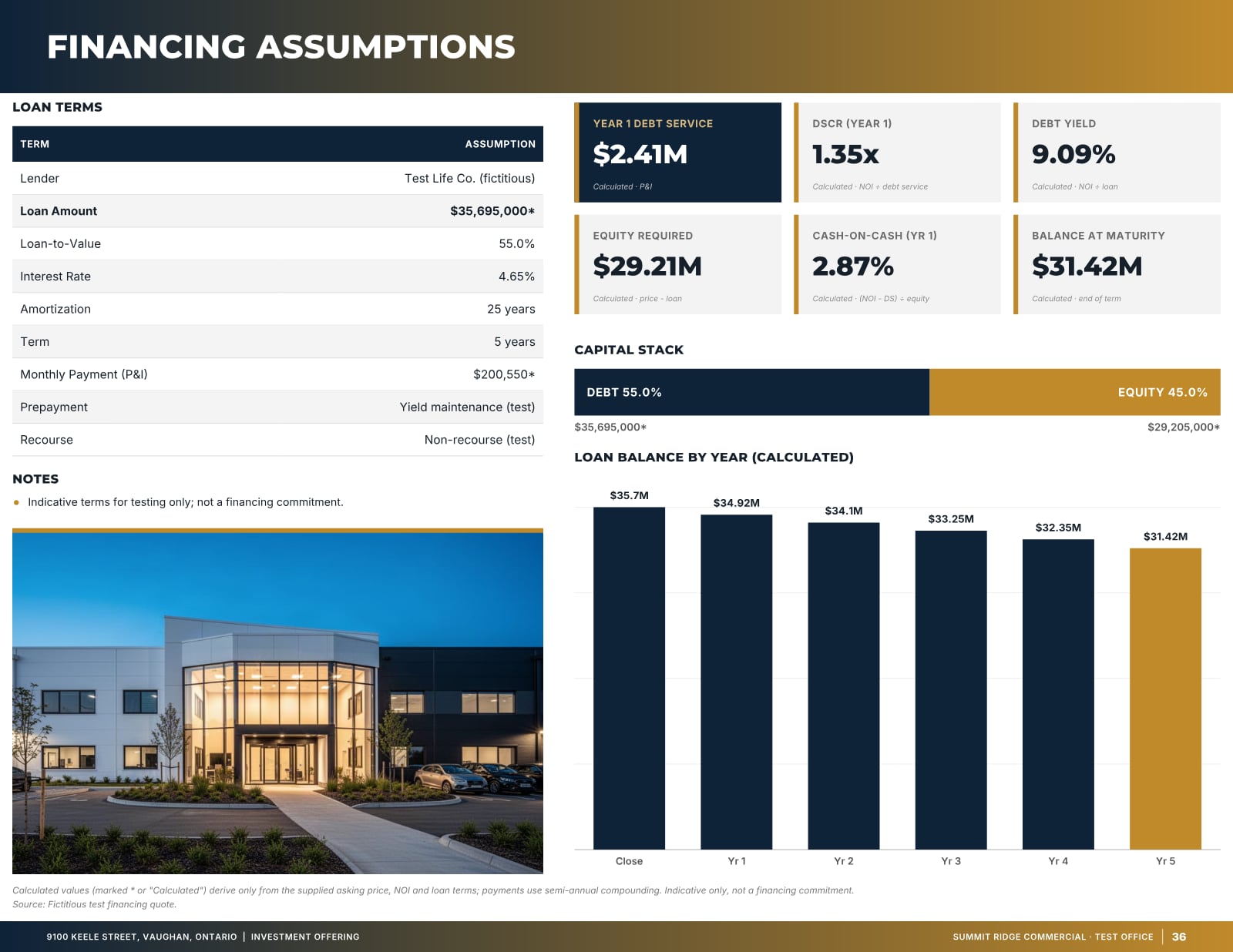
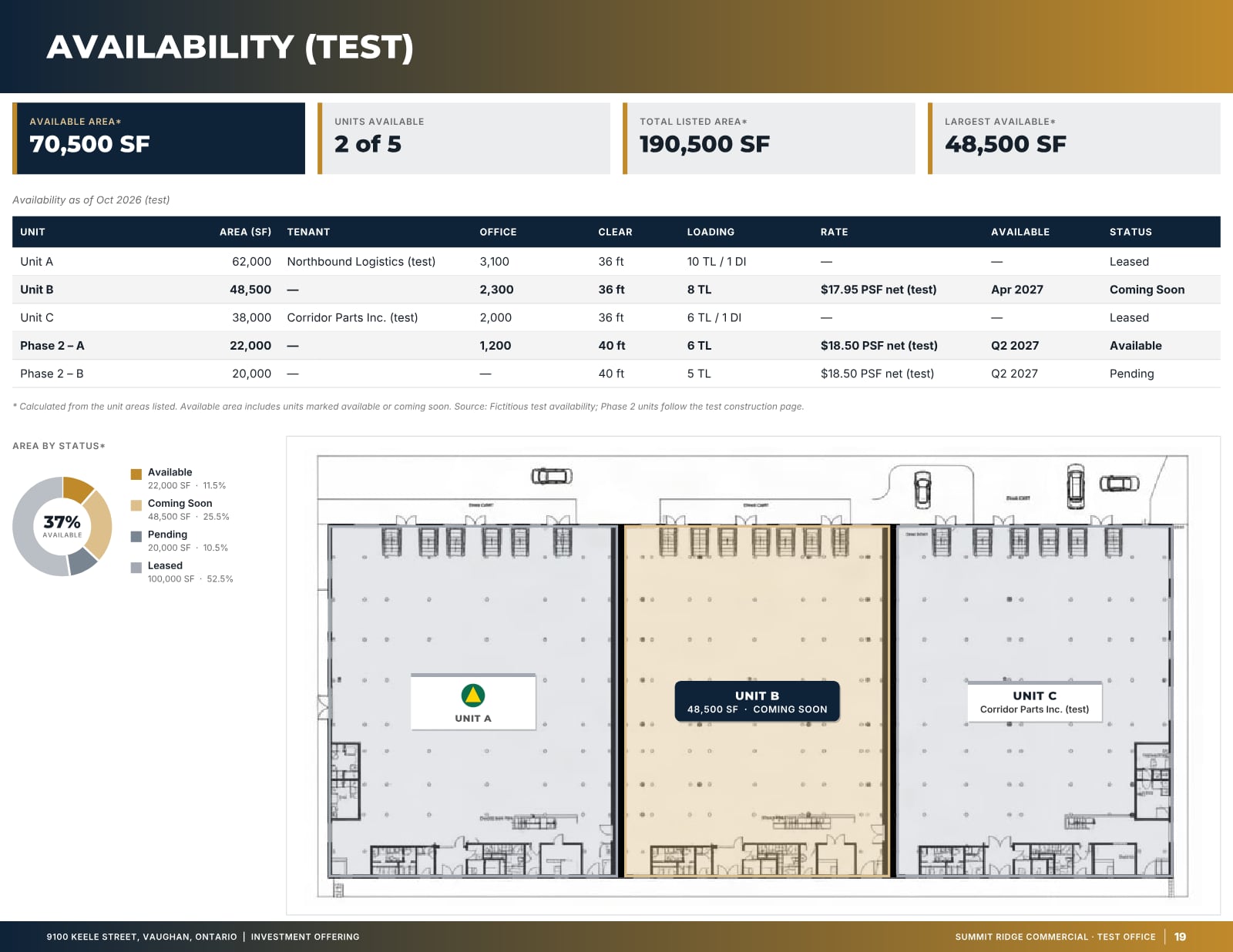
Sample pages are generated by the product from a fictitious test listing (9100 Keele Street, "Summit Ridge Commercial" test brand). Figures marked (test) are not real.

Related
Last updated 2026-10-14. General information for commercial real estate professionals, not legal advice.
Start with the fact sheet you already have.
Upload it, answer only what’s missing for the output you choose, and review a watermarked preview before you buy anything.