CRE marketing guide
Rent rolls and lease abstracts in an offering memorandum
How to present a commercial rent roll and lease abstracts in an OM: the columns buyers expect, vacancy, expiries, WALT, recoveries and common mistakes.
Why the rent roll matters
For an income property, the rent roll is the page a buyer’s analyst opens first. It is the bridge between the property and its value: every figure in the operating statement, the net operating income and the capitalization rate traces back to it. A clear, accurate rent roll makes the whole OM more credible; a messy one makes the buyer doubt everything else.
The rent roll is a summary. The leases are the source. The OM should present the summary cleanly and make it easy to check against the leases in due diligence.
The columns buyers expect
There is no single standard, but most commercial rent rolls include:
- Unit or suite, and floor where relevant.
- Tenant name (or “Vacant”).
- Rentable area, in square feet (and square metres if your market uses both).
- Lease start and expiry dates.
- Current base rent, per square foot per year and per year in total.
- Scheduled rent steps (escalations) with their dates.
- Lease type and recoveries: net, semi-gross or gross, and how additional rent (taxes, maintenance, insurance) is recovered.
- Renewal or extension options, and any termination or expansion rights.
- Security deposit or letter of credit, where relevant.
Add a totals row: total rentable area, leased area, vacant area and total base rent. If the property has storage, parking or rooftop income, show it on separate lines rather than folding it into base rent.
Show vacancy honestly
Vacant units belong on the rent roll, with their area. Leaving them off makes occupancy look better on one page and worse when the buyer adds up the building area. If you show a market rent for a vacant unit, label it as an assumption and keep it out of in-place income.
Occupancy can be shown by area (leased square feet divided by total rentable square feet). Say which measure you used.
Expiries and WALT
Buyers want to know when income is at risk. A lease expiry schedule (area or rent expiring in each year) answers that at a glance, and a simple bar chart often reads better than a table.
WALT, the weighted average lease term, summarises the same information in one number: the remaining term of each lease, weighted by its area or its rent. State which weighting you used, the date it was calculated, and whether options to renew are included (usually they are not). Label it as calculated.
Lease abstracts
A lease abstract is a one-page summary of a single lease. In an OM it is used for the tenants that matter most: the anchor of a retail plaza, the single tenant of an industrial building, or every tenant in a small multi-tenant property. A useful abstract covers:
- Parties, premises and rentable area.
- Commencement, expiry and remaining term.
- Base rent schedule, year by year.
- Additional rent and recovery structure, including any caps or exclusions.
- Renewal, extension, expansion, termination and right-of-first-refusal clauses.
- Permitted use and any exclusivity granted to the tenant.
- Landlord obligations: repairs, roof, structure, HVAC replacement.
- Assignment and subletting terms, and any guarantor or indemnifier.
Quote the lease, do not interpret it. If a clause is unusual or unclear, say that the lease should be reviewed rather than summarising it in a way the buyer’s lawyer will later contradict.
Building the rent roll from the leases
Start from the signed leases and amendments, not from last year’s rent roll or the property manager’s billing report. Billing systems show what is being charged, which can differ from what the lease says because of abatements, side agreements or errors. Work through each lease and its amendments in date order, then reconcile the result against the billing report and investigate every difference before the OM goes out.
Note anything that changes income in the next year or two: a free-rent period, a scheduled step, an option the tenant is likely to exercise, a lease in holdover, or a tenant in arrears. Buyers will find these in due diligence; finding them first in the OM builds trust. If the owner has agreed terms that are not yet signed, show them separately and label them as pending.
Recoveries and the operating statement
How additional rent is recovered changes how a buyer reads base rent. Under a net lease the tenant pays its share of property taxes, insurance and common area maintenance on top of base rent; under a gross or semi-gross lease the landlord carries some or all of those costs. Mixing these in one column without saying so makes rents look inconsistent and can mislead.
Show the recovery structure for each lease on the rent roll, then present the operating statement with recoverable and non-recoverable expenses separated. Net operating income is effective gross income (rent plus recoveries, less vacancy and credit loss) minus operating expenses, before debt service and capital items. Say whether NOI is in-place, trailing twelve months or projected.
Tenant profiles
For investment sales, a short profile of each significant tenant helps the buyer judge the quality of the income: what the business does, how long it has occupied the premises, and publicly available facts such as whether it is a national or regional operator. Use only facts you can source. Avoid credit judgements you cannot support, and never state a tenant’s financial position unless it comes from a public filing or the tenant has agreed to it being shared.
Keep the numbers consistent
The rent roll, the operating statement, the investment highlights and the pricing page must all agree. Before the OM goes out, check that:
- Total base rent on the rent roll matches base rent in the operating statement for the same period.
- Leased and vacant area add up to the total rentable area on the property details page.
- Occupancy, WALT and NOI in the highlights match the figures in the financial section.
- Every figure carries its as-of date, and the same date is used throughout.
If the rent roll changes during marketing, for example after a renewal, update every page that depends on it and send the new version to every party that has signed a confidentiality agreement.
Confidentiality
Rents and lease terms are confidential. The rent roll and lease abstracts belong in the full OM shared after a confidentiality agreement, not in a public teaser or brochure. Where tenants are individuals, their details may be personal information under privacy law, so share only what a buyer needs to evaluate the property.
Common mistakes
- Vacant units left off, or shown with assumed rent mixed into in-place income.
- Gross and net rents mixed in the same column without saying so.
- No as-of date, or different dates on different pages.
- Totals that do not match the operating statement.
- WALT given without saying how it was weighted or whether options are included.
- Lease abstracts that paraphrase key clauses loosely.
How OfferingStack helps
In OfferingStack the full OM has a tenancy and rent roll page that continues over as many pages as the rows need, an optional rent roll infographic, a stacking plan for multi-floor buildings, tenant profiles and one lease abstract page per lease. Calculated values are labelled, the same figures feed the investment summary and pricing pages, and pages without data are left out. You enter or verify the rent roll; the platform never invents rents or terms.
What these pages look like
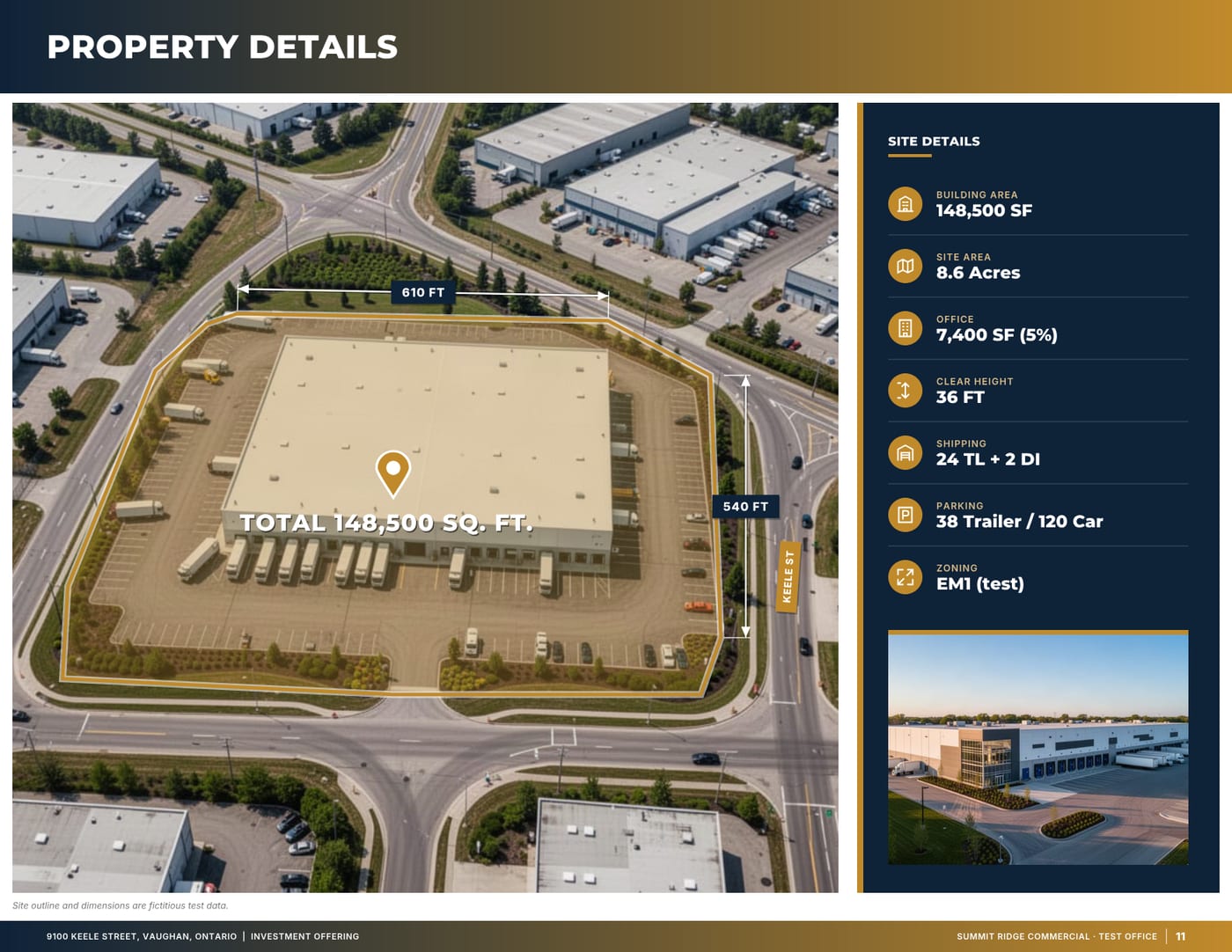
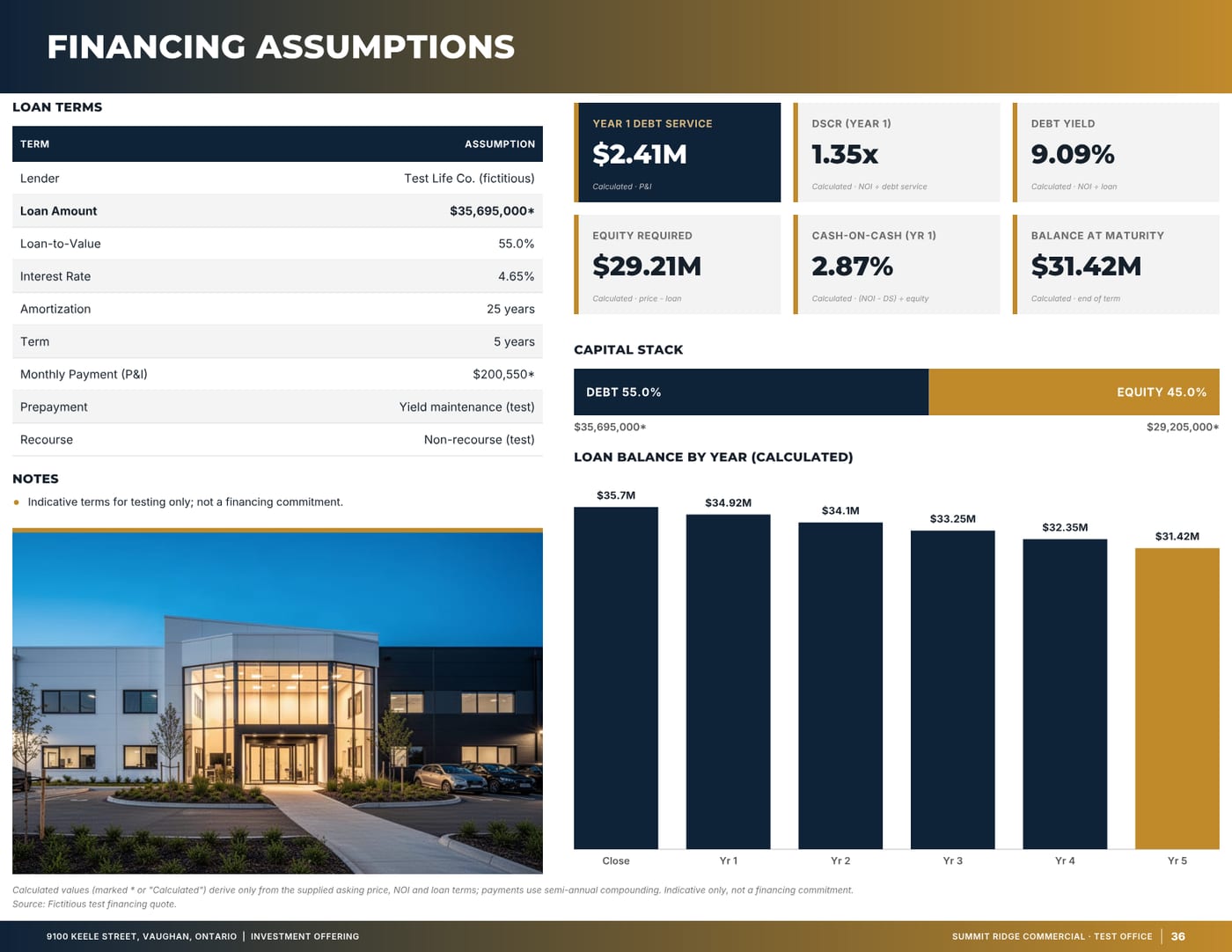
Sample pages are generated by the product from a fictitious test listing (9100 Keele Street, "Summit Ridge Commercial" test brand). Figures marked (test) are not real.

Related
Last updated 2026-10-14. General information for commercial real estate professionals, not legal advice.
Start with the fact sheet you already have.
Upload it, answer only what’s missing for the output you choose, and review a watermarked preview before you buy anything.