CRE marketing guide
Confidentiality agreements and the offering process in commercial real estate
How confidentiality agreements (CAs/NDAs) fit a commercial real estate sale: common terms, what to release before and after, and the offering process.
Why commercial sales use confidentiality agreements
An income property’s value sits in information the owner would rather not publish: rents, lease terms, tenant names, operating costs and sometimes the reason for selling. Tenants may not know the building is for sale, and competitors would like to know what the neighbours pay. A confidentiality agreement (often called a CA or an NDA) lets the listing broker share that information with serious parties while giving the owner a written promise about how it will be used.
The agreement is also a filter. A buyer who signs a CA has identified themselves, given contact details and accepted some obligations, which separates genuine interest from casual browsing. For the broker, the list of signed CAs becomes the working list of prospects for the rest of the process.
What a CA usually covers
The exact wording should come from your brokerage or the owner’s lawyer. This is a description of common terms, not legal advice. Most commercial real estate confidentiality agreements deal with:
- What counts as confidential information: the offering memorandum, the data room, leases, financial statements, reports and anything said during tours or calls.
- Permitted use: evaluating the purchase of the property, and nothing else.
- Who may see it: the buyer’s own advisers, lenders and investors, who must be bound by the same terms.
- No contact with tenants, employees or the property manager without the listing broker’s permission.
- No reliance: the information is provided without warranty, and the buyer must do its own due diligence.
- Return or destruction of the material if the buyer drops out.
- Principal or co-broker status: whether the signer is buying for itself or representing a client, and how a buyer’s broker is identified and paid.
- How long the obligations last.
Keep the agreement proportionate to the deal. A short, readable CA gets signed faster than a long one that sends every buyer to their lawyer before they have even seen the property.
What to release before and after the CA
A practical way to plan the offering is to sort every piece of material into two groups.
Before the CA (public or semi-public)
The teaser or marketing brochure: the address or general location, the property type, site and building size, key specifications, zoning designation, photos, location maps and the offering process. For a sensitive sale, the teaser can describe the property without naming it, and the address is only released after the CA.
After the CA (confidential)
The full offering memorandum: rent roll, lease abstracts, tenant profiles, operating statements, net operating income, the capital expenditure history, environmental and building condition reports, the survey and any planning studies. Large sales often open a data room for the documents behind the OM.
Whatever you decide, apply it consistently. If one buyer gets the rent roll before signing and another has to sign first, the second buyer will notice.
Running the offering process
The CA is one step in a sequence that buyers in the market recognise. A typical marketed sale runs roughly like this:
- Launch: the teaser or brochure goes out by email, on listing platforms and through direct calls.
- CA and OM: interested parties sign the CA and receive the full OM, and access to the data room if there is one.
- Tours and questions: the listing team organises tours and answers questions, ideally sharing answers to common questions with every party at the same time.
- Offer date or rolling offers: the owner either sets a date by which offers must be submitted (a call for offers) or reviews offers as they arrive.
- Shortlist and negotiation: the strongest offers are clarified, and sometimes a second round is held.
- Agreement of purchase and sale, due diligence period, waiver of conditions and closing.
The offering process page of the OM should explain the steps that apply to this listing: whether the property is priced or unpriced, the offer date if there is one, what an offer should include (price, deposit, conditions, due diligence period, closing date, evidence of financing) and who to contact.
Priced or unpriced?
A priced listing gives buyers a clear anchor and suits properties with obvious comparables. An unpriced process with an offer date is common for investment properties and land, where buyers will underwrite their own number and the owner wants competition to set the price. Either way, the OM should say clearly which approach is being used, so nobody wastes time asking for a price that will not be given.
If guidance is given verbally, keep it consistent between buyers and record what was said.
Preparing the data room
On larger sales, the documents behind the OM go into a data room that signed parties can access. Organise it the way a buyer’s team will work: title and survey, leases and amendments, financial statements and the rent roll, property tax and assessment, building condition and environmental reports, zoning and planning material, and service contracts. Name files clearly, date them, and keep an index.
Load the data room before launch rather than in response to questions, and check that nothing in it contradicts the OM. When a document is replaced, keep the old version out of view and tell every party what changed.
Tracking who has what
Keep a simple log for every party: the date the CA was signed, the version of the OM they received, the documents they opened, tours attended, questions asked and the answers given. When the OM is updated, for example after a lease renewal, send the new version to every signed party and note it in the log. The log protects the owner and the brokerage if a dispute arises, and it tells the listing team who is genuinely active before the offer date.
Confidentiality wording inside the OM
Most OMs open with a confidentiality and disclaimer page that repeats the key terms: the document is confidential, provided for evaluation only, prepared from sources believed reliable but not guaranteed, and does not replace the buyer’s due diligence. Use your brokerage’s approved text and keep it to one page.
Advertising and disclosure by real estate registrants are regulated. In Ontario, check your brokerage’s policies and RECO’s guidance under the Trust in Real Estate Services Act, 2002 (TRESA). Rent rolls can contain personal information about individual tenants, so also consider privacy law (in Canada, PIPEDA or the provincial equivalent) before sharing tenant details.
Common mistakes
- Sending the full OM with the rent roll before any agreement is signed.
- A CA so long that buyers stall before seeing the property.
- Different information given to different buyers, or questions answered to one party only.
- An offering process page that does not say whether the property is priced or how offers will be reviewed.
- Old versions of the OM still circulating after the facts changed.
- Tenant names or rents appearing in the public teaser by accident.
How OfferingStack helps
OfferingStack builds the teaser, the brochure and the full OM from one property file, so you can keep confidential pages (rent roll, lease abstracts, tenant profiles, financials) in the full OM and out of the teaser. The full OM can open with a confidentiality page that uses your brokerage’s own wording, and an offering process page sets out the steps for the listing. The CA itself, and the decision about what to release, remain yours and your brokerage’s.
What these pages look like
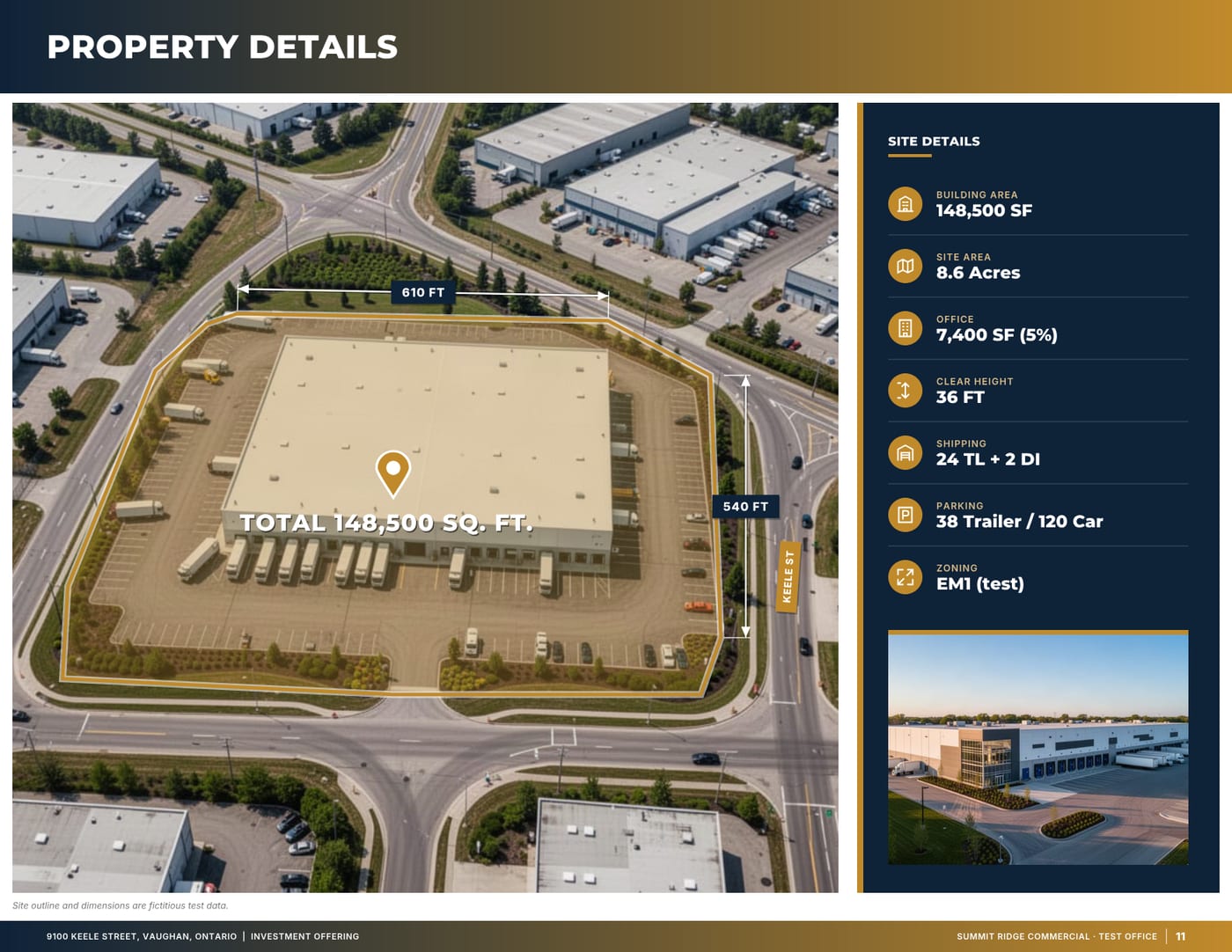
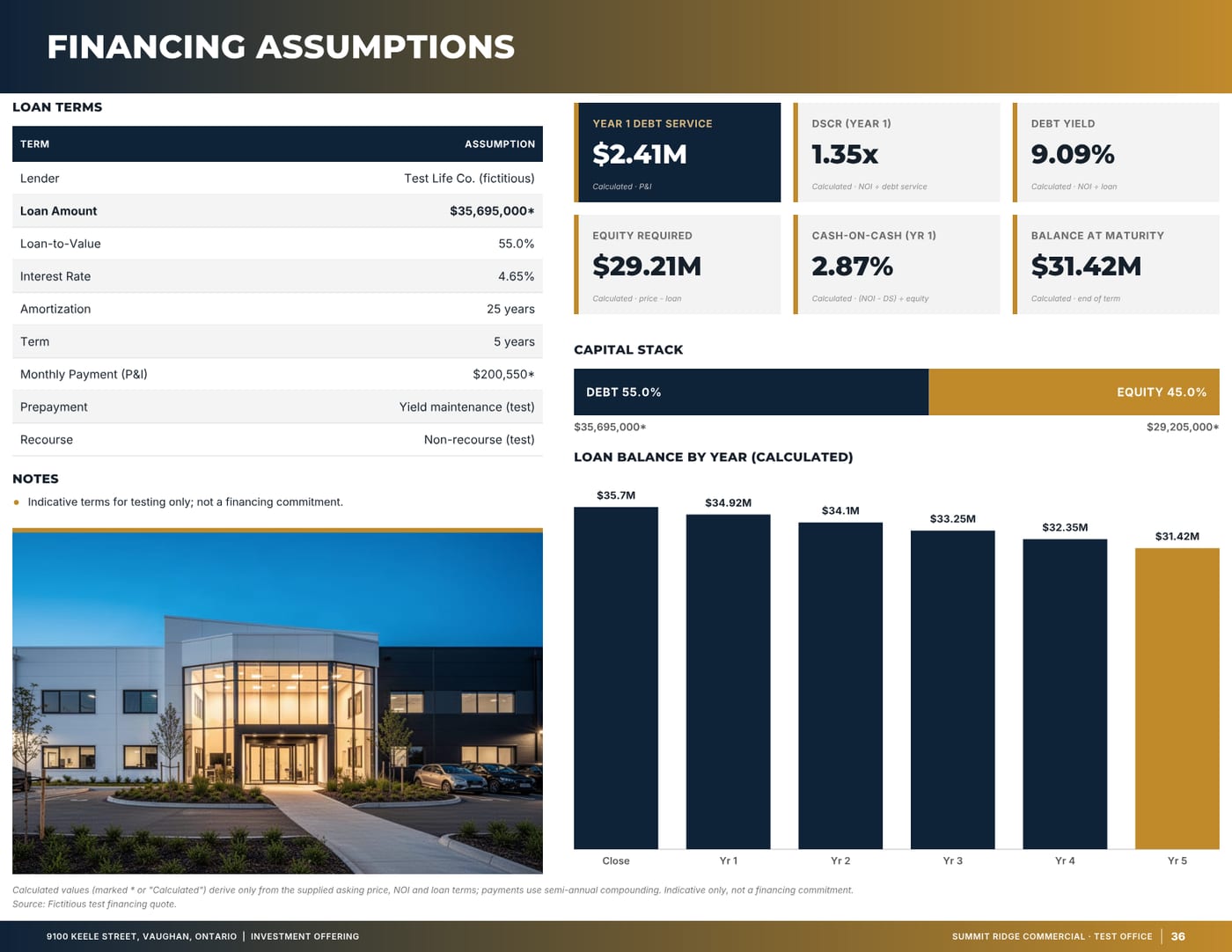
Sample pages are generated by the product from a fictitious test listing (9100 Keele Street, "Summit Ridge Commercial" test brand). Figures marked (test) are not real.

Related
Last updated 2026-10-14. General information for commercial real estate professionals, not legal advice.
Start with the fact sheet you already have.
Upload it, answer only what’s missing for the output you choose, and review a watermarked preview before you buy anything.