Offering memorandum
The offering process in commercial real estate: call for offers, offer dates and how to run them
How a commercial property sale is run: open listing vs call for offers, the timetable, what the offering process page should say, and avoiding disputes.
Why the process matters as much as the price
Two identical buildings can trade at different prices because of how they were taken to market. A clear, well-run offering process gives every serious buyer the same information, the same deadline and the same rules, which is what creates competition. A vague one invites buyers to wait, to negotiate one at a time, or to drop out because they cannot tell whether they are being taken seriously.
The process also protects the listing brokerage. Sellers, buyers and co-operating brokers all want to know in advance how offers will be received, compared and answered. Writing that down, and following it, is the simplest way to avoid disputes after the fact.
The main ways to sell a commercial property
Most sales fall into one of a few patterns. The choice depends on the asset, the depth of the buyer pool, the seller’s timing and how confident everyone is about price.
- Priced listing, offers any time: an asking price is published and offers are reviewed as they arrive. Common for smaller user buildings, condominium units and properties with an obvious buyer profile.
- Call for offers on a set date: the property is marketed for a fixed period, then offers are received together on an offer date. Often used for investment properties and land where the market will set the price.
- Unpriced offering with pricing guidance: no asking price, but the brokerage gives verbal or written guidance to qualified buyers. Usually combined with an offer date.
- Two-round process: a first round of non-binding expressions of interest or letters of intent, then a shortlist invited to submit final offers. Used on larger or more complex assets.
- Off-market or limited marketing: a small number of selected buyers are approached privately. Faster and quieter, at the cost of less competition.
Whichever you choose, say so plainly in the marketing. Buyers deal with many listings at once and plan their underwriting around your dates.
Building the timetable
A call for offers needs enough time for buyers to tour, read the offering memorandum, review the data room and get internal or lender approval to bid. Too short and serious buyers sit out; too long and momentum fades. Work back from the offer date and write each step down.
- Launch: teaser and email blast out, listing live, confidentiality agreement available.
- Information release: OM and data room access for parties who have signed the CA.
- Tours: set tour days, or tours by appointment, especially for occupied buildings where tenants need notice.
- Questions: a cut-off date for questions, with answers shared with all registered parties.
- Offer date: the date, time and time zone offers are due, and how they must be delivered.
- Selection and negotiation: when the seller expects to respond and how a shortlist or second round would work.
- Conditional period and closing: the expected due-diligence period and closing window, if the seller has a view.
Put the same dates in every document. A teaser that says one offer date and an OM that says another is a common, avoidable error.
What the offering process page should say
In an OM, the offering process page is the instruction sheet for buyers. It should be short, specific and consistent with the brokerage’s and the seller’s instructions. A typical page covers:
- How the property is offered: priced, unpriced with guidance, or on an offer date.
- What an offer must include: price, deposit structure, conditions and their length, proposed closing date, and the purchasing entity.
- The form of offer: the agreement of purchase and sale form the seller prefers, or a letter of intent first.
- Delivery: to whom, by what method, and by what date, time and time zone.
- Information about the buyer the seller will consider: track record, financing source, and any requirement for proof of funds.
- The seller’s rights: for example, the right to accept or reject any offer, to deal with any party, or to change the process, in the wording your brokerage uses.
- Contacts for questions, tours and data room access.
Keep legal language to what your brokerage and the seller’s lawyer have approved. The process page is not the place to invent new terms.
Fairness, disclosure and professional rules
Brokers in Canada and the United States work under provincial and state licensing rules and their own brokerage policies, and those rules affect how competing offers can be handled and disclosed. In Ontario, for example, the Trust in Real Estate Services Act, 2002 and the Real Estate Council of Ontario’s guidance set out obligations around offers and their disclosure. Rules differ by jurisdiction and change over time, so check the current requirements with your broker of record before you set the process.
Whatever the jurisdiction, the habits that prevent most complaints are simple: tell every registered buyer the same thing at the same time, record when each offer arrived, follow the published process, and document any decision to change it.
Questions, updates and the data room
During a call for offers, questions come in from many parties. Keep a single log, answer factual questions in writing, and share material answers with every party that has signed the confidentiality agreement, not only the one who asked. If a figure in the OM changes, issue an update that says what changed and why.
A data room makes this easier because there is one current set of documents. Typical contents are leases and amendments, the rent roll, operating statements for recent years, property tax bills, surveys and plans, building condition and environmental reports, and service contracts. Label each file clearly and date it.
OfferingStack’s deal room puts the OM and the documents you choose behind a confidentiality agreement: visitors sign, receive an emailed access link, see pages watermarked with their email, and can ask questions or submit offers, while you see who viewed what. See the pricing page for the current terms.
Common mistakes that cost bids
- An offer date that falls on a holiday or leaves less than a week after the data room opens.
- No stated time zone, which matters when buyers are in other provinces or states.
- Different dates or terms in the teaser, OM, email blast and listing website.
- Answering one buyer’s question privately when the answer changes how others would bid.
- Pricing guidance given verbally to some parties and not others.
- A process page that promises things the seller has not agreed to, such as a guaranteed second round.
Plan for the offer date not going to script, too. If no offer meets the seller’s expectations, decide in advance whether you will negotiate with the leading party, invite best-and-final offers, or return to the market with a priced listing, and tell the parties promptly and evenly which path you are taking. A process that ends in silence damages the next listing as well as this one.
How OfferingStack handles the process pages
The full OM can include an Offering Process page built from the steps, terms, text and offer dates you enter, a Key Dates timeline when you have two or more dates, a Frequently Asked Questions page, and a confidentiality agreement page with your own text for buyers to sign and return. Pages without data are left out rather than shown empty, and the same dates flow into every output built from the listing, so the teaser, brochure and OM agree. You review and approve every page before anything is distributed.
What these pages look like
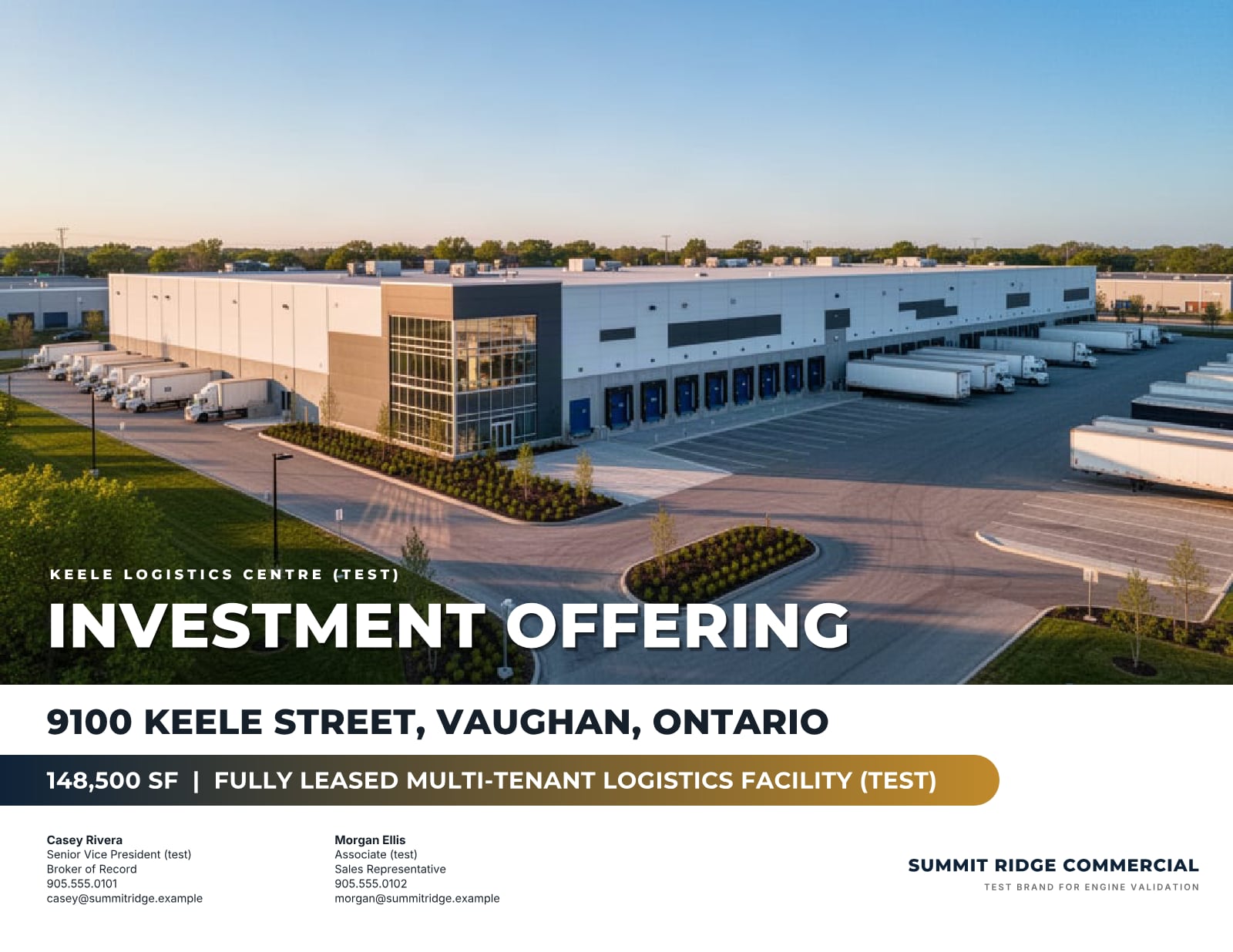
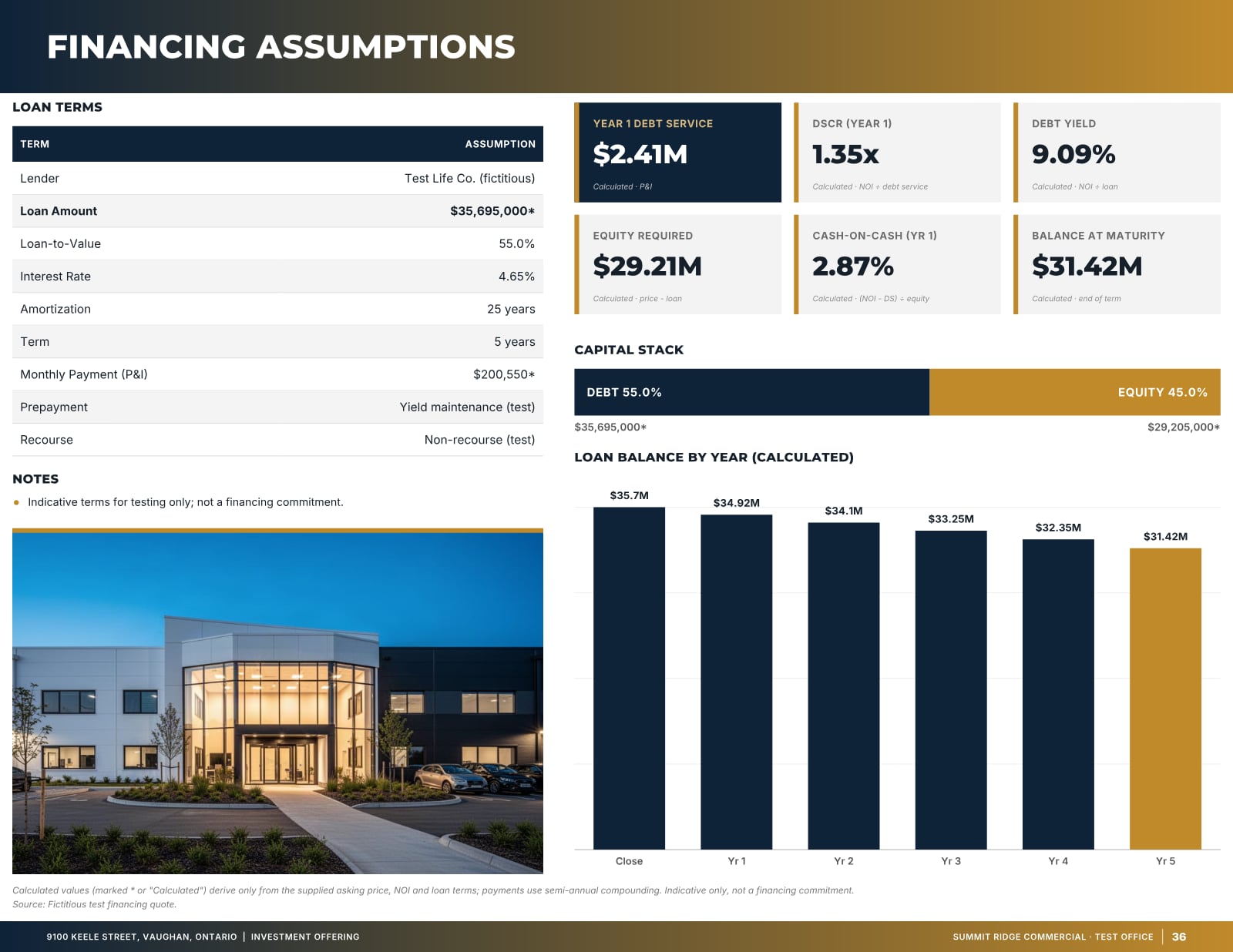
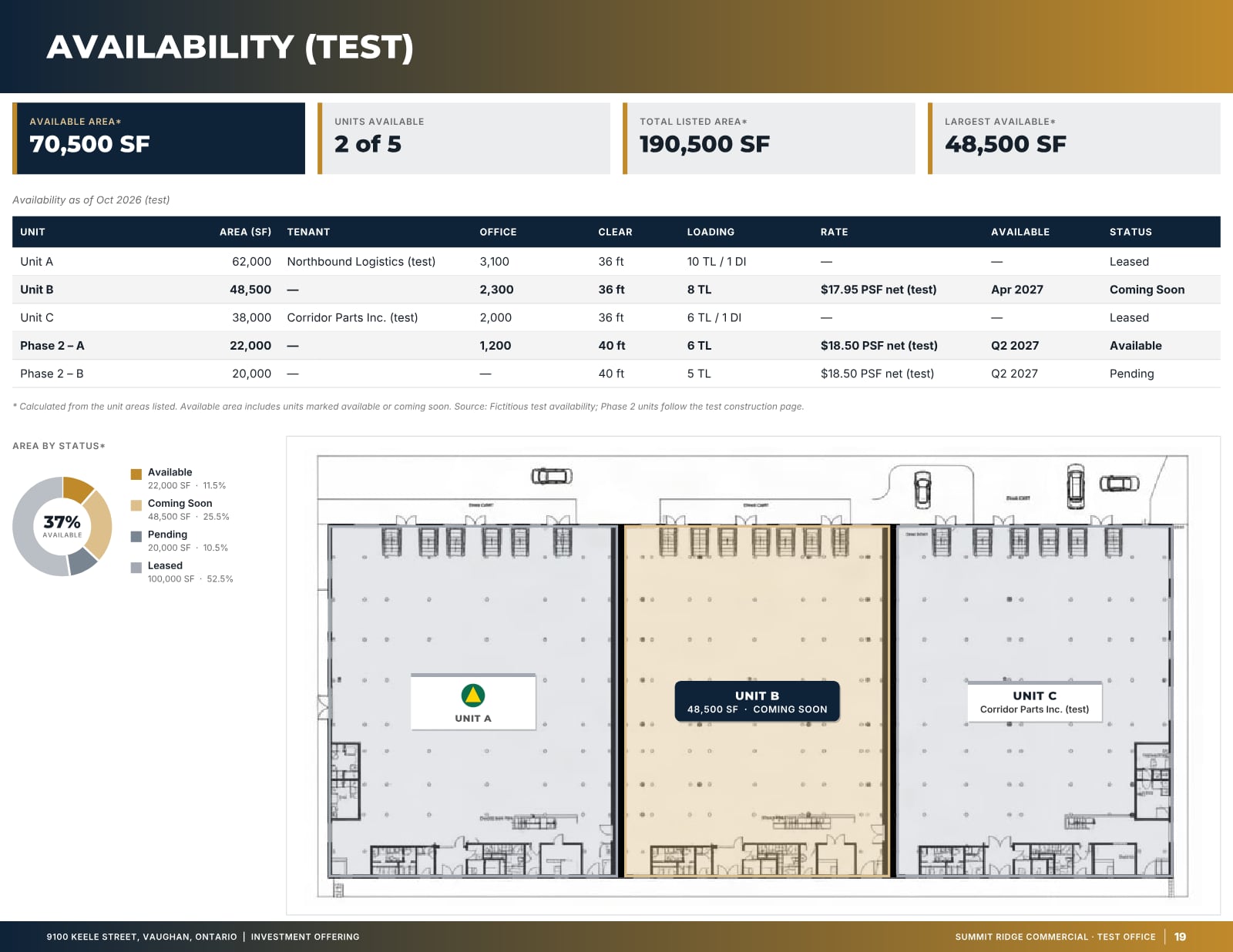
Sample pages are generated by the product from a fictitious test listing (9100 Keele Street, "Summit Ridge Commercial" test brand). Figures marked (test) are not real.
Related
Last updated 2026-10-14. General information for commercial real estate professionals, not legal advice.
Start with the fact sheet you already have.
Upload it, answer only what’s missing for the output you choose, and review a watermarked preview before you buy anything.