Template · Multifamily offering memorandum
Multifamily offering memorandum template for apartment buildings
Apartment buildings sell on a handful of numbers: how many suites of each type, what they rent for today against what they could rent for, what the building costs to run and what has been spent on it. A multifamily offering memorandum has to put those numbers in front of the buyer early, each one with its basis and date.
This template is the full OfferingStack OM with the pages an apartment buyer expects: a unit mix, a suite rent roll, an operating statement with in-place and pro forma columns, capital expenditures, pricing metrics per unit and the neighbourhood renters care about. It works for a six-plex sold to a first-time investor and for a mid-rise sold through a call for offers.
Best for
- Apartment buildings, walk-ups and mid-rise rentals for sale
- Townhouse and garden-style rental communities
- Mixed-use buildings where the residential income carries the value
What you need
- A rent roll or unit list (suite, type, size, rent)
- Operating statement or trailing 12 months of income and expenses
- Photos of the exterior, common areas, mechanical room and typical suites
Upload a fact sheet (PDF, Word, image or a phone photo of a flyer), paste its text, or start from the address. Extracted facts are marked “verify” until you accept them.
What’s inside
- Cover and executive summaryBuilding name, suite count, headline metrics and the listing team.
- Investment highlightsSpecific, checkable reasons to buy, written from your facts: rent upside, recent capital work, location.
- Unit mixOne row per suite type with count, average size, average in-place rent and market rent.
- Tenancy and rent rollSuite-level rent roll without tenant names, split across pages when it is long.
- Financial overview and 10-year cash flowIncome, vacancy, operating expenses and NOI with in-place and pro forma columns, plus a 10-year cash flow when you enter one.
- Capital expendituresRecent and planned capital work, shown when you list at least two items.
- Pricing, valuation and financingAsking price, price per unit, GRM and cap rate (calculated values labelled), a cap-rate sensitivity table and illustrative financing.
- Location, trade area and demographicsTransit, daily needs and drive times, plus population and households around the site from census tables, each with source and year.
What buyers check first
- Suite count and unit mixBachelors, one-, two- and three-bedrooms, with sizes. Price per unit means little without it.
- In-place rent against market rentThe gap is often the investment case; buyers want its source and how fast turnover can close it.
- Who pays the utilitiesHeat, hydro or electricity and water paid by the landlord change the NOI more than any other line.
- Operating expenses and NOI basisIn-place, trailing 12 months or pro forma, dated, with capital work kept out of operating costs.
- Capital work done and coming dueRoof, boiler, windows, balconies, elevators and suite renovations, with years.
- Rent rules that applyProvincial, state or city rent regulation shapes value; the OM should say what the seller understands applies.
How a multifamily OM differs from other commercial OMs
An office or industrial OM is organised around a few leases, each with its own abstract. An apartment OM is organised around many small tenancies, so the summary tables do the work: the unit mix tells the buyer what the building is, and the suite rent roll proves it. Lease abstracts are replaced by a clear statement of the rules that govern residential rent increases and turnover.
Expenses also look different. In most apartment buildings the landlord pays realty taxes, insurance, repairs, staff and often utilities directly, so the operating statement has more lines and more room for disagreement. A buyer will rebuild it line by line, which is why every figure needs a period and a source.
Rent regulation in Canada and the United States
Residential tenancy law is set by province or state, and in the US sometimes by city, and it changes over time. In Ontario most units are subject to the provincial rent increase guideline, while units first occupied for residential purposes after November 15, 2018 are exempt from it. British Columbia sets an annual allowable increase. In the United States, regimes range from no statewide limit to statewide caps such as California’s Tenant Protection Act and local rent stabilization in cities like New York.
The OM is not the place for legal advice. Say which rules the seller understands to apply to the building, how many suites are exempt or above guideline and why, and recommend that buyers confirm the position with their own counsel.
Pricing metrics apartment buyers compare
- Price per unit (per suite or door): asking price divided by the number of suites, read next to the unit mix.
- Gross rent multiplier: asking price divided by gross annual income; state whether income is in place or pro forma and before or after vacancy.
- Cap rate: NOI divided by the asking price; only as reliable as the NOI and its basis.
- Price per square foot of rentable residential area, when suite sizes are known.
Financing shapes what buyers can pay. In Canada many apartment buyers use CMHC-insured financing, including the MLI Select program, which has its own underwriting rules; in the US, agency lenders such as Fannie Mae and Freddie Mac play a similar role. If you show a loan, label it illustrative and state the rate basis, amortization and debt service coverage ratio, and leave product advice to a mortgage broker.
Location the way renters see it
For apartments, the location story is about daily life rather than highways: walking distance to transit, grocery and pharmacy, schools and parks, and the employment areas within a reasonable commute. Show them on a map with distances, and add population, households and renter figures for the surrounding area from Statistics Canada for Canadian properties or the US Census Bureau American Community Survey for US properties, with the table and year.
Building it in OfferingStack
Upload the rent roll, operating statement and photos, or start from the address. OfferingStack builds a Unit Mix page from your suite rows, a Tenancy & rent roll page, a Financial Overview with in-place and pro forma columns, a 10-year cash flow when you enter one, a Capital Expenditures page when you list at least two items, Pricing & Valuation with a cap-rate sensitivity table and Financing Assumptions. Price per unit and GRM appear as headline metrics labelled as calculated when the price, suite count and gross income are entered.
Pages without data are left out rather than shown empty, and you review and approve every page before it goes to buyers. The same property file also produces a short teaser for the first look and a brochure.
Real pages from the product
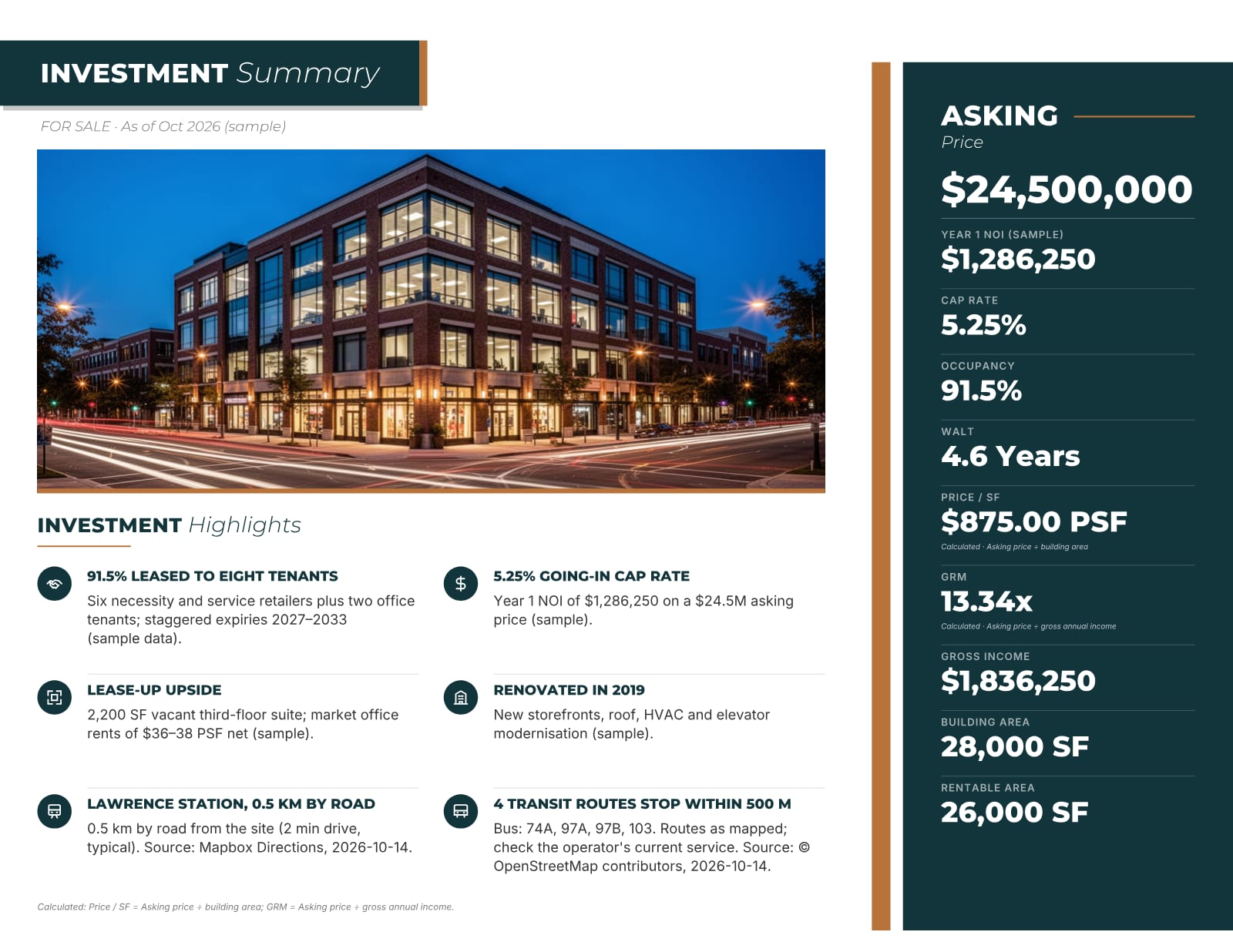
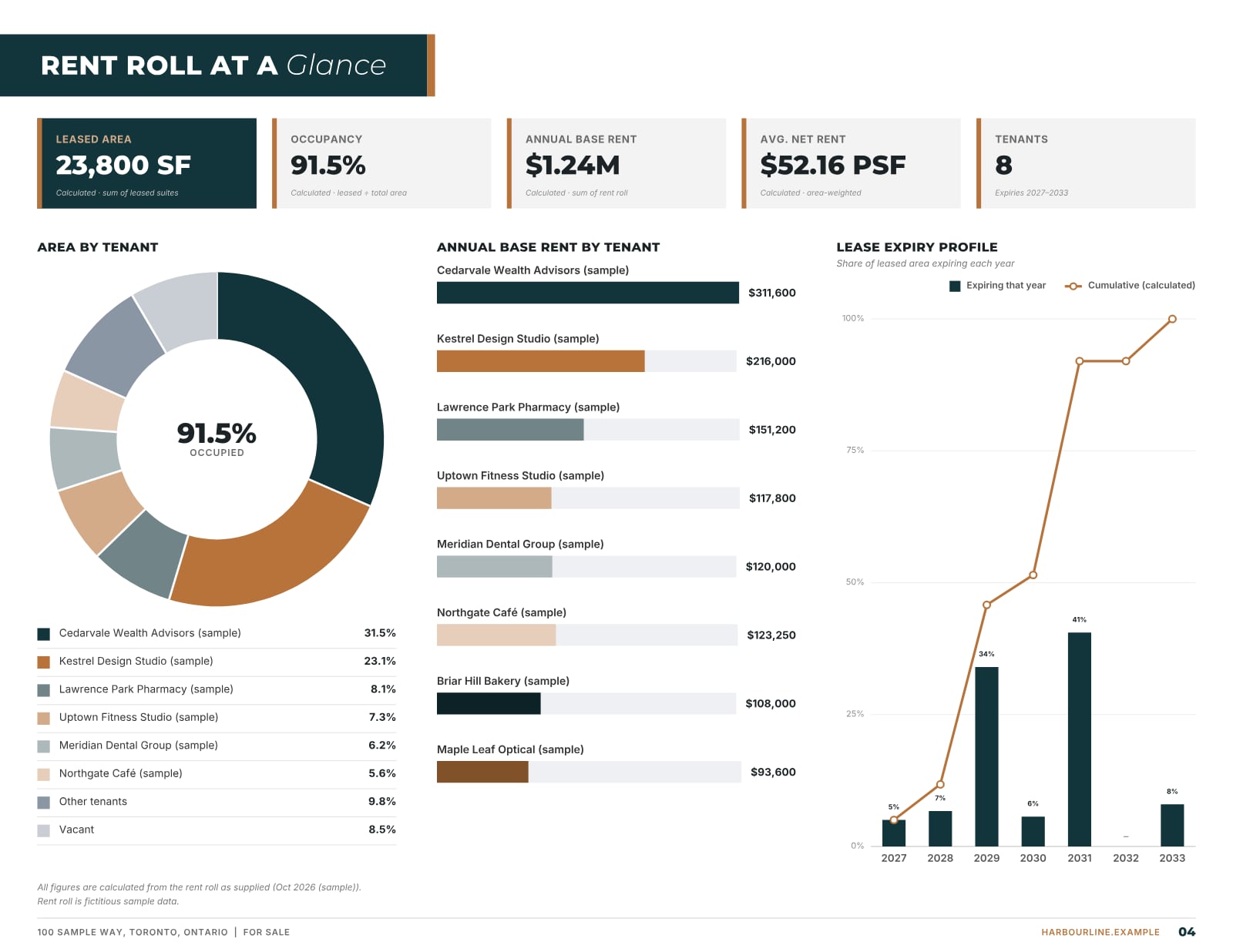
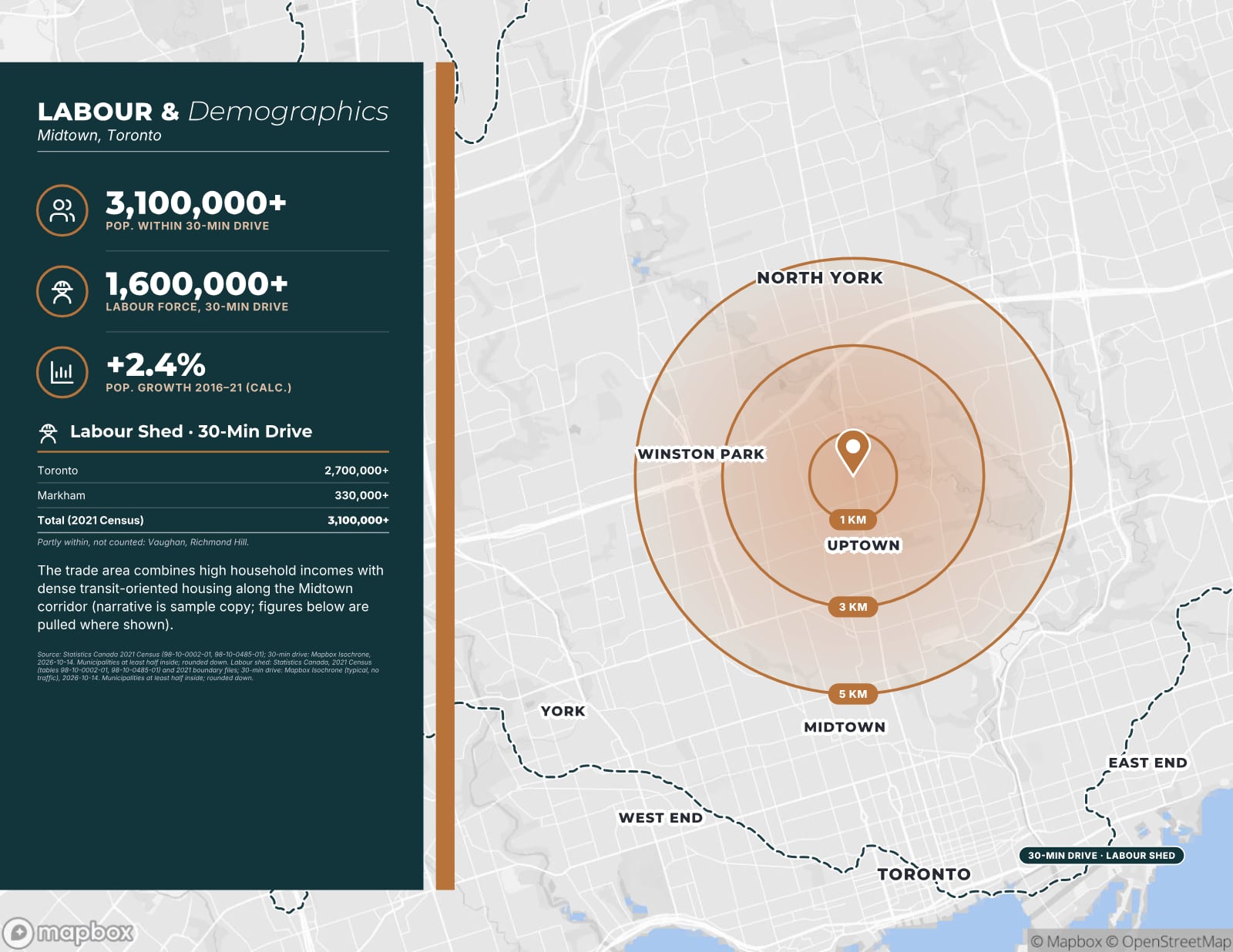
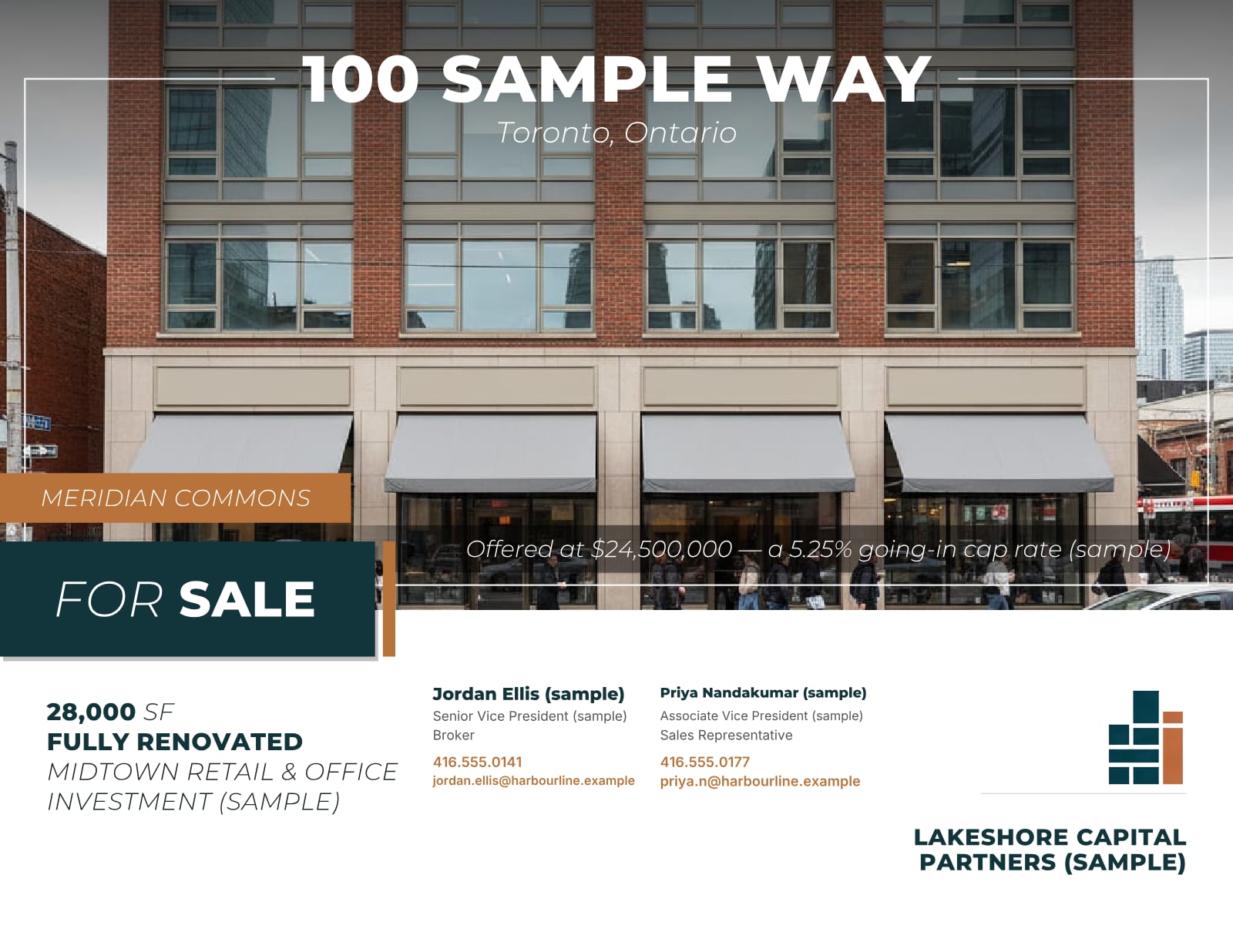
No multifamily or land sample has been rendered yet, so these pages come from the closest fictitious showcase: “Meridian Commons, 100 Sample Way”, a mixed-use sample with an invented name, address and brands. Every figure marked (sample) is not real.
See a sample for your property type
Fictitious properties, each labelled as a sample.
- MultifamilyApartment buildings and rental communitiesSample on the wayMultifamily
Questions
Can I leave tenant names out of the rent roll?
Yes. You choose the columns. Tenant names and contact details are not needed to underwrite an apartment building, so leave them out of the OM and release a fuller rent roll through your data room under the confidentiality agreement if needed.
Does it calculate price per unit and GRM?
Yes. When the asking price, suite count and gross income are entered, price per unit and the gross rent multiplier appear with the headline metrics, labelled as calculated. You can check the arithmetic with the free GRM calculator.
Can I show in-place and pro forma income side by side?
Yes. The Financial Overview page has in-place and pro forma columns. Label the basis and date of each so buyers can see which figures are achieved and which are projected.
Does it work for US apartment buildings?
Yes. Properties anywhere in Canada or the United States are supported, with figures in CAD or USD and demographics from Statistics Canada or the US Census Bureau ACS.
Is there a shorter version for the first look?
Yes. The same file produces a 4-page teaser and a brochure, so the facts match across every document you send.
Start with the fact sheet you already have.
Upload it, answer only what’s missing for the output you choose, and review a watermarked preview before you buy anything.