Free tool · no sign-up
Cash-on-cash return calculator
Cash-on-cash return is a property's annual cash flow after debt service divided by the cash the buyer invested, usually the down payment plus closing costs, shown as a percentage. Because it reflects the loan, it differs from the cap rate, and it measures only one year's cash yield, not appreciation or principal paid down.
Work out the first-year cash-on-cash return on a financed commercial property: the cash flow left after mortgage payments, divided by the cash you put in (down payment plus closing costs). Add the price to compare it with the cap rate. Amounts in Canadian or US dollars; nothing you type leaves your browser.
Results (year 1, before income tax)
- Cash-on-cash return
- 5.60%
- Cash flow after debt service
- $84,000
- Per month
- $7,000
- Cash invested
- $1,500,000
- DSCR
- 1.54×
- Cap rate on price
- 6.00%
Opens the free builder with your asking price and NOI filled in, for you to check. Your numbers leave this page only when you click.
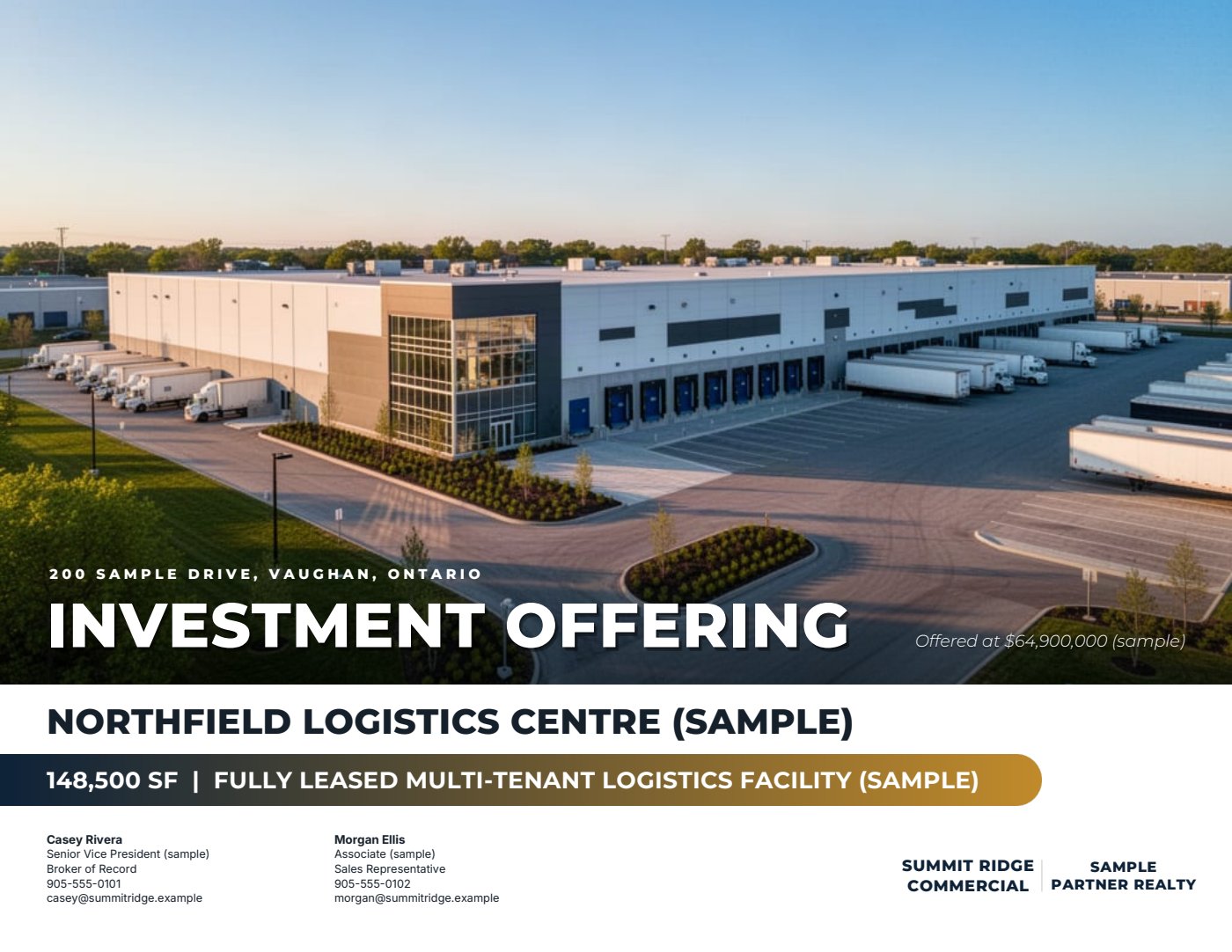 Industrial offering memorandum example
Works in Canadian or US dollars: enter every amount in the same currency. Calculated in your browser; nothing is sent or saved.
Free, no sign-up: your inputs, results and formulas in one file.
How it’s calculated
- Cash-on-cash return
Cash-on-cash = (NOI − annual debt service) ÷ cash invested × 100 - Cash invested
Cash invested = down payment + closing costs - DSCR
DSCR = NOI ÷ annual debt service
Worked examples (illustrative numbers)
- Canada: a fictitious buyer pays $4,000,000 for a small industrial building in British Columbia with a year-1 NOI of $240,000 (a 6.00% cap rate). The down payment is $1,400,000, closing costs $100,000, and the mortgage costs $156,000 a year.
- Cash flow = 240,000 − 156,000 = $84,000 ($7,000 a month). Cash invested = $1,500,000. Cash-on-cash = 84,000 ÷ 1,500,000 = 5.60%, below the 6.00% cap rate. DSCR = 1.54×.
- US: a fictitious $9,000,000 neighborhood retail center in Georgia with an NOI of $585,000 (6.50% cap rate), $402,000 of annual debt service, a $2,750,000 down payment and $250,000 of closing costs.
- Cash flow = $183,000. Cash invested = $3,000,000. Cash-on-cash = 6.10%, below the 6.50% cap rate. DSCR = 1.46×.
Illustrative figures for fictitious properties; they are not market returns, cap rates or loan terms for any property type or city.
What cash-on-cash return measures
Cash-on-cash return is the buyer's first-year yield on the cash actually invested. The cap rate tells you what the property earns on its full price; cash-on-cash tells you what the equity earns once the lender has been paid. It is the number many private buyers look at first, because it is the cash that lands in their account.
It is a one-year snapshot before income tax. It doesn't count principal paydown (which builds equity but isn't cash), future rent growth or the eventual sale, so it says nothing about the total return over a hold. The equity multiple and IRR calculators linked below cover the full hold.
Why cash-on-cash can be below the cap rate
In both examples the cash-on-cash return is lower than the cap rate. That happens whenever the loan constant (annual payments as a percentage of the loan) is higher than the cap rate: the borrowed money costs more than the property yields on it, so leverage pulls the equity's return down. This is called negative leverage. When the cap rate is above the loan constant, leverage pushes cash-on-cash above the cap rate instead. The loan constant calculator shows the comparison directly.
Closing costs matter too. Land transfer tax in Canada, transfer or recording taxes in many US states, legal fees, lender fees and due diligence all add to the cash invested and lower the return. Count every dollar the buyer has to bring to close.
Use the right figures
Use year-1 NOI on the same basis as the price (in-place or pro forma, and say which). Use the actual annual debt service: 12 monthly payments of principal and interest, or interest only if that is the loan. If the buyer must fund a capital reserve or immediate repairs at closing, add that to the cash invested.
Arithmetic only. This is not an appraisal, a valuation opinion, investment advice, a loan offer, or financial, legal or tax advice.
Showing returns in an offering memorandum
If an offering memorandum quotes a cash-on-cash return, it should show the loan assumptions behind it, and label them as illustrative unless a lender has quoted them. OfferingStack's Financing Assumptions page calculates debt service and DSCR from the loan inputs you enter, next to the Financial Overview page with the NOI.
Questions
How do you calculate cash-on-cash return?
Subtract the annual mortgage payments from the NOI to get the cash flow, then divide by the cash invested (down payment plus closing costs) and multiply by 100. $84,000 of cash flow on $1,500,000 invested is a 5.60% cash-on-cash return.
What is the difference between cash-on-cash return and cap rate?
The cap rate is NOI divided by the full price and ignores financing. Cash-on-cash is the cash flow after debt service divided by the cash the buyer invests, so it changes with the loan.
What is a good cash-on-cash return?
There is no single benchmark: it depends on the property type, the risk, the leverage and interest rates at the time. Compare it with the cap rate and with what the buyer could earn elsewhere. This calculator doesn't supply market return figures.
Does cash-on-cash include principal paydown or appreciation?
No. It only counts cash received in the year. Principal paydown and any rise in value show up in the equity multiple and IRR over the hold, not in cash-on-cash.
Should closing costs be included?
Yes, they are part of the cash the buyer invests. Leaving them out overstates the return. Include land transfer or transfer taxes, legal and lender fees, and any reserves funded at closing.
Is my data saved?
No. The calculation runs in your browser and nothing you type is sent to OfferingStack.
Related
Put the numbers in a finished offering memorandum.
Upload your fact sheet or rent roll, add the NOI and price, and review a watermarked preview of the financial and pricing pages before you buy anything.