Free tool · no sign-up
Development yield on cost calculator
Development yield on cost is a project's stabilized net operating income divided by its total project cost, including land and construction. Developers compare it with the cap rate the finished property could sell at; the difference, called the development spread, shows the margin the project earns for taking on construction and lease-up risk.
Check a development or redevelopment the way builders and lenders do: stabilized NOI divided by the all-in project cost (land, hard costs, soft costs and financing). Add the cap rate you expect at completion to see the development spread, the stabilized value and the profit on cost. Amounts in Canadian or US dollars; nothing you type leaves your browser.
Results
- Total project cost
- $21,000,000
- Cost per sq ft
- $200.00
- Yield on cost
- 6.50%
- Development spread
- 100 bps
- Value at completion
- $24,818,182
- Profit on cost
- $3,818,182
- Margin on cost
- 18.18%
Opens the free builder with your NOI and building size filled in, for you to check. Your numbers leave this page only when you click.
 Land offering memorandum example
Works in Canadian or US dollars: enter every amount in the same currency. Calculated in your browser; nothing is sent or saved.
Free, no sign-up: your inputs, results and formulas in one file.
How it’s calculated
- Yield on cost
Yield on cost = stabilized NOI ÷ total project cost × 100 - Total project cost
Total cost = land + hard costs + soft costs + financing costs - Development spread
Spread = yield on cost − cap rate at completion (in basis points) - Profit on cost
Value = NOI ÷ cap rate; profit = value − total cost; margin = profit ÷ total cost
Worked examples (illustrative numbers)
- Canada: a fictitious 105,000 sq ft industrial building in Ontario. Land $3,500,000 + hard costs $14,000,000 + soft costs $2,800,000 + financing $700,000 = $21,000,000 all-in ($200.00/sq ft). Stabilized NOI is $1,365,000.
- Yield on cost = 1,365,000 ÷ 21,000,000 = 6.50%. At an assumed 5.50% cap rate at completion the building is worth $24,818,182: a 100 bps development spread and a profit of $3,818,182, or 18.18% on cost.
- US: a fictitious 250,000 sq ft distribution building in Arizona. Land $6,000,000 + hard $31,000,000 + soft $6,200,000 + financing $1,800,000 = $45,000,000 ($180.00/sq ft). Stabilized NOI $3,150,000.
- Yield on cost = 7.00%. At an assumed 6.25% cap rate the value is $50,400,000: a 75 bps spread and a profit of $5,400,000, or 12.00% on cost.
Illustrative figures for fictitious projects; the costs, rents and cap rates are examples, not market costs, rents or cap rates for any city.
Why developers look at yield on cost
Yield on cost is the development version of the cap rate: the income the finished, leased-up property will produce, divided by everything it took to build. It tells a developer, a lender or a land buyer whether a project creates value. If a stabilized building would sell at a 5.50% cap rate and it can be built at a 6.50% yield on cost, building it creates value; if it can only be built at 5.25%, buying an existing building is cheaper.
The gap between the two is the development spread, usually quoted in basis points (100 bps = 1 percentage point). Developers want a spread wide enough to pay for construction risk, lease-up risk and the time the money is tied up; how wide depends on the project and the market, so this calculator doesn't set one.
What goes into total project cost
Count every dollar to reach stabilization: land and its closing costs (including land transfer tax in Canada or transfer taxes in many US states); hard costs (site work, building, tenant improvements); soft costs (design, permits, development charges or impact fees, legal, leasing commissions, marketing, insurance, property taxes during construction, contingency); and financing costs (lender fees and construction interest). Missing soft or financing costs is the most common way a yield on cost gets overstated.
Use stabilized NOI: the NOI once the building is leased at the rents and occupancy you assume, after a vacancy allowance and the operating expenses the landlord bears. Say which rents you assumed and why.
Canada and the US
The arithmetic is the same in both countries; the cost lines differ. Canadian projects often carry municipal development charges, education development charges and parkland fees, and quote areas in square feet with site plans in square metres. US projects carry impact fees and, in some places, transfer taxes on the land. Price per buildable square foot and FSI/FAR calculators linked below help with the land side.
Arithmetic only. This is not an appraisal, a valuation opinion, a feasibility study, investment advice, or financial, legal or tax advice.
Presenting a development site
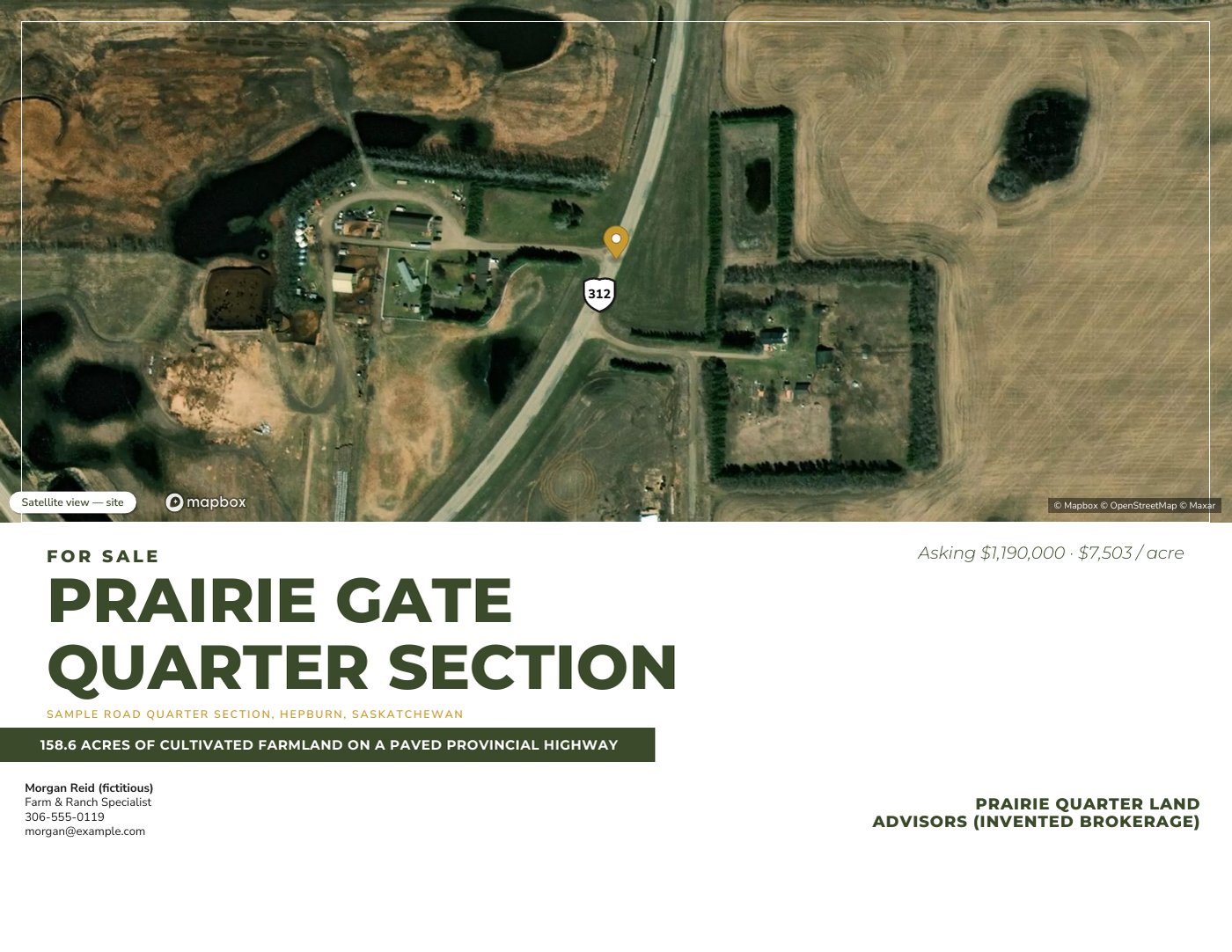
A land or development-site listing helps buyers run their own yield on cost when it gives the site area, zoning and permitted density, servicing, and any approvals in place, rather than a projected return. OfferingStack's land and development-site brochure lays out those facts with site plans and location maps, and leaves out any page without data.
Questions
How do you calculate yield on cost?
Divide the stabilized net operating income by the total project cost (land, hard, soft and financing costs) and multiply by 100. $1,365,000 of NOI on a $21,000,000 project is a 6.50% yield on cost.
What is a development spread?
The difference between the yield on cost and the cap rate the finished property would sell at, usually in basis points. A 6.50% yield on cost against a 5.50% cap rate is a 100 bps spread.
What is a good yield on cost?
There is no single benchmark. What matters is the spread over the cap rate a stabilized building of the same type would trade at in that market, and whether it pays for the project's risks and time. This calculator doesn't supply market cap rates or target spreads.
What is the difference between yield on cost and cap rate?
The cap rate divides NOI by a purchase price or market value. Yield on cost divides the NOI by what the project cost to build, including land. Comparing the two shows whether building creates value.
Should financing costs be included in total cost?
Yes. Construction interest and lender fees are part of what it costs to deliver the building. Leaving them out overstates the yield on cost.
Is my data saved?
No. The calculation runs in your browser and nothing you type is sent to OfferingStack.
Related
Put the numbers in a finished offering memorandum.
Upload your fact sheet or rent roll, add the NOI and price, and review a watermarked preview of the financial and pricing pages before you buy anything.