CRE marketing guide
Financing assumptions in an offering memorandum: assumable debt, new loans, DSCR and debt yield
What a financing page in an OM should show for assumable debt or a new loan, how to calculate debt service, DSCR and debt yield, and what to avoid.
Why an OM has a financing page
Most commercial buyers borrow, so the first question after “what does it earn?” is often “what can I borrow against it, and what does that leave me?”. A financing page answers that question in the vendor’s terms: either by describing an existing loan the buyer may be able to assume, or by showing illustrative terms for new financing. Either way it helps a buyer judge quickly whether the deal works for them, before their own lender has looked at it.
The page is optional. Many OMs leave financing entirely to the buyer, particularly for properties where buyers will use very different capital structures. Include it when there is something specific to say: assumable debt with terms better or worse than the market, a lender who has expressed interest, or a property type where buyers routinely ask about leverage.
Two cases: assumable debt or new financing
Existing debt a buyer may assume
If the property has a mortgage that can be assumed, the buyer needs its terms in full: lender, outstanding balance and the date it was measured, interest rate and whether it is fixed or floating, amortization remaining, maturity date, monthly payment, prepayment terms, and what the lender requires to approve an assumption (fees, a new guarantor, financial statements). Assumable debt can add value or take it away, so state the facts and let the buyer judge. Confirm every figure against the loan documents or a lender statement.
Illustrative new financing
If there is no assumable debt, the page can show what a typical loan might look like: a loan-to-value ratio, an interest rate, an amortization period and a term. Label these as illustrative assumptions, not a commitment or a quote, and date them; rates change, and a page that looked reasonable when it was written can be misleading a month later. If a lender has provided indicative terms in writing, you can name the lender and say that, with their permission.
The figures to calculate
From the loan terms and the property’s net operating income, a financing page usually shows:
- Loan amount, from a stated loan-to-value ratio and the asking price, or the actual balance for assumable debt.
- Equity required: price minus the loan, before closing costs.
- Monthly payment and annual debt service, from the rate, the amortization period and the compounding convention.
- Debt service coverage ratio: net operating income divided by annual debt service. Lenders set minimums by property type and market.
- Debt yield: net operating income divided by the loan amount, a measure many lenders use alongside the coverage ratio.
- Cash-on-cash return: net operating income minus debt service, divided by the equity.
- Loan balance by year and at maturity, so a buyer can see the refinancing amount.
Every one of these is calculated from inputs, so label them as calculated and show the inputs on the same page. If interest-only months are part of the loan, show the first-year debt service with the interest-only period and say when amortizing payments begin.
Canadian compounding: semi-annual, not monthly
In Canada, fixed-rate mortgage rates are commonly quoted compounded semi-annually, not monthly. On the same quoted rate, semi-annual compounding produces a slightly lower effective monthly rate and a slightly lower payment than monthly compounding. US commercial loans are usually quoted with monthly payments on a monthly rate. A financing page should state which convention it uses, and the payment should be calculated accordingly; using the wrong one is a small error that experienced buyers notice immediately.
Insured multi-unit residential financing in Canada, such as CMHC-insured loans, and agency loans in the United States have their own terms and eligibility rules. If you mention them, describe them in general terms and point buyers to a lender or mortgage broker for current terms rather than quoting rates.
Use the right net operating income
The coverage ratio and debt yield are only as good as the net operating income behind them. Use the same figure the rest of the OM uses, and say which one it is: in-place, trailing twelve months, or stabilized. If the price is based on a stabilized figure, show the coverage on in-place income as well, because that is closer to what a lender will underwrite on day one. Lenders also often deduct reserves or a management fee the vendor does not pay; a note that the buyer’s lender will apply its own underwriting is worth including.
Where it sits in the OM
Place the financing page after the operating statement and any cash flow projection, and before pricing and the offering process, so the reader already knows the net operating income it relies on. In a shorter brochure, a single line under the price, such as “assumable first mortgage, terms available after signing a confidentiality agreement”, usually works better than a full page. Keep the details of an existing loan out of public material: the lender, the balance and the rate of a vendor’s mortgage are normally confidential and belong in the OM or the data room, shared with buyers who have signed.
Presenting it on the page
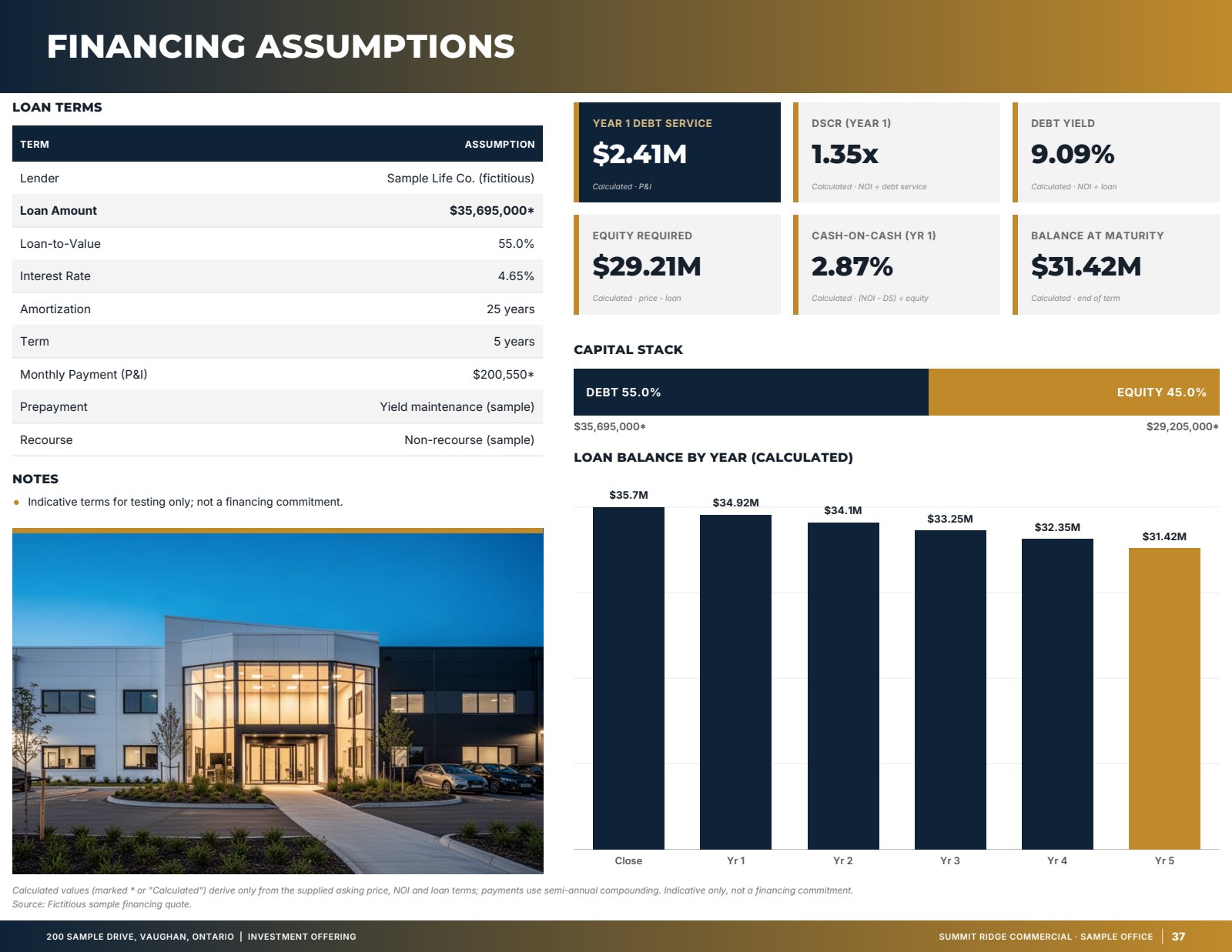
Keep the financing page short and visual. A small table of the loan terms, a few tiles for the key results (debt service, coverage ratio, debt yield, equity), a simple bar or stack showing debt and equity against the price, and a line chart or table of the balance by year are usually enough. Put the date, the source of the terms and the word “illustrative” where they cannot be missed. Avoid filling the page with lending commentary; buyers want the numbers and their basis.
What to avoid
- Presenting an illustrative rate as available to every buyer.
- Quoting “current market rates” without a date and a source.
- Mixing a stabilized net operating income into coverage figures without saying so.
- Leaving out prepayment penalties or assumption conditions on existing debt.
- Calculating a Canadian mortgage payment with monthly compounding, or the reverse.
- Advising buyers on what loan to take. Describe the terms and leave advice to their lender.
Adding a financing page with OfferingStack
In the OfferingStack builder you enter the loan amount or the loan-to-value ratio (the other is calculated from the asking price), the interest rate, the amortization period, the term, any interest-only years and whether the rate compounds monthly or semi-annually, plus an optional lender name, up to ten extra terms, short notes and a source.
The page then calculates the payment, the annual and first-year debt service, the equity, the debt service coverage ratio and debt yield from the document’s net operating income, the cash-on-cash return and the loan balance by year to maturity, and labels each one as calculated. Figures that cannot be calculated because an input is missing are left out rather than guessed. You can see a real financing page from a fictitious sample property on the samples page, and the free mortgage and DSCR calculator uses the same compounding conventions.
Financing page checklist
- Assumable or illustrative: said plainly at the top.
- Every term dated and sourced; existing debt checked against the loan documents.
- Compounding convention stated and used in the payment.
- Net operating income basis named and consistent with the rest of the OM.
- Debt service, coverage, debt yield and equity labelled as calculated, with inputs shown.
- Prepayment and assumption conditions included for existing debt.
- No advice on which loan to take; the buyer’s lender decides.
What these pages look like
Sample — fictitious property. Pages generated by the product for an invented sample listing with an invented brokerage brand. Figures marked (sample) are not real.

Related
Last updated 2026-10-17. General information for commercial real estate professionals, not legal advice.
Start with the fact sheet you already have.
Upload it, answer only what’s missing for the output you choose, and review a watermarked preview before you buy anything.