CRE marketing guide
Commercial real estate listing presentation: what to put in the pitch that wins the mandate
What owners compare when they choose a listing broker, and how to build a listing pitch around an opinion of value, comparables and a marketing plan.
What a listing presentation is for
A listing presentation (also called a pitch, a proposal or a pitch book) is what a commercial broker puts in front of a property owner to win the right to sell or lease the property. It comes before the listing exists: there is no signed agreement yet, often no photography, and the owner may be talking to two or three brokerages at the same time.
Owners rarely choose on presentation design. They choose the broker who seems to understand the property best, gives the most credible view of what it will achieve, and has a clear plan for getting there. A good presentation is built to show those three things quickly, in a document the owner can keep, reread and forward to a partner, a lender or a board.
What owners compare between brokers
When an owner lines up several proposals, the same questions come up every time. Build the presentation so each one has an obvious answer:
- What is it worth, or what will it lease for? The opinion of value or rent, with the reasoning behind it.
- How do you know? The comparable sales or leases, and what they say about this property in particular.
- Who will buy or lease it? A realistic view of the buyer or tenant pool for this property type, size and location.
- How will you reach them? The documents, the listing web page, the outreach and the offering process.
- How long, and what happens if it doesn’t go to plan? A timeline and the decision points along it.
- Why you? The people who will do the work, their experience with similar properties, and how they will report back.
- What does it cost? The commission and any marketing costs, set out plainly.
Notice what is not on the list: a long history of the brokerage, generic market commentary, or every deal the firm has ever closed. Owners skim those pages. Spend the space on this property.
Start with the opinion of value or rent
The number is the first thing most owners turn to, and the part they will test hardest. Present it as a range or a recommended figure with its basis stated: the income approach on the in-place or stabilized net operating income, a price per square foot, per unit or per acre from the comparables, or replacement cost where that is relevant. If you use more than one method, show each one and how you reconcile them.
Resist the temptation to win the mandate with a high number. An owner who lists at a price the market will not support usually ends up with a stale listing and a price reduction, and the broker who promised the number is the one who has to explain it. A credible range with honest reasoning protects both of you.
An opinion of value prepared by a broker is not an appraisal. Say so on the page. Where a lender, a court or a tax authority needs a value, the owner will need a qualified appraiser, and in some jurisdictions there are rules about how brokers may present opinions of value. Check the requirements of your regulator or brokerage.
Comparables the owner can follow
Comparables are the evidence behind the number. Choose a small set of recent, genuinely similar transactions rather than every deal in the area, and explain in a line each why it is relevant and how it differs: older, larger, better located, a different tenancy. A map of the comparables next to the subject property often does more to persuade than another table.
For a lease pitch, use lease comparables in the same units the market quotes: net rent per square foot per year in most of Canada and the US for industrial, office and retail, with the additional rent or operating costs stated separately. Mixing gross and net rents without saying so is the quickest way to lose an experienced owner.
A short market snapshot, not a market report
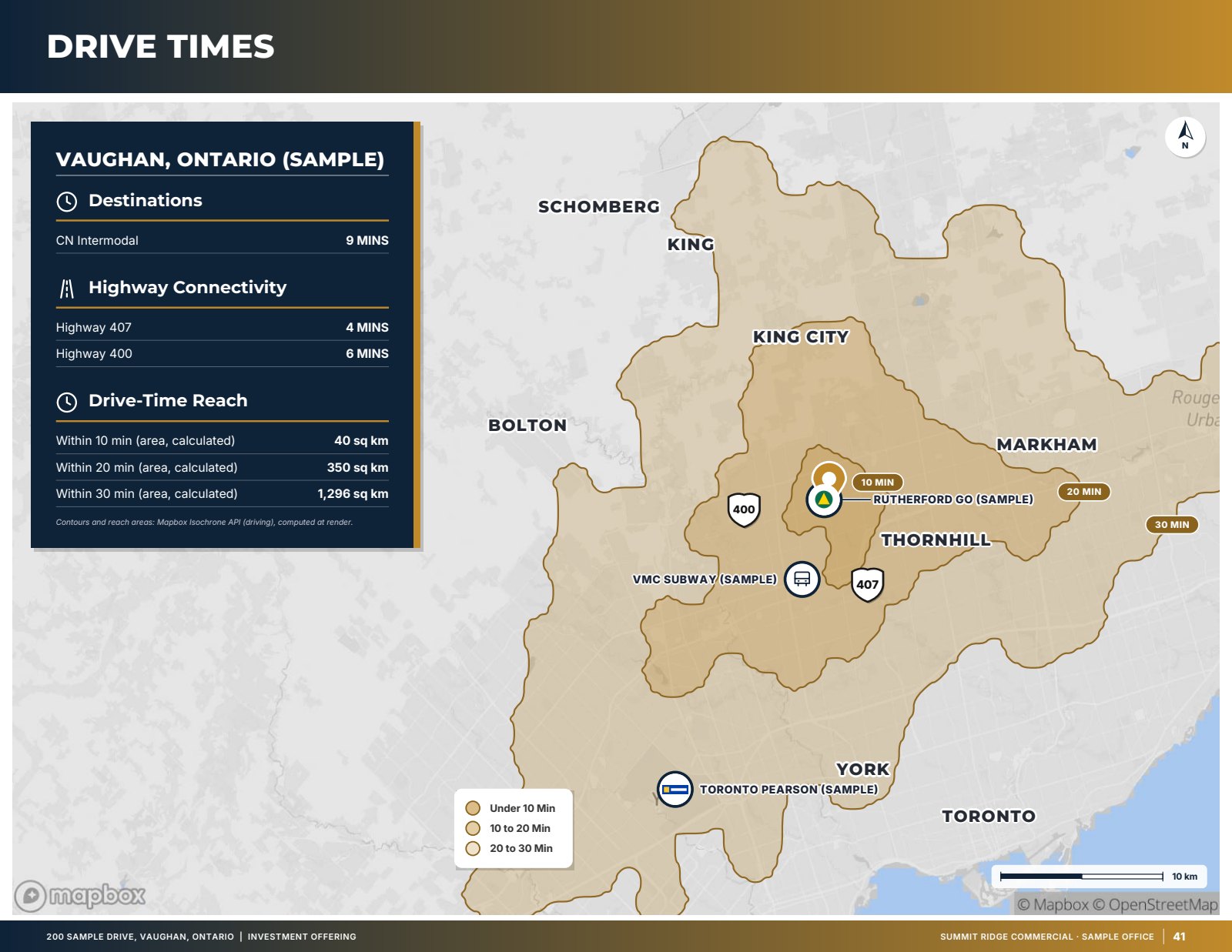
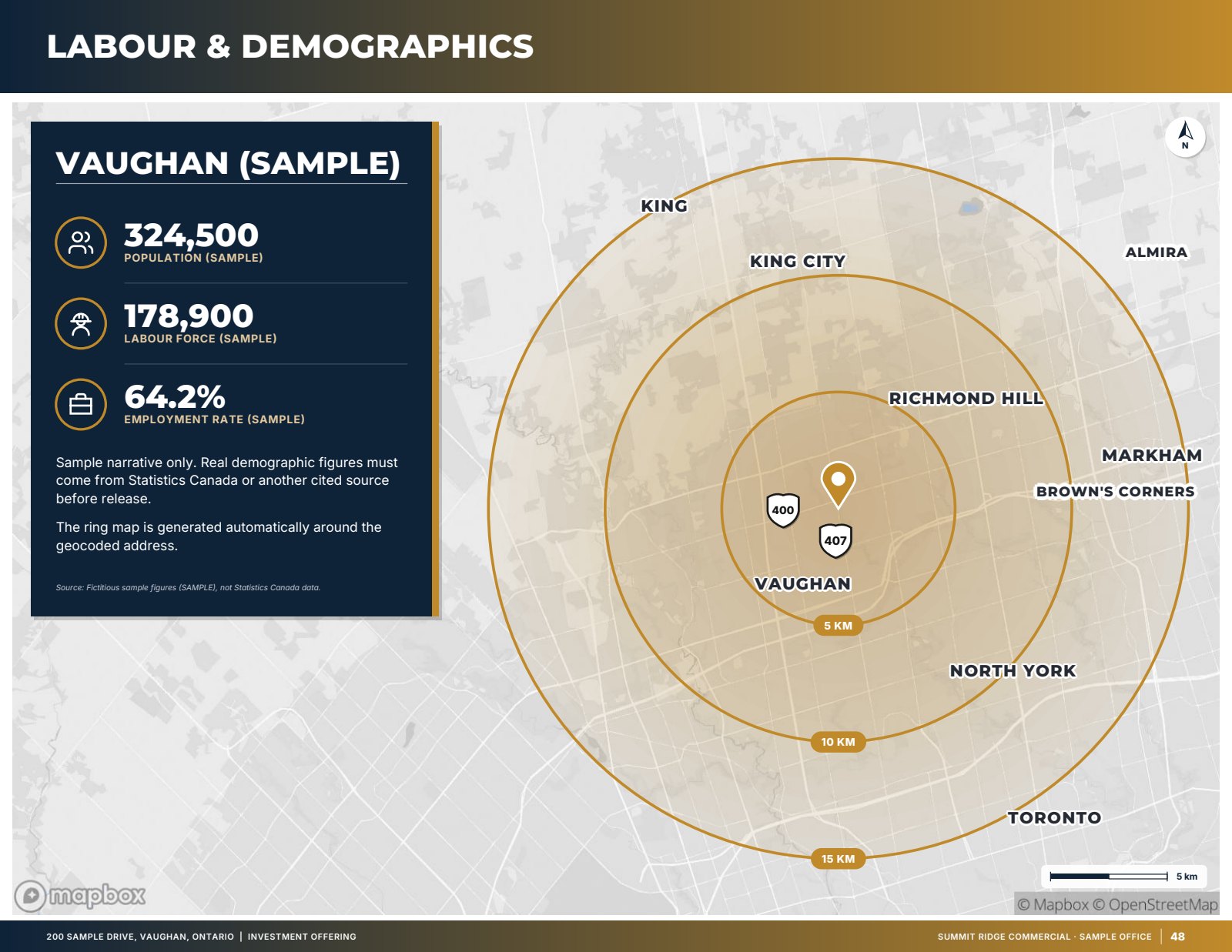
One to three pages of market context is plenty: the local market for this property type, the population and households around the site, and access, such as drive times to the highway network or the labour pool. Every figure should carry its source and date. The owner wants to see that you know the market; they do not need a regional economic report.
Tie each market page back to the property. “Industrial availability in this submarket is low” matters only if the next sentence says what that means for this building’s pricing or lease-up.
The marketing plan: show what you will produce
This is where a listing presentation becomes concrete. Instead of promising “a full marketing campaign”, list what the owner will actually get and when:
- For a sale: a short teaser for the first email to buyers and their brokers, a marketing brochure for qualified buyers and a full offering memorandum released after a confidentiality agreement.
- For a lease: a leasing brochure, a one-page availability sheet with net and additional rent, and a teaser for tenants and their brokers.
- A listing web page with photos, key facts, a map and the documents, plus signage where the property suits it.
- A deal room or data room for confidential information, with a record of who has viewed what.
- The outreach: which buyer or tenant groups you will contact, how, and in what order.
- The offering process: marketed with an asking price or unpriced with a call for offers, and the timeline for each stage.
Showing a sample of the actual documents is more convincing than describing them. If you can, include a page or two of a comparable listing you produced, with confidential details removed or with a clearly labelled sample.
Credentials that are specific
Keep the credentials section short and relevant. Name the people who will work on the listing and what each will do. Show transactions of a similar type, size or location, with permission to disclose them. Designations and memberships belong here too. Avoid unverifiable claims about market share or rankings unless you can source them, and never present someone else’s deals as your own.
Finish with the terms: the proposed commission (and how it is split with a co-operating broker), any marketing costs and who pays them, the proposed listing period, and the reporting the owner can expect during the mandate. Owners are wary of surprises later; a clear page now builds trust.
Format and length
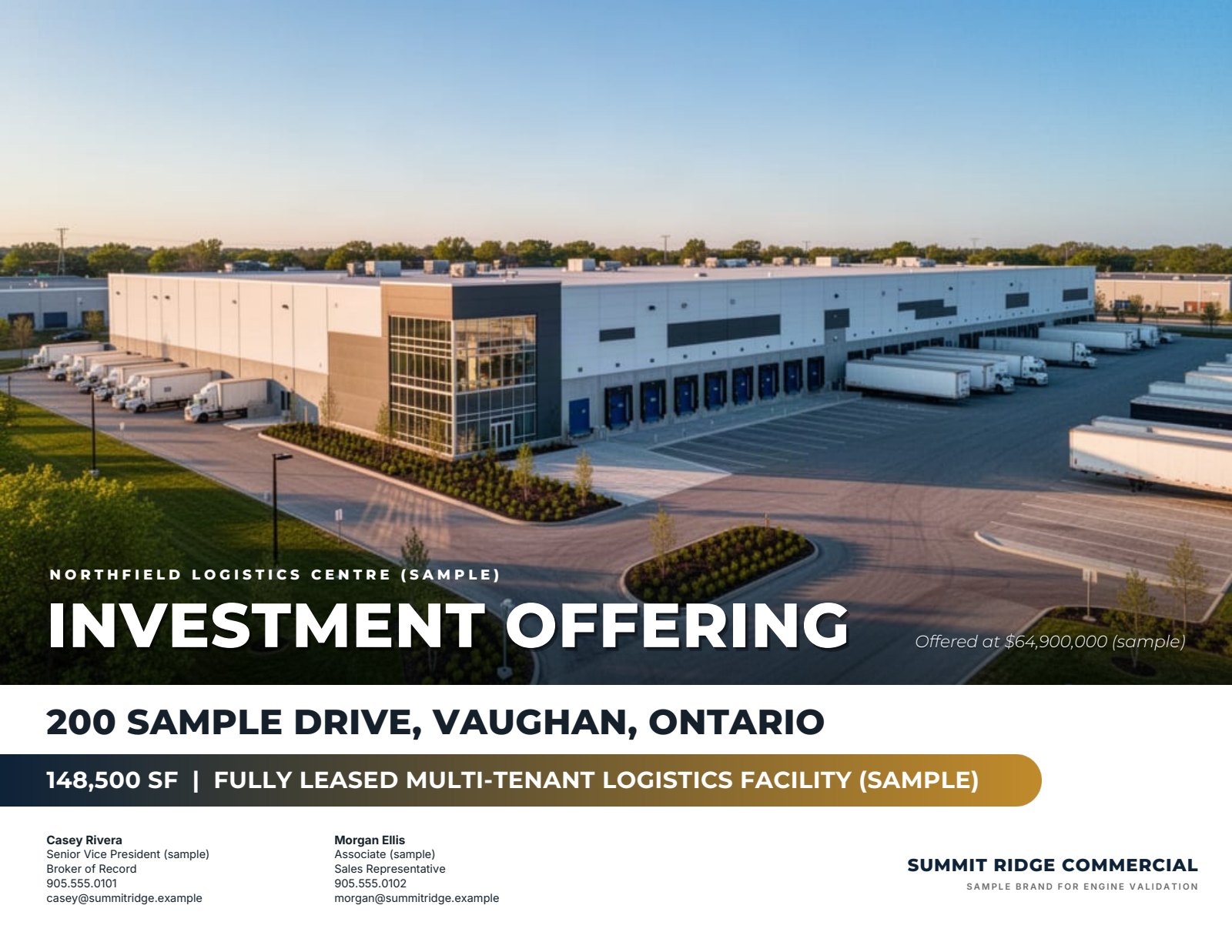
Most listing presentations run between about ten and twenty pages. Shorter is fine for a small property or an owner you know well; longer usually means padding. Landscape pages suit the maps, comparables tables and photos that make up most of the content. Use the owner’s property on the cover, not a stock image, and keep the brokerage’s branding consistent with the marketing documents you are proposing, so the presentation itself is a preview of the quality the owner will get.
Send the presentation as a PDF after the meeting, even if you presented it in person. The owner will reread it, and it is often forwarded to someone who was not in the room.
Building a listing presentation with OfferingStack
On the Professional and Team plans, OfferingStack builds a listing pitch kit: one PDF to win a mandate, assembled from the property’s broker opinion of value, so that opinion of value needs to be unlocked first. The kit re-orders those pages for the owner: a cover, your opinion of value or rent, up to four pages on the property, a comparables summary of up to three pages (the first page of each comparables table and the comparables map), a market snapshot of up to three pages, a marketing-plan page that lists what you will produce for this listing (sale or lease), your strategy, a credentials page, sources and contacts.
Nothing is invented to fill the kit. A section without data, such as comparables you have not entered yet or credentials without a broker bio, is left out and the builder tells you what to add to get it. The marketing-plan page describes the documents, listing web page and deal room you would produce once the mandate is signed; it does not contain any data about the property. You review every page before you send it.
Listing presentation checklist
- The opinion of value or rent is a range or a recommended figure with its method stated, and marked as not an appraisal.
- Each comparable has a reason to be there and a note on how it differs from the subject.
- Lease rents are quoted in the market’s units, with net and additional rent kept separate.
- Market pages are short, sourced and tied back to the property.
- The marketing plan lists real deliverables, the outreach and a timeline.
- Credentials name the team and show relevant, disclosable transactions.
- Commission, costs, listing period and reporting are set out on one page.
- The PDF is sent after the meeting, ready to be forwarded.
What these pages look like
Sample — fictitious property. Pages generated by the product for an invented sample listing with an invented brokerage brand. Figures marked (sample) are not real.
Related
Last updated 2026-10-17. General information for commercial real estate professionals, not legal advice.
Start with the fact sheet you already have.
Upload it, answer only what’s missing for the output you choose, and review a watermarked preview before you buy anything.