CRE reference
TMI, additional rent and NNN: how to present net lease terms in Canadian and US listings
What net rent, TMI, additional rent, CAM, NNN, modified gross and full-service leases mean in Canada and the US, and how to quote them.
Why lease terms cause so many misunderstandings
Two listings can show the same rent per square foot and cost a tenant very different amounts. One rent is net, with taxes, insurance and common costs billed on top; the other is gross and already includes most of them. Add the fact that Canadian and US markets use different words for similar structures, and it is easy for a tenant, a co-operating broker or a buyer reading a rent roll to compare figures that are not comparable.
A leasing brochure exists to make the cost of occupancy clear enough that a tenant can shortlist the space. That means stating what the quoted rent includes, what is extra, what the extra is estimated to be, for which year, and on what area. None of that is complicated, but it has to be said every time.
The Canadian vocabulary: net rent, TMI and additional rent
In most Canadian commercial leasing, rent is quoted as a net rent per square foot per year, plus additional rent. Additional rent is the tenant’s share of the property’s operating costs and realty taxes, and is very often called TMI, short for taxes, maintenance and insurance. You will also see it called operating costs and taxes, or CAM and taxes, depending on the market and the landlord.
- Net rent: the base rent the landlord receives, usually quoted per square foot per year and often escalating during the term.
- Additional rent or TMI: an estimate of the tenant’s share of realty taxes, insurance, and common area maintenance and management, billed monthly and reconciled after year end against actual costs.
- Gross rent: net rent plus additional rent, the figure a tenant uses to compare total occupancy cost per square foot (before utilities they pay directly and before sales tax).
- Semi-gross or gross: some or all operating costs are built into the rent. Common for smaller office suites and some retail; the lease says which costs, if any, can still be passed through.
- Absolutely net or carefree net: the tenant bears essentially every cost of the property, including structural items, as in many single-tenant investment leases.
In Canada, sales tax (GST or HST, depending on the province) usually applies to commercial rent, including additional rent. Listings commonly quote rents before tax. Our guide to HST in Ontario commercial real estate covers the wording; it is not tax advice, and the treatment of a specific lease is a question for an accountant.
The US vocabulary: NNN, NN, modified gross and full service
US leasing uses a different set of labels, organised around which of the three main property costs (real estate taxes, insurance and common area maintenance, or CAM) the tenant pays on top of base rent.
- Triple net (NNN): the tenant pays base rent plus its share of taxes, insurance and CAM. Very common for industrial and retail, and for single-tenant net lease investments. Listings often show the base rate and an estimate of the NNN charges per square foot.
- Double net (NN): taxes and insurance are passed through, while some or all maintenance stays with the landlord. Less common, and definitions vary, so spell it out.
- Modified gross: a middle ground where the rent includes some costs and the tenant pays others, often utilities and janitorial. Meaning varies by market and landlord.
- Full service gross (FSG): typical in multi-tenant office. The rent covers operating costs, often with a base year or expense stop so that increases above the base year are passed through.
- Absolute net or bondable lease: the tenant carries every cost and risk, including roof and structure.
Most US markets quote rent per square foot per year, but some markets, notably parts of California, often quote monthly rates per square foot. Commercial rent is generally not subject to a national sales tax in the US, but some states and localities tax commercial rent or gross receipts, so check the local rules before printing a figure “plus tax”.
TMI versus NNN: similar idea, different habits
A Canadian “net rent plus TMI” and a US “NNN rate plus estimated NNN charges” describe broadly the same structure: base rent to the landlord, with the property’s taxes, insurance and common costs recovered from tenants on top. The habits around them differ, and those differences are what trip up readers who work in both countries.
- Labels: Canadian listings tend to show additional rent as a single TMI figure; US listings may split it into taxes, insurance and CAM, or show one NNN estimate.
- Inclusions: management fees, structural reserves, capital repairs and utilities are treated differently from lease to lease in both countries. The label alone does not tell a tenant what is included.
- Office: in Canada, office space is commonly quoted net plus additional rent; in many US markets it is quoted full service gross with a base year. Comparing a Canadian net office rent with a US gross one without adjusting is a classic error.
- Currency and units: say whether figures are in Canadian or US dollars, and keep the area unit consistent (square feet in most commercial listings in both countries; square metres where the market or the client uses them).
If a listing will be read by people from both countries, add a short line that translates the structure, for example “net rent plus additional rent (taxes, maintenance and insurance), comparable to a triple net lease”.
How to quote lease terms in a brochure or listing
Whatever the market, the same few facts let a reader compare spaces properly. Put them in label and value rows rather than in a paragraph, and keep them identical across the brochure, the listing website, MLS or portal remarks and the email blast.
- Asking rent and its basis: net, NNN, modified gross or full service gross. Never just “$X/SF”.
- The additional rent or NNN estimate, per square foot per year (or per month, if that is the market convention), with the year of the estimate: “Additional rent (2026 est.)”.
- What the additional rent includes, in a few words: realty taxes, insurance, common area maintenance, management fee.
- The area basis: rentable or usable area, and the measurement standard if known (BOMA standards are widely used in both countries).
- Escalations, the term the landlord prefers, any free rent or tenant improvement allowance on offer, and availability date.
- The currency and a note on sales tax where it applies, for example “plus HST” in Ontario.
A calculated gross figure helps tenants, but label it as calculated and show how: “Gross rent (calculated): net rent + additional rent”. If an estimate is old or the landlord has not confirmed it, say so rather than guessing.
Lease terms in an offering memorandum
For an investment sale, buyers read the lease structure set out in the offering memorandum as risk. The rent roll should state, for each tenant, whether the lease is net or gross, how operating costs and taxes are recovered, any caps on recoveries, and any landlord obligations such as roof or structure. The operating statement then shows recoveries as income and the matching costs as expenses, so a buyer can check that the two line up.
Be precise about the vacancy and non-recoverable items. A building described as “fully net” where the landlord actually carries management fees, a capped tax recovery or the cost of vacant units will not survive due diligence, and the price will move. A short note under the rent roll, explaining the recovery structure in plain language, saves a lot of questions.
Where an OM uses US conventions for a Canadian property, or the reverse, keep the original lease wording and add the translation in brackets, so that nothing is lost when a buyer reads the leases themselves.
Common mistakes
- Quoting a net rent without saying it is net, or a gross rent without saying what it includes.
- Showing an additional rent figure from several years ago without the year.
- Mixing rentable and usable area between the brochure and the floor plan.
- Adding sales tax into some figures and not others.
- Using “NNN” for a lease where the landlord still pays significant costs, or “gross” where taxes are passed through.
- Comparing Canadian net office rents with US full service gross rents without adjusting.
Worked example (illustrative)
Suppose a unit of 10,000 square feet is offered at a net rent of $15.00 per square foot per year, with additional rent estimated at $6.50 per square foot for the current year. The calculated gross rent is $21.50 per square foot per year. Annual net rent is $150,000 and annual additional rent is about $65,000, so the tenant should budget about $215,000 a year before sales tax and utilities, or about $17,900 a month. The figures here are illustrative only, not market rents for any location.
The free commercial rent calculator does the same arithmetic for any space, adding escalations and free months and showing the total over the term, so you can check the figures you are about to print.
How OfferingStack handles lease terms
In OfferingStack you enter the net rent and the additional rent per square foot, the year of the additional rent estimate and what it includes. The pages show Net Rent and Additional Rent as provided figures, and Gross Rent as a calculated figure labelled with its formula. Figures can be in Canadian or US dollars. Operating expenses per square foot are calculated from the operating expenses and the rentable area when both are given. Anything you do not provide is left out rather than estimated, and you review every page before it is published or sent.
What these pages look like
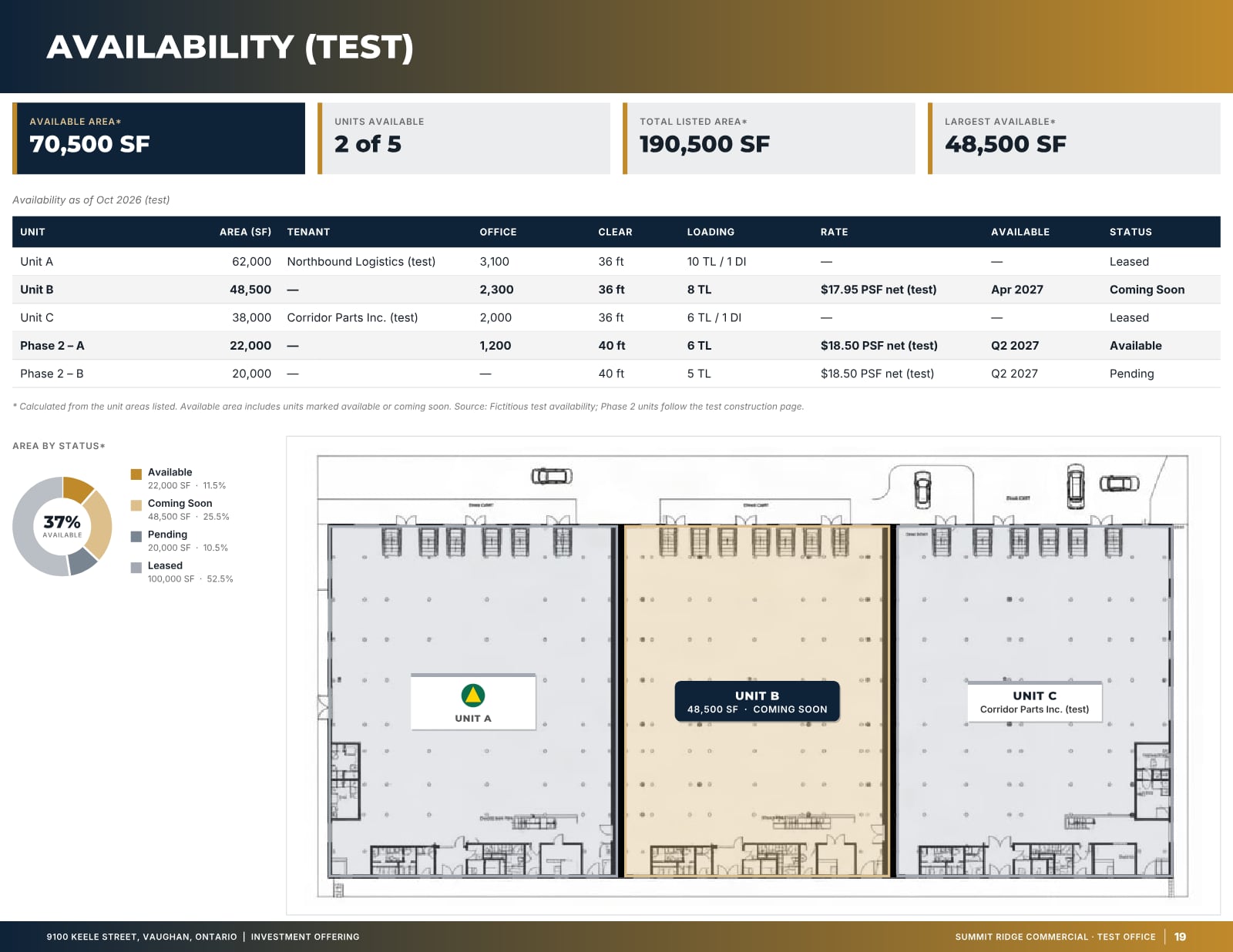
Sample pages are generated by the product from a fictitious test listing (9100 Keele Street, "Summit Ridge Commercial" test brand). Figures marked (test) are not real.

Related
Last updated 2026-10-14. General information for commercial real estate professionals, not legal advice.
Start with the fact sheet you already have.
Upload it, answer only what’s missing for the output you choose, and review a watermarked preview before you buy anything.