CRE marketing guide
Letters of intent and offers in commercial real estate: what buyers and tenants put in them, and how to compare them
What a commercial real estate letter of intent covers for a sale or lease, binding vs non-binding terms, and how listing brokers gather and compare offers.
What a letter of intent is
A letter of intent (LOI) sets out the main business terms a buyer or tenant proposes before the parties spend money on lawyers and a full agreement. In commercial real estate it is the usual first step for larger or more complex deals: the parties agree the price or rent, the timing and the key conditions in a few pages, then negotiate the agreement of purchase and sale or the lease from that base.
Terminology varies by market. In the US, LOIs are common for both sales and leases. In Canada, many deals go straight to an offer to purchase or an offer to lease on a standard or brokerage form, which is itself a binding agreement once accepted and conditions are waived; an LOI is used where the parties want to agree terms before drafting a bespoke document. Brokers on both sides should be clear which kind of document is on the table.
Binding and non-binding terms
Most LOIs say that the business terms are not binding and that no deal exists until a definitive agreement is signed. They often make a few clauses binding anyway: confidentiality, an exclusivity or “no-shop” period during which the seller or landlord will not negotiate with others, who pays which costs, and the governing law. Whether a particular LOI is binding depends on its wording and on the law where the property is, and courts have enforced documents the parties thought were non-binding. That is a question for the parties’ lawyers, not for the marketing team.
For the listing broker, the practical point is to make sure the client understands what signing back an LOI commits them to, especially an exclusivity period that takes the property off the market.
What goes in an LOI or offer for a sale
A purchase LOI or offer typically covers:
- Parties: the buyer entity (and any right to assign to a related company) and the seller.
- Property: address and legal description, and whether chattels, equipment or other assets are included.
- Price and deposit: the purchase price, the deposit amount, when it is paid and who holds it, and any additional deposit on waiver of conditions.
- Due diligence: the length of the conditional period and what the buyer needs (financing, environmental, building condition, leases and estoppel certificates, zoning, title), plus the documents the seller will deliver.
- Closing: the closing date or period after waiver, and any extension rights.
- Other terms: tenancies to be assumed, a vendor take-back mortgage or assumption of existing financing, and any conditions that are not standard.
Buyers compare offers on more than price. A slightly lower price with a larger deposit, a short due diligence period and no financing condition can be the stronger offer, because it is more likely to close. Laying offers out in a common table helps the seller see that.
What goes in an LOI or offer to lease
A lease LOI or offer to lease covers the business terms of the tenancy:
- Premises and area: the unit, the rentable area and how it was measured.
- Term and commencement: the length of the term, the commencement date, and any fixturing period before rent starts.
- Net rent and steps: the year-one net rent per square foot and how it changes during the term.
- Additional rent: the current estimate of taxes and operating costs (TMI or CAM), what it includes, and any cap the tenant asks for.
- Concessions: free rent (net only, or net and additional rent), a tenant improvement allowance, and the landlord’s work before possession.
- Options and rights: renewal and extension options, expansion or first-offer rights, signage, parking, exclusive use and assignment or subletting.
- Security and conditions: deposit, letter of credit or guarantee, and conditions such as financing, permits or board approval.
Because lease offers differ in rent, steps and concessions all at once, landlords compare them on net effective rent: the face net rent over the term less free rent, the TI allowance and leasing commissions, spread over the area and the term. A present-value version, discounting each month’s rent, rewards offers that pay more early. Our free net effective rent calculator shows both.
Collecting offers during a marketing campaign
When a listing has a call for offers or an offer date, the way offers arrive matters. Ask every party to submit on the same basis, by the same deadline, through the same channel, and say in the offering process what you need with each offer: the completed form or LOI, evidence of the buyer’s ability to close, and any material conditions. Acknowledge each offer when it arrives so no one is left wondering whether it was received.
- Publish the offer date and time zone in the brochure, on the listing website and in the data room.
- Provide a short offer summary form so the key terms come in a consistent format, even when the party also attaches its own LOI.
- Keep a log of every offer received, with the time.
- Put the offers side by side for the client: price or rent, deposit, conditions and their length, closing or commencement, and concessions.
- Answer clarifying questions in writing, and treat all parties consistently.
Rules on handling and disclosing competing offers differ by jurisdiction and by whether the property is residential or commercial. Follow your regulator’s rules and your brokerage’s policy.
Common gaps that slow a deal down
Most delays after an LOI is signed come from terms that were left vague. A few checks before the client signs back save weeks of drafting later:
- Area basis: is the rent on rentable or usable area, and has the area been measured to a named standard?
- Rent start: does net rent start at commencement, after the fixturing period, or after the free-rent months, and is free rent net only or gross?
- Additional rent: is the estimate for the current year, and are management fees, capital items or structural repairs included or capped?
- Landlord’s work: is it described clearly enough to price, with a delivery date and a remedy if it is late?
- Conditions: does each condition have a clear deadline and a clear owner, and what happens to the deposit if it is not waived?
- Assignment: can the buyer or tenant assign to a related company, and on what terms?
When the same question comes up in several offers, it usually means the marketing left it unanswered. Add the answer to the brochure, the OM or the data room so later offers arrive on a cleaner basis.
How OfferingStack handles offers
When you set an offer date in the offering process, the OfferingStack listing website shows the deadline with a countdown and an offer form. For a listing for sale the form asks for price, deposit, due diligence and closing; for a listing for lease it asks for term, year-one net rent, rent steps, free rent, TI allowance and landlord’s work; for a listing offered for sale or lease the party chooses. Either way they can attach their own letter of intent as a PDF (up to 4 MB). Offers arrive in your offer grid and by email, so you can compare them in one table.
The form collects the business terms in a consistent format; it is not a binding agreement, and the parties still negotiate and sign their own documents with their lawyers.
What these pages look like
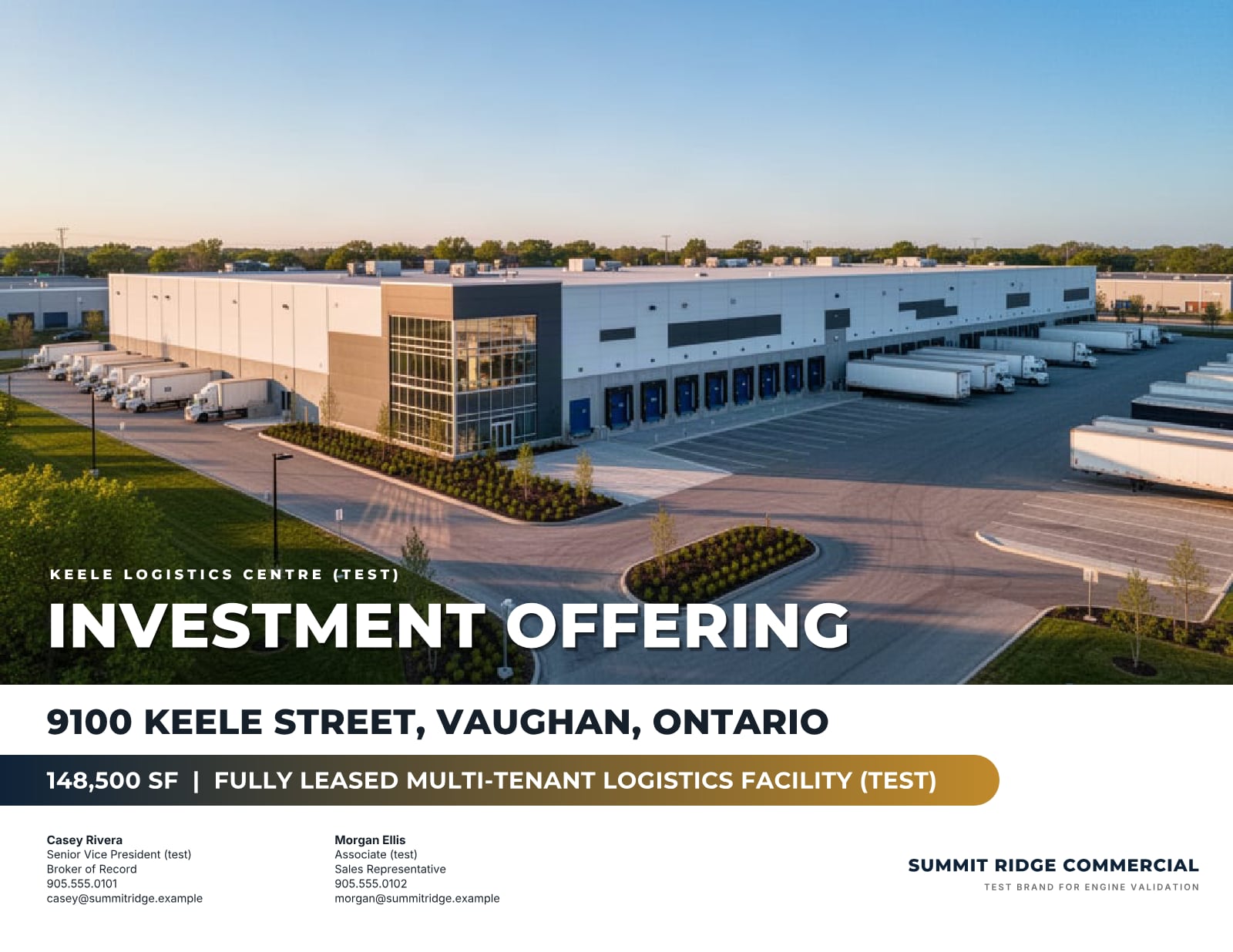
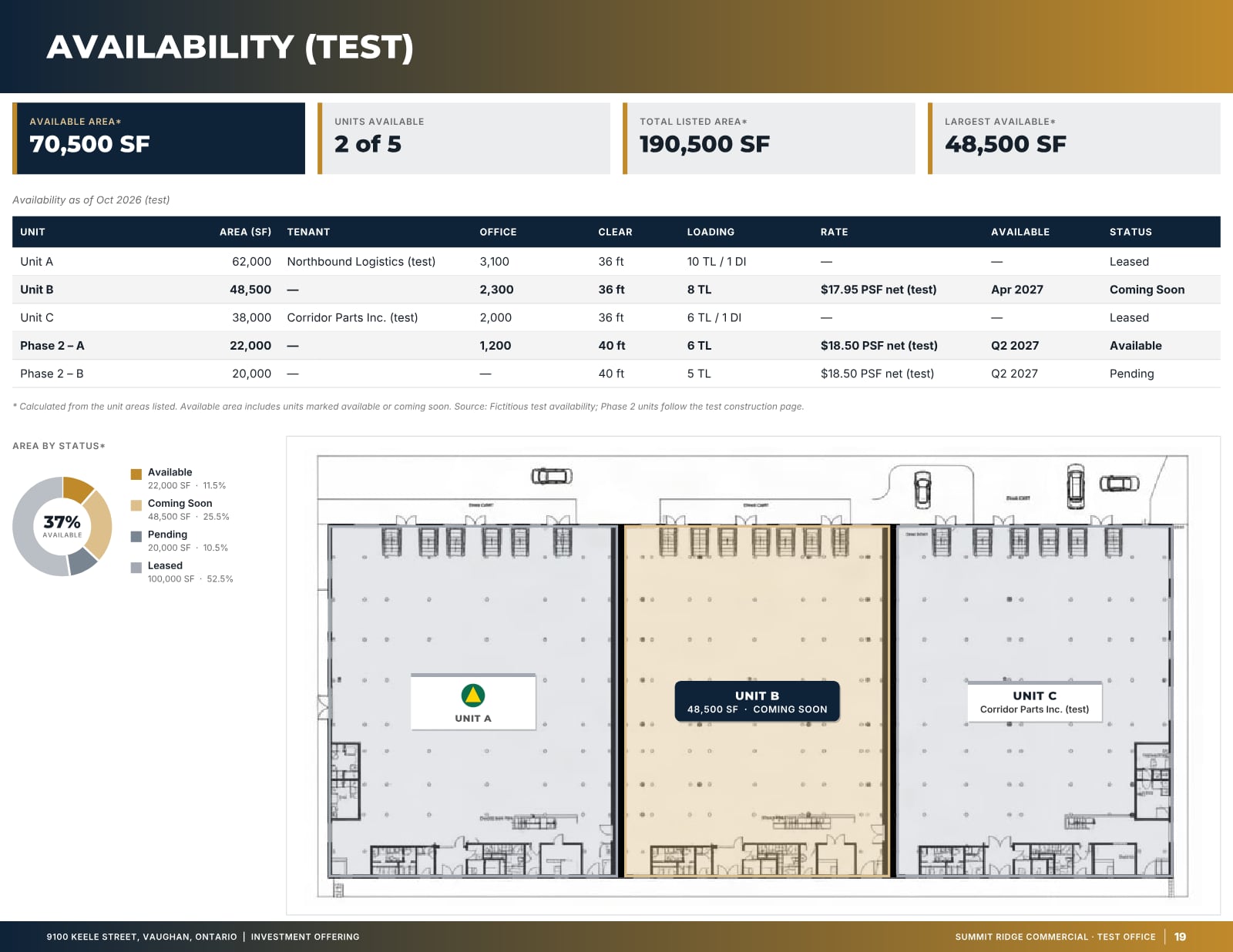
Sample pages are generated by the product from a fictitious test listing (9100 Keele Street, "Summit Ridge Commercial" test brand). Figures marked (test) are not real.
Related
Last updated 2026-10-15. General information for commercial real estate professionals, not legal advice.
Start with the fact sheet you already have.
Upload it, answer only what’s missing for the output you choose, and review a watermarked preview before you buy anything.