CRE marketing guide
Data rooms and deal rooms for commercial real estate listings: what to include and how to run one
What a CRE data room or deal room is, the documents buyers expect by asset type, how to organise and control access, and how to run Q&A before offers.
Data room, deal room, VDR: what the terms mean
A data room is the collection of source documents a buyer needs to verify what the marketing says: leases, statements, reports, surveys and title. Before the internet it was a physical room in the listing brokerage or the seller’s lawyer’s office; today it is almost always a virtual data room (VDR), a secure website where approved parties can read and sometimes download the files.
Brokers also use “deal room” for a slightly broader idea: one controlled place where qualified buyers find the offering memorandum, the supporting documents, the questions and answers, and the instructions for offers. The labels overlap. What matters is the function: release detailed information only to people who have signed the confidentiality agreement, keep a record of who saw what, and give every bidder the same information.
Where the data room sits in the offering process
On a typical sale the sequence runs from wide distribution to narrow, with more detail at each step:
- Teaser or brochure to the market, with headline facts only.
- Confidentiality agreement signed by each interested party.
- Full OM released to the parties who signed.
- Data room opened, either at the same time as the OM or once a party has toured and shown real interest.
- Questions and answers through the data room until a cut-off before the offer date.
- Offers, then a firm deal with its own due diligence period, during which the buyer may get access to further documents.
Some listing teams open everything at once to speed up the process; others hold back the most sensitive items, such as individual tenant financials, until a preferred buyer is chosen. Decide which approach the seller wants before launch and say so in the offering process, so bidders know what they will and will not see before offers are due.
The documents buyers expect
Every property is different, and the seller decides what is released, but most buyers of an income property will ask for the following. Gather them before launch; a data room that fills up during marketing invites questions about what else is missing.
Income and tenancy
- Current rent roll, dated, reconciling to the operating statement.
- Leases, amendments, renewals and assignment documents for every tenant, with lease abstracts if you have them.
- Arrears report and any tenant disputes or notices.
- Operating statements for the last two or three years and the current year to date, plus the budget.
- Recovery (TMI or CAM) reconciliations for recent years.
Property and physical condition
- Building condition assessment and roof report, if any; recent capital work with invoices.
- Environmental reports (Phase I environmental site assessment, and Phase II where one exists).
- Floor plans, site plan, survey and as-built drawings.
- Service contracts (elevators, HVAC, snow, landscaping, security) and warranties.
- Utility bills and, where the market requires it, energy or water benchmarking reports.
Legal, tax and zoning
- Title search or title summary, registered easements and agreements.
- Realty tax bills and any appeals; assessment notices.
- Zoning information, site plan agreements, permits and any outstanding work orders or compliance letters.
- Insurance summary and claims history.
Land and development sites need a different set: surveys, zoning and official plan (or comprehensive plan) designations, servicing letters, studies already done (traffic, geotechnical, environmental, archaeological where relevant), and any concept plans. Leasing listings rarely need a data room at all; a clear brochure with floor plans and the additional rent estimate usually does the job.
Organise it so buyers can find things
Analysts often work through several data rooms in the same week. A predictable structure saves them time and saves you questions.
- Number the folders in the order of the OM: 1 Offering documents, 2 Leases and tenancy, 3 Financials, 4 Physical, 5 Environmental, 6 Legal and title, 7 Zoning and municipal.
- Name files so they sort and explain themselves: “2.03 Lease – Unit 105 – Tenant name – 2021-06.pdf” beats “scan0042.pdf”.
- Keep an index listing every document with its date, so a bidder can see at a glance what is there and what was added.
- Use searchable PDFs, not phone photos of pages; combine a lease and its amendments in date order.
- When a document is replaced, say so in the index and note the date, rather than silently swapping the file.
Control access and keep a record
The confidentiality agreement is only useful if access follows it. Admit each party after their agreement is signed, give them a personal login or link rather than a shared password, and record who opened which document and when. Watermarking pages with the reader’s name or email discourages forwarding and helps trace a leak if one happens.
Decide whether downloads are allowed. Many sellers allow downloads for the core leases and financials so buyers and lenders can underwrite, but keep view-only access for the most sensitive files. Remove access promptly for parties who drop out, and close the room when the deal is firm or the listing ends.
Leases and rent rolls can contain personal information, especially for residential tenants and small businesses run by individuals. Release only what a buyer needs to evaluate the property, and follow the privacy law that applies to the brokerage and the seller (in Canada, PIPEDA or the provincial equivalent; in the US, state law). When in doubt, redact contact details and ask the seller’s lawyer.
Run the Q&A fairly
Questions from bidders are a sign of interest, and the way you answer them affects the result. Log every question with the date and the party, answer in writing, and when an answer would change how any buyer reads the offering, share the answer (without naming who asked) with every party in the room. Set a cut-off for questions a few business days before the offer date and announce it in the offering process, so late questions don’t become a reason to ask for an extension.
If a material fact changes during marketing, such as a tenant giving notice, update the documents and the OM, tell every party in the room on the same day, and keep a copy of what was sent.
How OfferingStack’s deal room works
OfferingStack includes a deal room for any listing, opened from the OM builder. Buyers enter from the listing website: they give their name, email and company, read your confidentiality text and select “I agree”, then receive a personal link by email that works for 30 days. The newest full OM (or, if there is none, the newest brochure or teaser) opens page by page in the browser, and every page is stamped with the reader’s email and the date; there is no PDF download in the room, and a broker opinion of value is never shown to buyers.
You see everyone who accepted, whether they opened the room, how many pages they read and when they last viewed it, can download the list as CSV, and can withdraw a person’s access. Buyers can ask questions at the bottom of the room; you choose which answers to share with everyone, and a shared question never shows who asked it. When you generate a newer version of the document, the room tells you it is out of date until you update it, and you can close the room at any time. The deal room is priced per room per month with a free trial; see the pricing page for the current price and plan inclusions.
It is a deal room for the marketing documents and buyer engagement, not a replacement for a full due diligence VDR with every lease and report: keep using the data room your brokerage or the seller’s lawyer prefers for those, and link to it from your offering process if needed.
What these pages look like
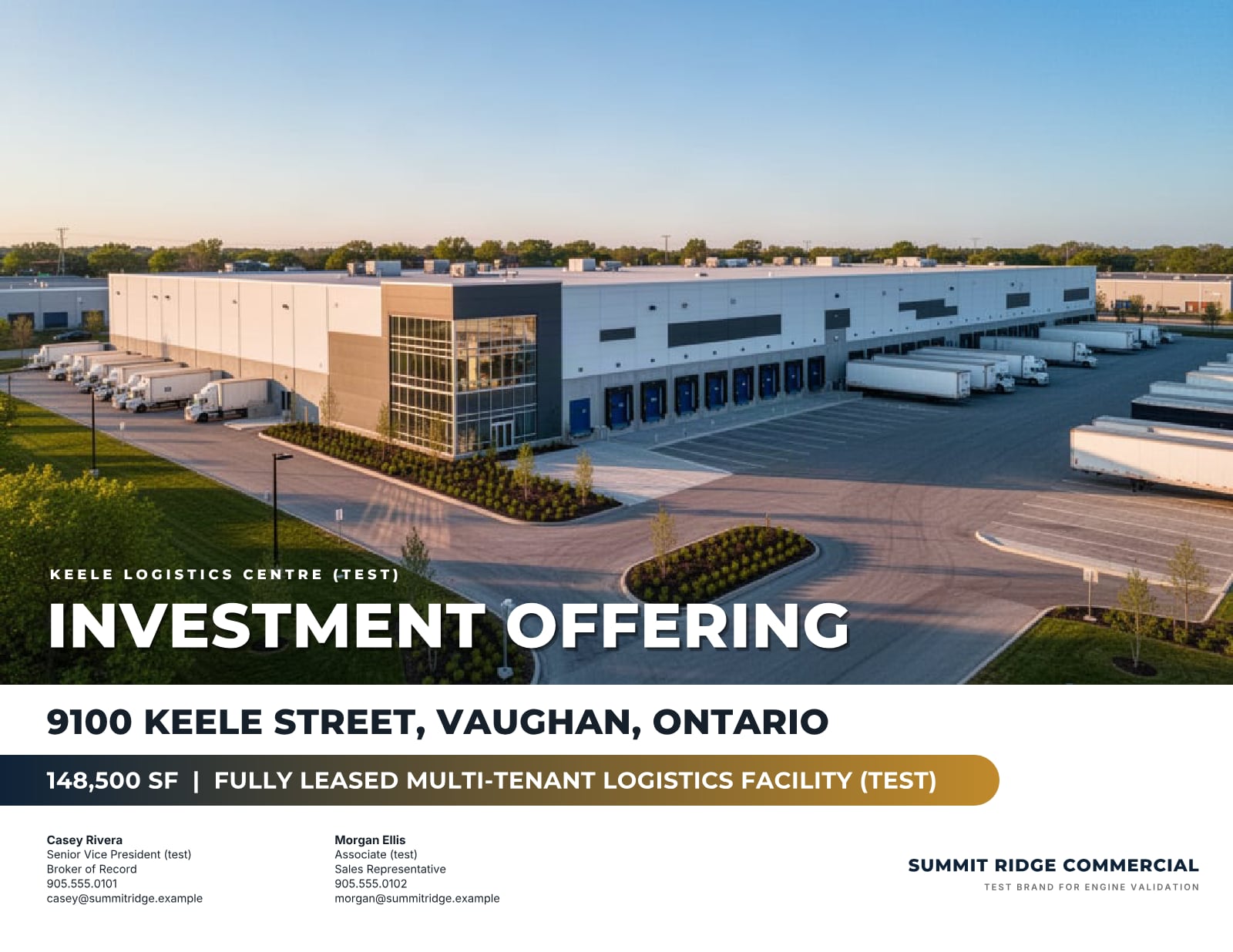
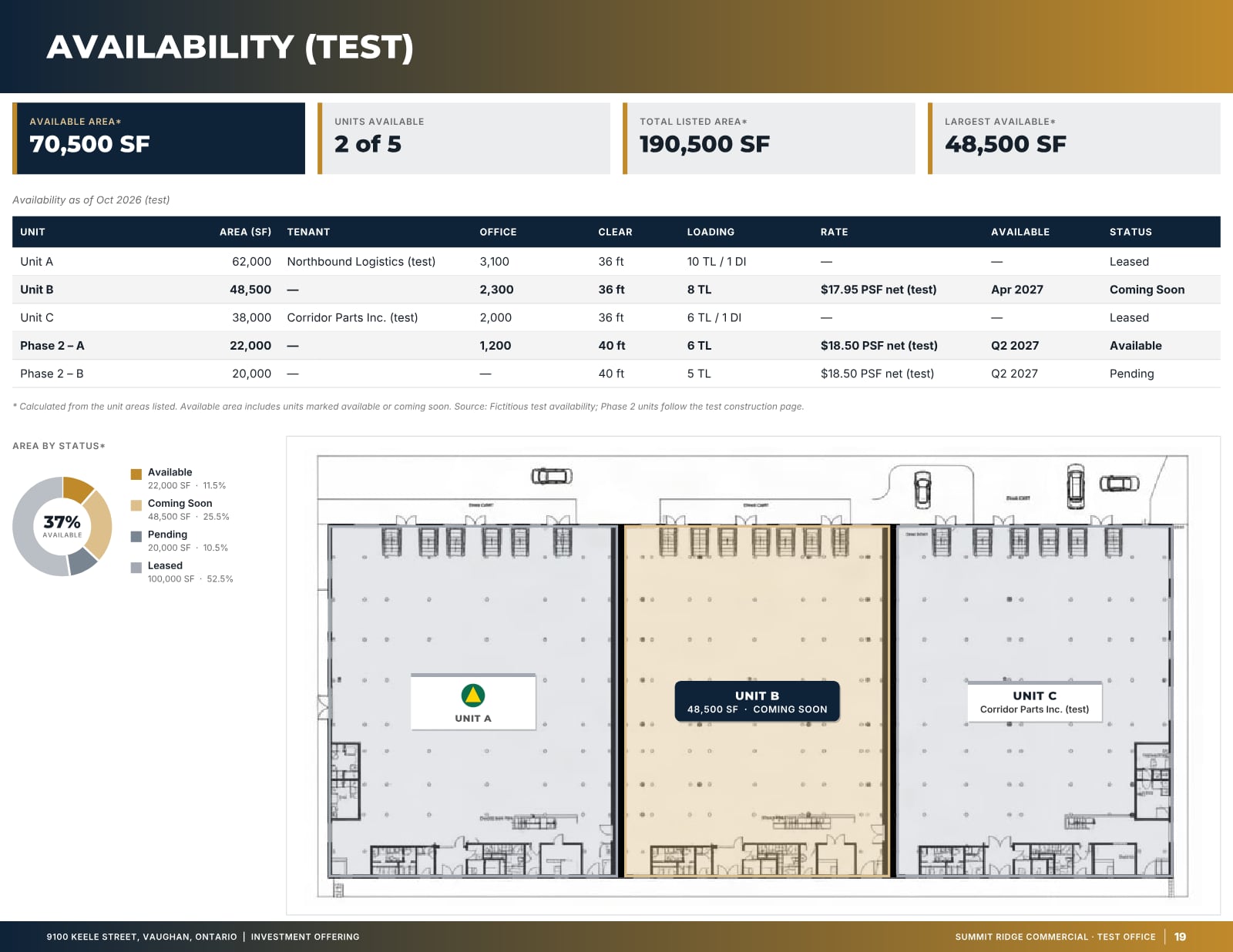
Sample pages are generated by the product from a fictitious test listing (9100 Keele Street, "Summit Ridge Commercial" test brand). Figures marked (test) are not real.
Related
Last updated 2026-10-15. General information for commercial real estate professionals, not legal advice.
Start with the fact sheet you already have.
Upload it, answer only what’s missing for the output you choose, and review a watermarked preview before you buy anything.