CRE marketing guide
Flex and small-bay industrial listing checklist: what tenants ask before they visit
A checklist for marketing flex and small-bay industrial space: the facts tenants screen on, how to show each unit, and what the brochure needs.
Who rents flex space, and how fast they decide
Flex and small-bay buildings are rented by trades, distributors, service companies, small manufacturers, showrooms and labs. Many of them need one loading door, some finished office and a place to park a few vehicles, and not much more. They are often owner-operators who decide in days, not quarters, and who will screen ten listings from their phone before visiting one.
That changes how the listing should be written. A small-bay tenant does not read an eight-page narrative. They scan for a handful of facts, and a listing that makes them hunt for the unit size or the door type loses to one that does not.
The facts they screen on
Put these where they can be found in seconds, for every unit, not only for the building:
- Unit area and whether it can be combined with the next unit or divided. Say what the demising options are.
- Office or showroom finish: how much of the unit is finished space, and its condition. A tenant needing fifteen per cent office will not call about a unit that is two per cent.
- Clear height, measured the way you say it is measured, and the column grid. Racking, mezzanines and equipment depend on both.
- Doors: how many, truck-level or drive-in, and their sizes. A drive-in door and a dock door attract different tenants.
- Power and services: amperage and voltage, whether three-phase is available, heating type, sprinklers, washrooms and compressed-air or floor-drain provisions if present.
- Zoning and permitted uses, with the source. Trades and light manufacturers need to know whether their work is allowed before they spend time on the unit.
- Parking and yard: spaces per unit, trailer parking, outside storage rules, and truck access to the unit.
- Cost: base rent and additional rent for leases, or price and condo fees for industrial condominiums, stated on a clear basis.
If you do not know one of these, say it is to be confirmed rather than leaving a gap that looks like an omission.
Show each unit, not just the building
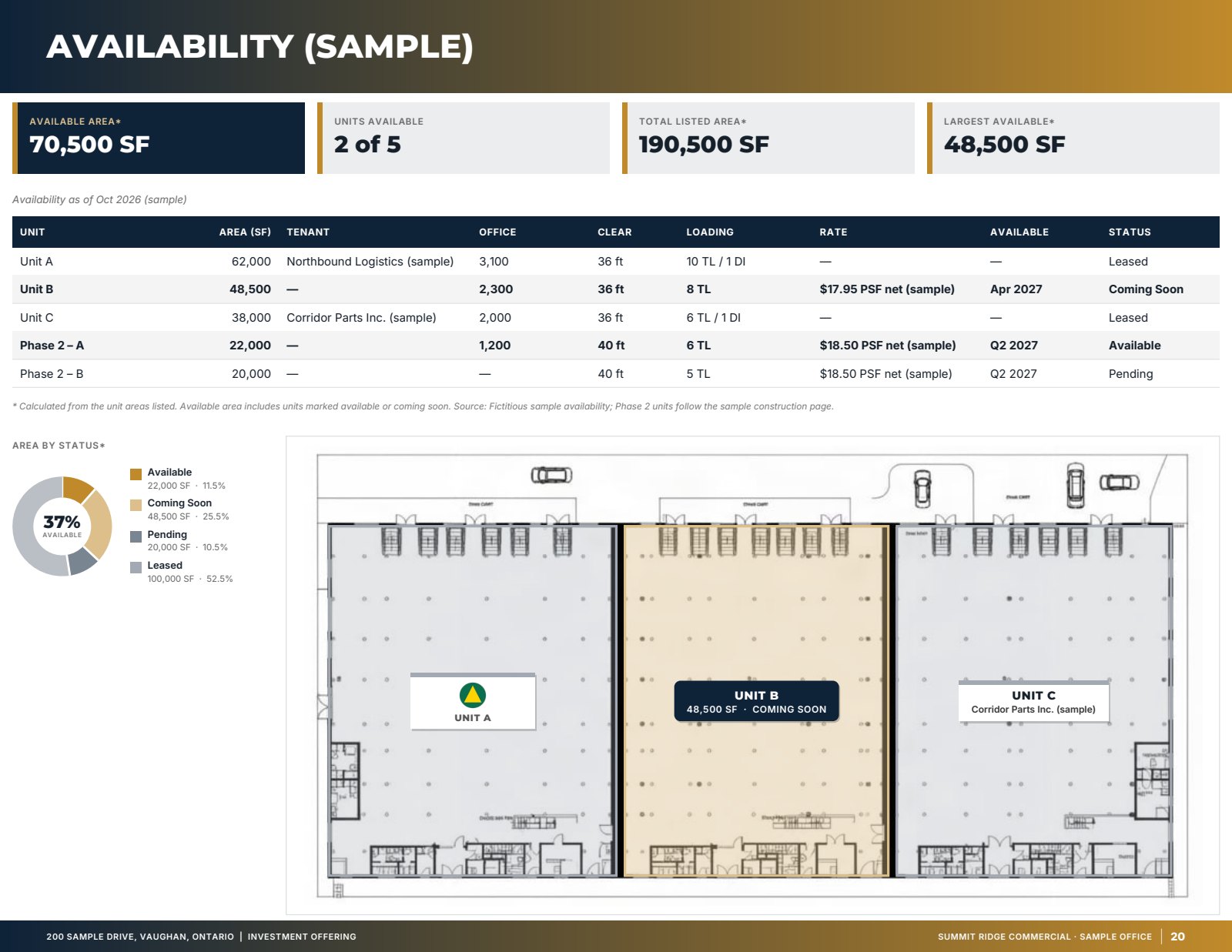
A tile per unit with its area, status and availability date is the quickest way to let a tenant find a fit. Pair it with a plan of the building showing the unit outlines and the doors, so a reader can see which end is the loading side and which unit has the corner. If a larger unit can be divided, show the options and the area of each.
Leave a unit off the table when it is not yet available or when you cannot describe it accurately. A listing that shows a unit leased last week costs you the caller’s trust in everything else on the page.
Sale or lease, and industrial condos
Many small-bay buildings are sold unit by unit as industrial condominiums to owner-occupiers. For those, buyers look at the price per square foot, the condo fees, what the fees cover, the reserve fund position and the condo rules on uses and signage. Ask the condo corporation for the documents a buyer will need and say they are available on request.
For a multi-tenant building sold to an investor, the conversation shifts to the rent roll, lease expiries and operating costs. Keep that material for qualified buyers and send the leasing brochure to tenants, not the other way around.
Location: labour, highways and neighbours
Show the highways and major roads with drive times from the property, the nearest ports, rail yards or airports if freight matters, and the businesses next door. Drive times are more useful than straight-line distances; label how each was measured.
Where you use population or labour-force figures, name the source and the year. Avoid claims about the strength of a market that you cannot support with a named, dated source.
Common mistakes in flex listings
The most frequent problem is a listing written for the building rather than the unit. A reader sees the total building area, the year built and a paragraph about the neighbourhood, and cannot tell whether the unit with the loading door is available or how large it is. Lead with the units and keep the building description short.
The second is mixing measurements. If one page quotes gross area and another quotes rentable area, or if clear height is measured at the lowest point on one unit and the highest on another, tenants will find the difference on site and stop trusting the rest. State your measurement basis once and keep to it throughout the brochure, the sign and the email.
The third is photographing only the exterior and the office. Tenants of this kind want to see the warehouse side: the floor, the ceiling, the door from inside and the yard. If a unit is occupied and cannot be photographed, say so and use the plan, rather than substituting a photograph of a different unit.
The fourth is silence about timing. Say when each unit is available, and whether it is being delivered as is, with improvements or as a shell. A tenant planning a move in ninety days needs to know whether a unit will be ready.
Where to send it
Small-bay tenants are reached by trade associations, equipment dealers, contractors’ suppliers, neighbouring businesses and brokers who represent local companies. Send a short teaser first and the fuller brochure to those who reply. Follow your jurisdiction’s anti-spam rules, and keep a record of how each contact agreed to hear from you.
A sign on the building does a lot of work for flex space, because tenants often decide to move while driving past. Put a phone number and the unit sizes on it, and match it to the brochure.
How OfferingStack helps
The flex and light industrial brochure template builds a for-lease or for-sale brochure around these facts: a tile per unit, the industrial specifications as icon rows, leasing plans and demising options when you provide them, zoning uses with the source, and a location page with drive times and neighbouring occupiers. Population and labour figures come from census tables with their source and year. Pages without data are left out instead of showing empty boxes, and you review everything before it is shared. See the template and the sample pages for what it produces.
Flex industrial listing checklist
- Every unit shows area, status, availability date and whether it can be combined or divided.
- Office or showroom finish is stated as a share of each unit.
- Clear height, column grid, door count and door type are listed per unit or per building as appropriate.
- Power, heating, sprinklers and washrooms are described accurately, or stated as to be confirmed.
- Zoning and permitted uses are given with a source, and no use is promised that is not confirmed.
- Parking, trailer parking and yard rules are stated.
- Rent basis and additional rent (or price and condo fees) are clear.
- A plan shows unit outlines and doors.
- Drive times and distances are measured from the property and labelled.
- Recipients are chosen by fit and have agreed to receive your email.
This guide is general information, not legal advice. Zoning, condo law and anti-spam rules differ by province, state and country.
What these pages look like
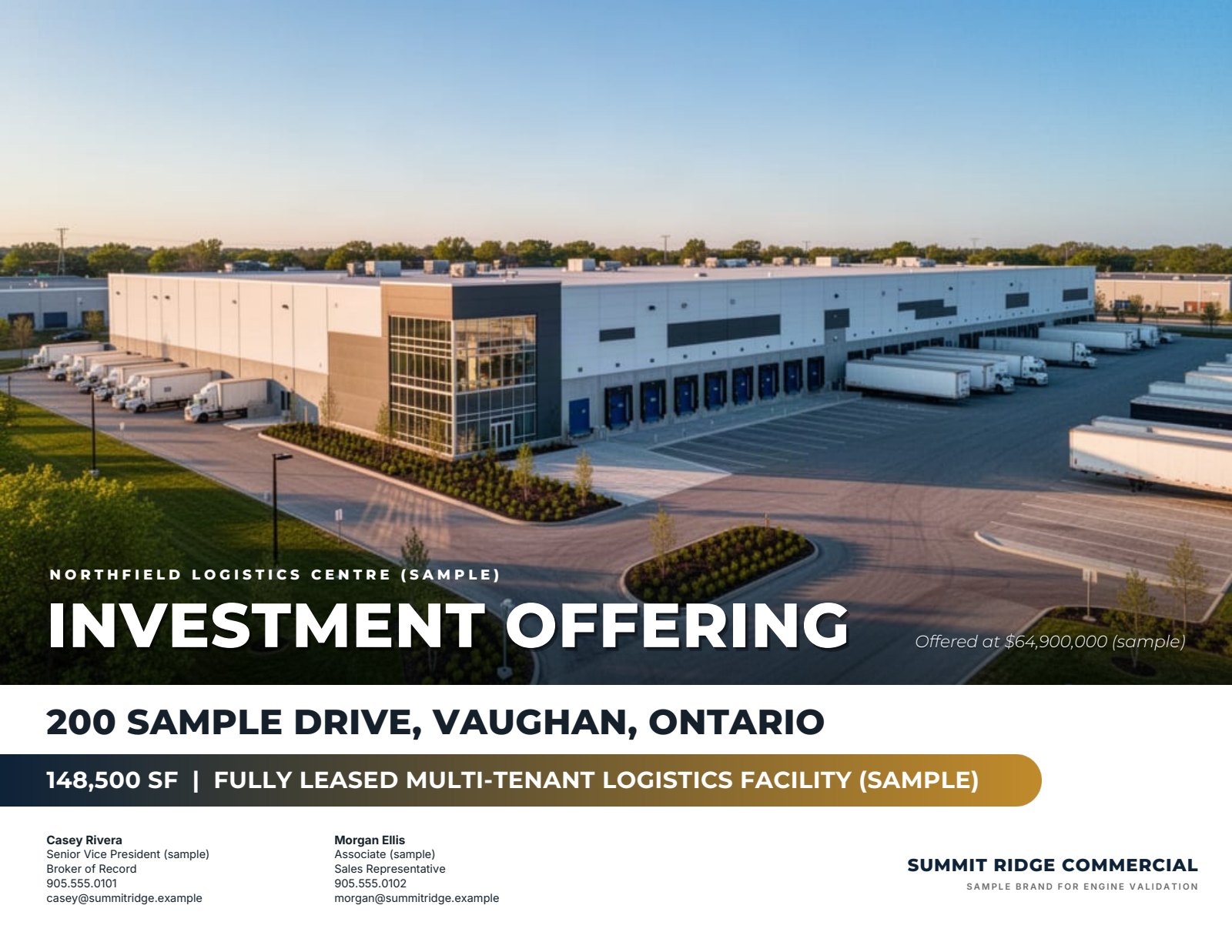
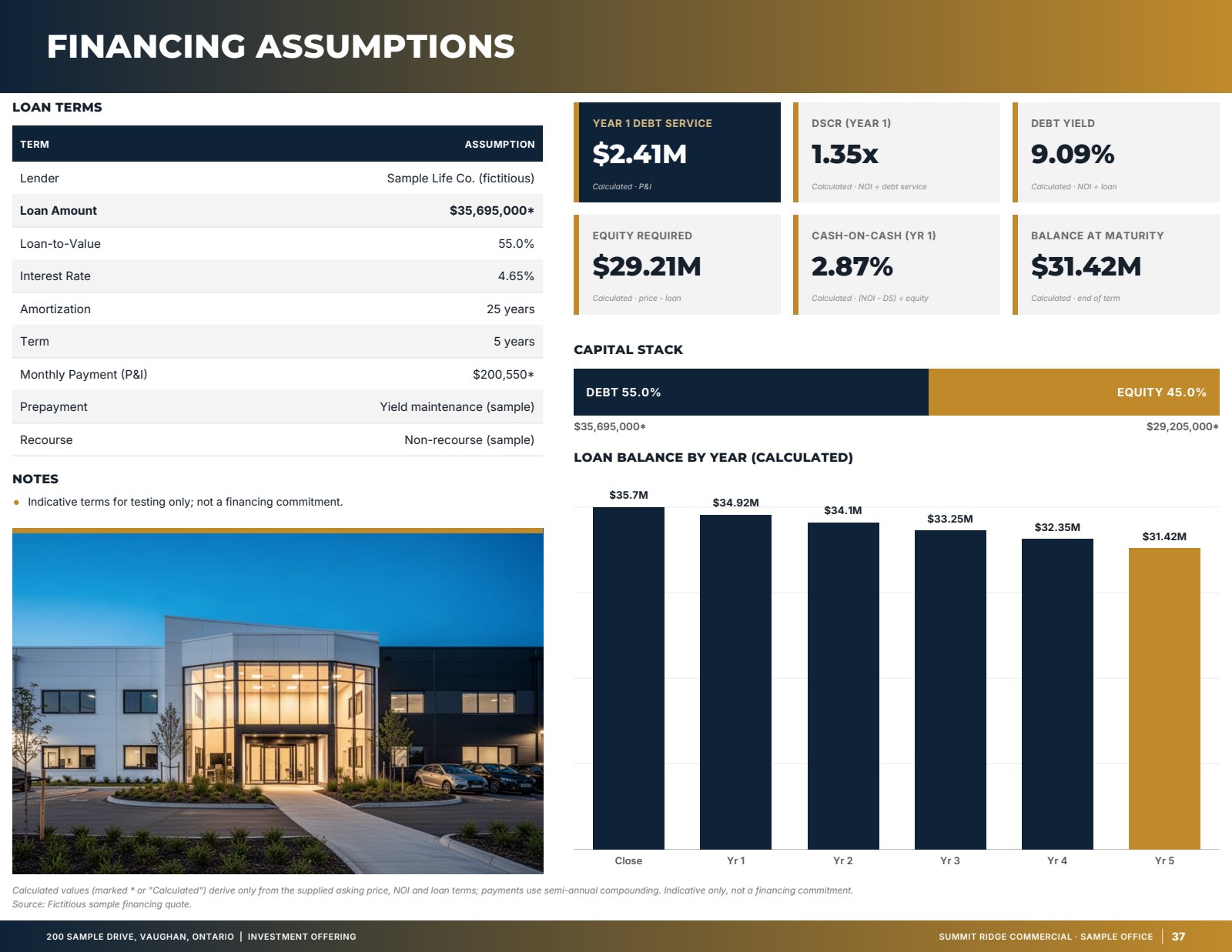
Sample — fictitious property. Pages generated by the product for an invented sample listing with an invented brokerage brand. Figures marked (sample) are not real.
Related
Last updated 2026-10-16. General information for commercial real estate professionals, not legal advice.
Start with the fact sheet you already have.
Upload it, answer only what’s missing for the output you choose, and review a watermarked preview before you buy anything.