CRE marketing guide
Commercial real estate due diligence checklist: what a seller should have ready before launch
Seller-side due diligence checklist for commercial property: title, leases, financials, condition and environmental reports, zoning and staging.
Why sellers should do their own due diligence first
Due diligence is the period after a buyer’s offer is accepted when the buyer checks everything it was told. Most discussion of it is written for buyers. This guide is for the listing side: the broker and owner who want the checking period to be short, calm and unlikely to end in a price reduction.
The logic is simple. Every question a buyer cannot answer from the materials turns into a request, every request takes days, and every day of delay gives a buyer, a lender or a market change a chance to reopen the deal. A seller who has already gathered the documents, read them critically and fixed or disclosed the problems controls the pace. The offering memorandum is the first impression, and the due diligence package is the proof behind it.
Start with a file review, not a folder of PDFs
Before anything is uploaded anywhere, one person should read the whole file the way a buyer’s lawyer would. Look for documents that disagree with each other: a lease that says one area while the rent roll says another, a survey that shows an easement the OM does not mention, a tax bill for a different parcel number. Each mismatch you find yourself is a conversation you control. Each one a buyer finds is a reason to ask for a discount.
Keep a short list of known issues next to the file: deferred maintenance, a tenant in arrears, an expiring lease, an open work order, a zoning non-conformity. Decide with the seller how each will be handled, either fixed, priced in or disclosed in plain words. The OM and the data room should agree with that list.
Title, legal and land
- Title: a current title search or title insurance policy, with copies of registered easements, restrictions, encumbrances and any right-of-way agreements.
- Survey: the most recent survey or reference plan, with a note of whether it reflects the buildings and improvements that exist today. In the United States, buyers and lenders often ask for an ALTA/NSPS land title survey; in Canada, a recent surveyor’s real property report or reference plan is the usual starting point.
- Legal description and parcel identifiers, matching the tax bill and the OM.
- Zoning: the current zoning designation, the permitted uses and any compliance letter or zoning certificate you can obtain from the municipality. Say honestly if the property is legal non-conforming.
- Permits, building and occupancy approvals, open orders or violations, and any development approvals that run with the land.
- Any option, right of first refusal or purchase agreement that affects the property.
Land, site and servicing items matter more in land and redevelopment listings, where the buyer’s whole case rests on what can be built. See our guide on zoning, servicing and site plans for what to show.
Leases and tenants
For an income property, the leases are the asset. A buyer will read every one, so the seller should provide complete, current copies with all amendments, side letters, renewal and expansion notices, and any guarantees. Match each to the rent roll line by line before the buyer does.
- Complete leases with every amendment, assignment and sublease consent.
- A current rent roll with tenant, suite, area, start and expiry dates, base rent, recoveries and security deposits.
- Lease abstracts that summarize key terms, so the buyer’s team does not have to find them in long documents. Our rent roll and lease abstract guide shows the fields.
- Tenant estoppel certificates, which are signed statements by each tenant confirming the lease terms, rent paid and that there are no defaults. They are standard in US deals and commonly requested in Canada. Ask what the leases require of the tenant, and when the buyer wants them, since tenants can be slow to respond.
- Where the property is financed, a non-disturbance or attornment agreement if the buyer’s lender will ask for one.
- Arrears, disputes, rent concessions in force, and any tenant with a termination, relocation or purchase right.
Be careful about what you send before a buyer is under a confidentiality agreement and has been accepted. Tenant names and rents are often confidential, and a data room that releases information in stages is the usual answer.
Financial records
- Operating statements for the last three years, plus the current year to date, in a consistent format.
- The current year’s budget and the assumptions behind any pro forma. Mark what is actual and what is projected.
- Property tax bills and any assessment appeals, as well as insurance costs and policies.
- Utility bills, service and management contracts, and a list of which ones transfer to a buyer.
- Common area maintenance reconciliations for the last few years if tenants pay recoveries. Disputes about recoveries are a classic late surprise.
- Capital expenditure history: what was replaced and when, and what is budgeted.
The numbers in the OM, such as net operating income and occupancy, must tie back to these records. Our operating statement guide explains how to present them so a buyer can reconcile them quickly.
Physical condition and environmental
Buyers and lenders often commission their own reports, but a seller who has recent ones gives them a head start. Reports older than a year or two, or limited in scope, are usually refreshed anyway, so list them with their dates and authors and let the buyer decide.
- Property condition assessment or building condition report, covering the roof, structure, mechanical and electrical systems, parking and paving, and an estimate of near-term capital needs. In the United States these often follow ASTM E2018.
- Phase I environmental site assessment. US reports commonly follow ASTM E1527-21, and Canadian reports commonly follow CSA Z768. Where a Phase I recommended further work, include the Phase II and any remediation records.
- Geotechnical report for land or development sites, and any hazardous materials surveys for older buildings.
- Elevator, fire safety, sprinkler, roof and other inspection certificates.
- Warranties still in force, such as roof or equipment warranties that can transfer.
Environmental documents deserve care. Describe them accurately and never describe a property as clean unless a qualified professional’s report says so, in its own words.
Seller and transaction documents
Owner and entity documents, authority to sign, any existing mortgage and what must be paid out at closing, and the contracts the buyer will want to assume or terminate. For a sale-leaseback, the proposed lease terms belong in this package too. Settle the form of purchase agreement with the seller’s lawyer before launch so the first offer starts from a document everyone has read.
Order the package by what buyers ask for first
Not everything is needed on day one. A practical order is: the OM and financial summary for all interested parties, then leases, rent roll, operating statements and tax bills for buyers who have signed a confidentiality agreement, then reports, title and survey for the buyer with an accepted offer. A data room with folders in that order lets you open each stage when you choose.
Label every document with a date, and keep a log of what each buyer has seen. When a document changes, replace it and record that, so no one underwrites a stale version.
Canada and the United States
The categories are the same on both sides of the border, but the names and the process differ. In the United States, title insurance and escrow are central, and buyers expect estoppel certificates, ALTA surveys and ASTM-standard reports. In Canada, a lawyer typically handles title and registration, land registry systems vary by province, and Québec uses a civil-law notary and its own terminology. Taxes also differ, including the possible application of GST/HST on a sale in Canada and transfer taxes in many US states. Those are questions for the parties’ lawyers and accountants, not for the OM.
How OfferingStack fits into the process
OfferingStack builds the marketing documents, not the legal file, so it does not replace a lawyer, a title search or a data room service. It does help the front of the process line up with the back. The listing’s documents library can hold surveys, environmental and geotechnical reports and the zoning source with their dates; these are kept for the data room and are never printed on an OM page. The financial pages show calculated figures such as net operating income, with the calculation labelled, so they are easy to reconcile with your records. The deal room shows the OM to buyers who have accepted your confidentiality text. You review every page before it is distributed.
Seller due diligence checklist
- Whole file read for mismatches; known issues listed with a plan for each.
- Title, easements and survey collected and consistent with the OM.
- Zoning and permits confirmed, with any non-conformity stated.
- Complete leases, current rent roll and abstracts that agree.
- Estoppel certificate process and timing agreed.
- Three years of operating statements, tax bills, insurance and reconciliations.
- Condition and environmental reports listed with dates and authors.
- Documents staged in folders by buyer stage; access log started.
- Form of purchase agreement settled with the seller’s lawyer.
This guide is general information, not legal, tax or investment advice. A licensed professional should review the file, the OM and the transaction documents before anything is distributed.
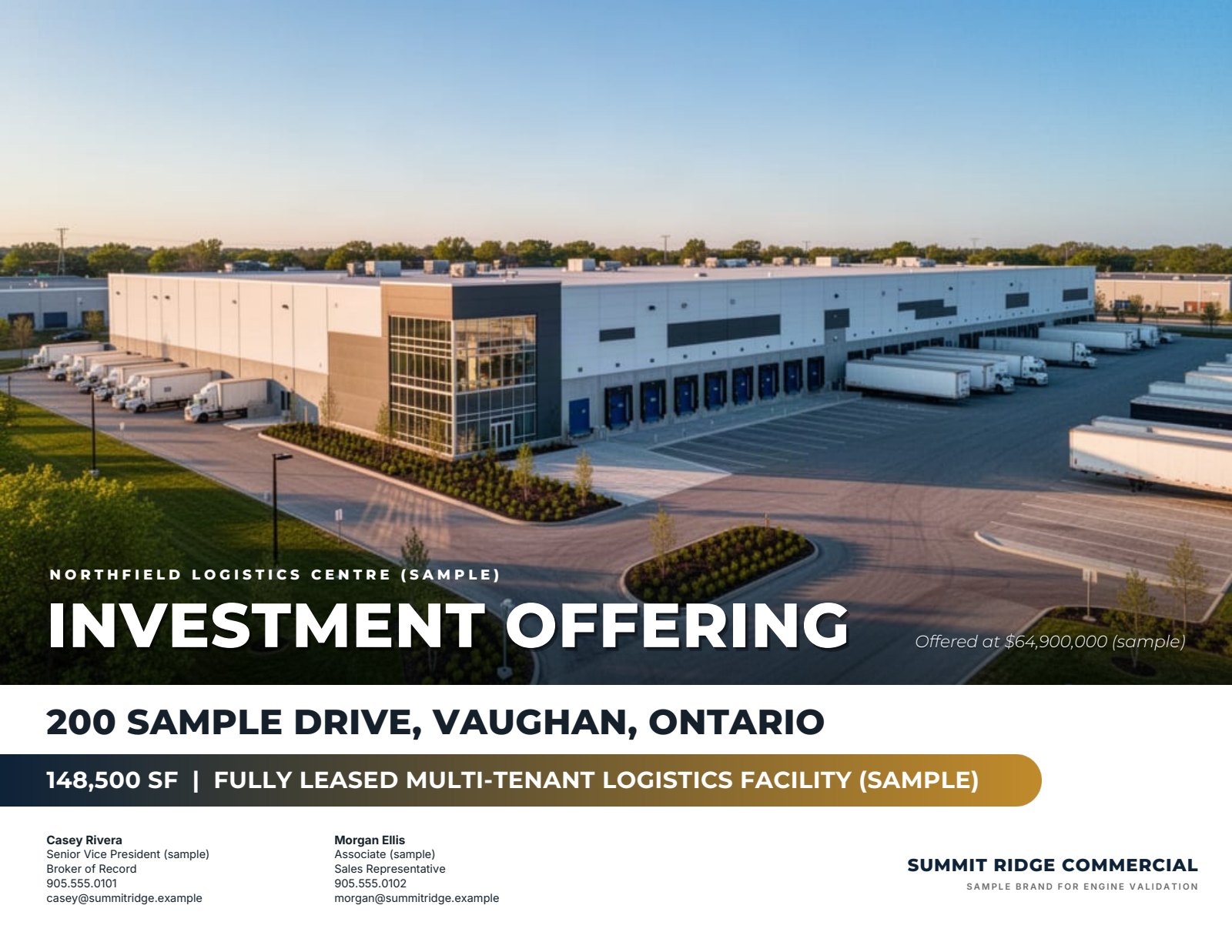
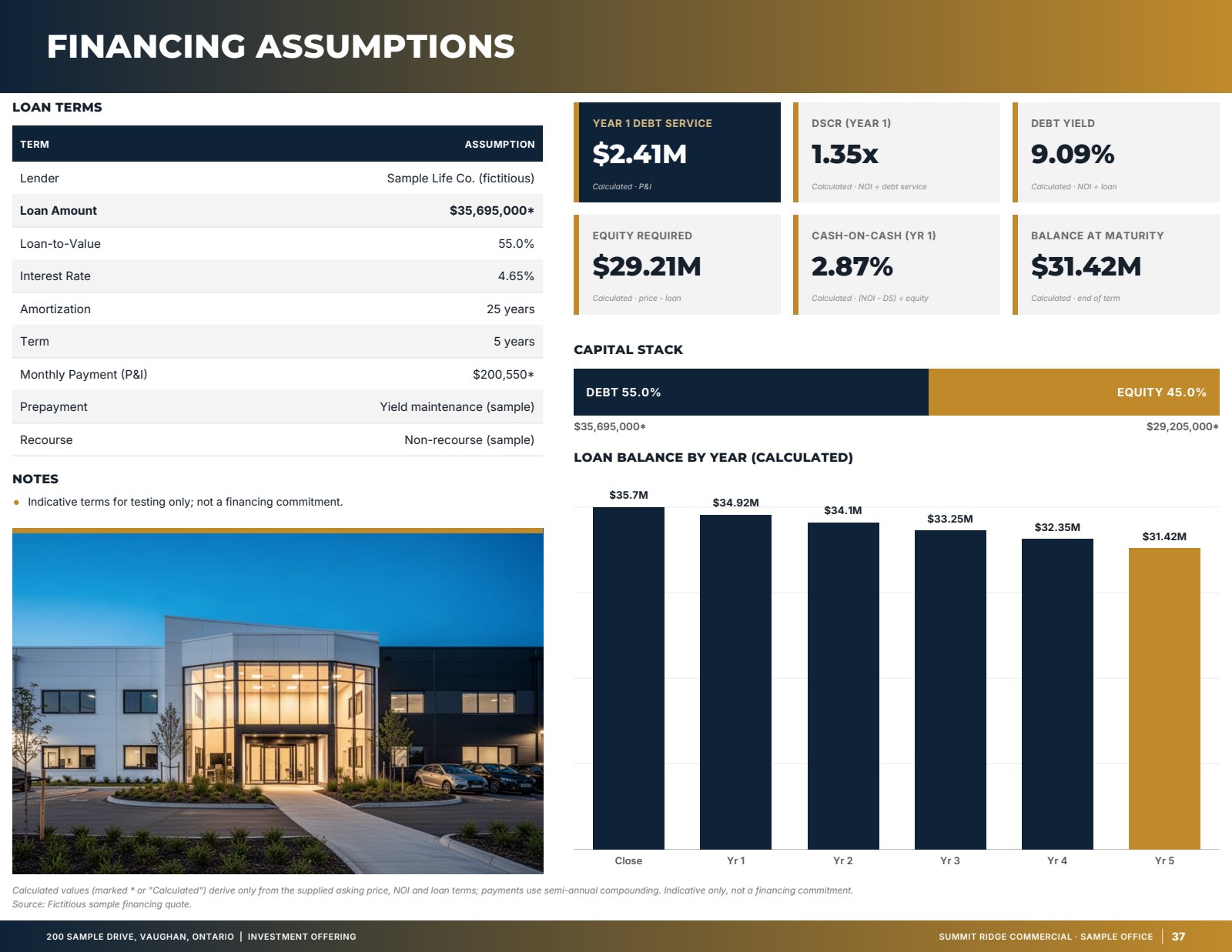
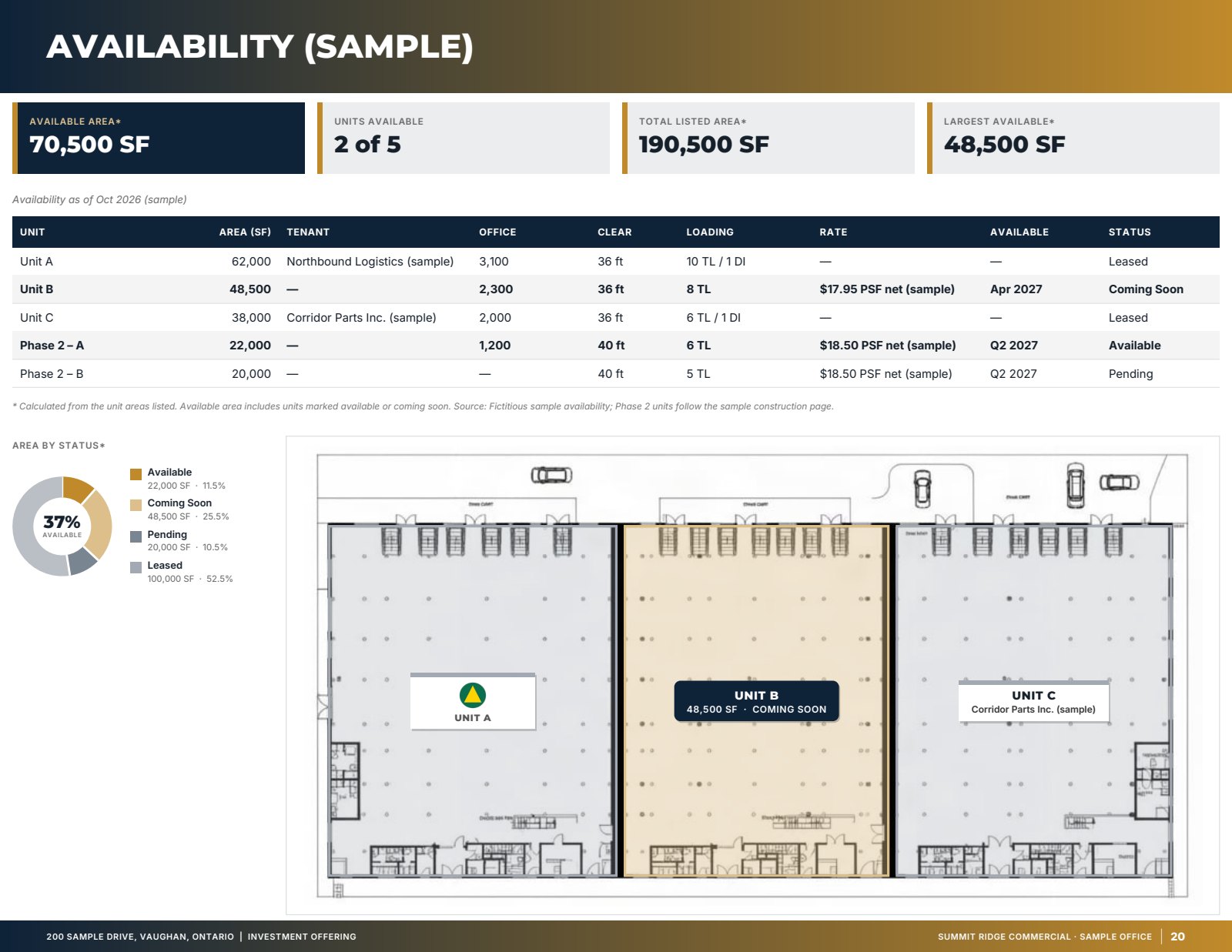
What these pages look like
Sample — fictitious property. Pages generated by the product for an invented sample listing with an invented brokerage brand. Figures marked (sample) are not real.
Related
Last updated 2026-10-15. General information for commercial real estate professionals, not legal advice.
Start with the fact sheet you already have.
Upload it, answer only what’s missing for the output you choose, and review a watermarked preview before you buy anything.