CRE marketing guide
Sale-leaseback offering memorandums: how to market a property the seller will lease back
How to market a sale-leaseback: a lease that starts at closing, the occupier’s credit, a rent buyers can underwrite, and the OM pages that matter.
What a sale-leaseback is, and why it is marketed differently
In a sale-leaseback, a business that owns the building it operates from sells the property to an investor and, at the same closing, signs a lease to stay on as the tenant. The seller turns real estate into cash for its operations; the buyer gets an occupied building with a new lease and a tenant that already knows the property.
For the listing broker, this changes what is being sold. The buyer is not really buying a building with an existing income stream; it is buying a lease that has not been signed yet, from a tenant whose business it has to understand, at a rent the seller has an interest in setting. Every page of the offering memorandum should help a buyer get comfortable with those three things: the lease terms, the tenant, and whether the rent makes sense for the property.
Settle the lease terms before you market
The single most important document in a sale-leaseback is the proposed lease. Buyers price it, lenders underwrite it, and most disagreements after an offer come from terms that were left vague in the marketing. Agree the main terms with the seller, and have its lawyer review them, before the OM goes out:
- Term in years and the start date (usually the closing date), and any renewal options with how their rent is set.
- Base rent in year one, stated with its basis: per square foot per year, or a total annual amount.
- Rent escalations: fixed steps, a percentage each year, or a review to market at set dates.
- Lease structure: who pays property taxes, insurance, maintenance and capital repairs (net, triple net, absolute net or another split).
- Responsibility for the roof, structure, parking areas and building systems, which buyers read closely in older buildings.
- Any guarantee from a parent company or affiliate, and any security deposit or letter of credit.
- Assignment and subletting rights, and any early termination or relocation rights the tenant needs.
Present these as a term sheet in the OM, labelled as the proposed lease to be signed at closing. Do not describe a lease as signed or in place when it is not.
The occupier is the investment
In a single-tenant building the tenant’s ability to pay rent for the whole term is what the buyer is underwriting. A sale-leaseback OM should therefore introduce the occupier properly: what the business does, how long it has operated, how important this location is to its operations, and how many people work there. Buyers give more weight to a facility that is central to the business (a main plant, a distribution hub, a head office) than to one that could be closed without much disruption.
Financial statements are the most sensitive part. Most sellers share them only with qualified buyers who have signed a confidentiality agreement, often in a data room rather than in the OM itself. Say in the OM what is available and how to request it. If the tenant is publicly traded or rated, cite the public source and its date rather than summarizing it in your own words.
Setting a rent the buyer can underwrite
A seller can be tempted to set a high rent to support a higher price. Experienced buyers discount that: they ask what the property would earn if the tenant left, and a rent well above that level makes the income look less secure, not more valuable. A rent close to what the market would pay for similar space, with sensible escalations, usually supports a cleaner sale.
Show the buyer how you got there. If you include rent comparables, give their dates, areas and basis. If the rent is set by another method, such as a percentage of value, say so plainly. Calculated figures such as the cap rate at the asking price, the rent per square foot, or the rent schedule over the term should be labelled as calculated, with their inputs on the page. Our free cap rate and rent escalation calculators show the arithmetic for a given price and rent schedule; they are illustrations, not appraisals.
The pages a sale-leaseback OM needs
- Investment summary: price or offering process, the year-one rent and the cap rate it implies (labelled as calculated), lease term, escalations and the lease structure.
- Proposed lease abstract: the term sheet above, with the rent schedule year by year.
- Tenant profile: the business, its history, the role of this facility, and what financial information is available on request.
- Property details and building specifications: the facts a buyer would need to re-lease the building one day, such as clear height, loading, power, office percentage and site coverage for industrial, or floor plates and parking for office.
- Location: access, labour and neighbouring occupiers, which matter for the tenant’s operations and for a future re-leasing.
- Site plan and photos showing the property as it is operated.
- Offering process: how and when offers are due, and that the sale is conditional on the lease being signed at closing.
Questions buyers will ask early
- Why is the owner selling, and what will it do with the proceeds?
- Is the rent at, above or below what the space would earn on the open market?
- Who is responsible for the roof, structure and major systems over the term?
- Is there a guarantee, and from which entity?
- What happens at the end of the term: renewal options, and how specialized is the building for another user?
- Are there environmental reports, building condition reports or surveys in the data room?
Answering these in the OM, or saying where the answer is available, shortens the questions round and keeps serious buyers moving towards a letter of intent.
Environmental and building condition
Owner-occupied industrial and special-purpose buildings often come with operating history that buyers will investigate: past uses, storage tanks, process areas. Gather the existing environmental and building condition reports before launch and list them in the data room with their dates and authors. If a report is old or limited in scope, say so; buyers and lenders will ask for a new one anyway, and surprises late in the process cost more than disclosure early.
Canada and the United States
The structure is the same in both countries, but the vocabulary and the tax questions differ. Canadian leases are often described as net or absolute net with additional rent; US listings commonly use NNN, absolute NNN or bondable. In Canada the sale of commercial property can carry GST/HST, and in the US transfer taxes and other costs vary by state. Sellers also weigh the income tax effect of the gain on sale. These are questions for the seller’s accountant and lawyer, not for the OM: describe the transaction, and leave tax treatment to the parties’ advisers.
How OfferingStack handles a sale-leaseback listing
OfferingStack has no special sale-leaseback page; you build the OM from the same pages as any single-tenant investment, using the proposed lease terms as the lease data. A for-sale listing with a price and income gets an investment summary with NOI, cap rate, occupancy and WALT, with calculated values labelled. Tenant profile and lease abstract pages show the tenant and the lease terms with the rent schedule, and building specifications, the site plan and sourced location pages follow when you have the data. Write in your own words that the lease starts at closing; the engine never describes a lease as signed. Reports such as surveys and environmental studies can be attached to the listing for the data room without being printed on a page, and the deal room shows the OM to buyers who have accepted your confidentiality text. You review every page before it is distributed.
Sale-leaseback marketing checklist
- Proposed lease terms agreed with the seller and reviewed by its lawyer.
- Lease described as starting at closing, never as already in place.
- Rent stated with its basis; calculated cap rate and rent schedule labelled.
- Tenant profile written; financial statements offered under a confidentiality agreement.
- Responsibility for roof, structure and systems stated plainly.
- Guarantee, deposit and renewal options described accurately.
- Environmental and building condition reports listed with dates.
- Offering process explains that the sale and the lease close together.
This guide is general information, not legal, tax or investment advice. A licensed professional should review the OM and the lease terms before anything is distributed.
What these pages look like
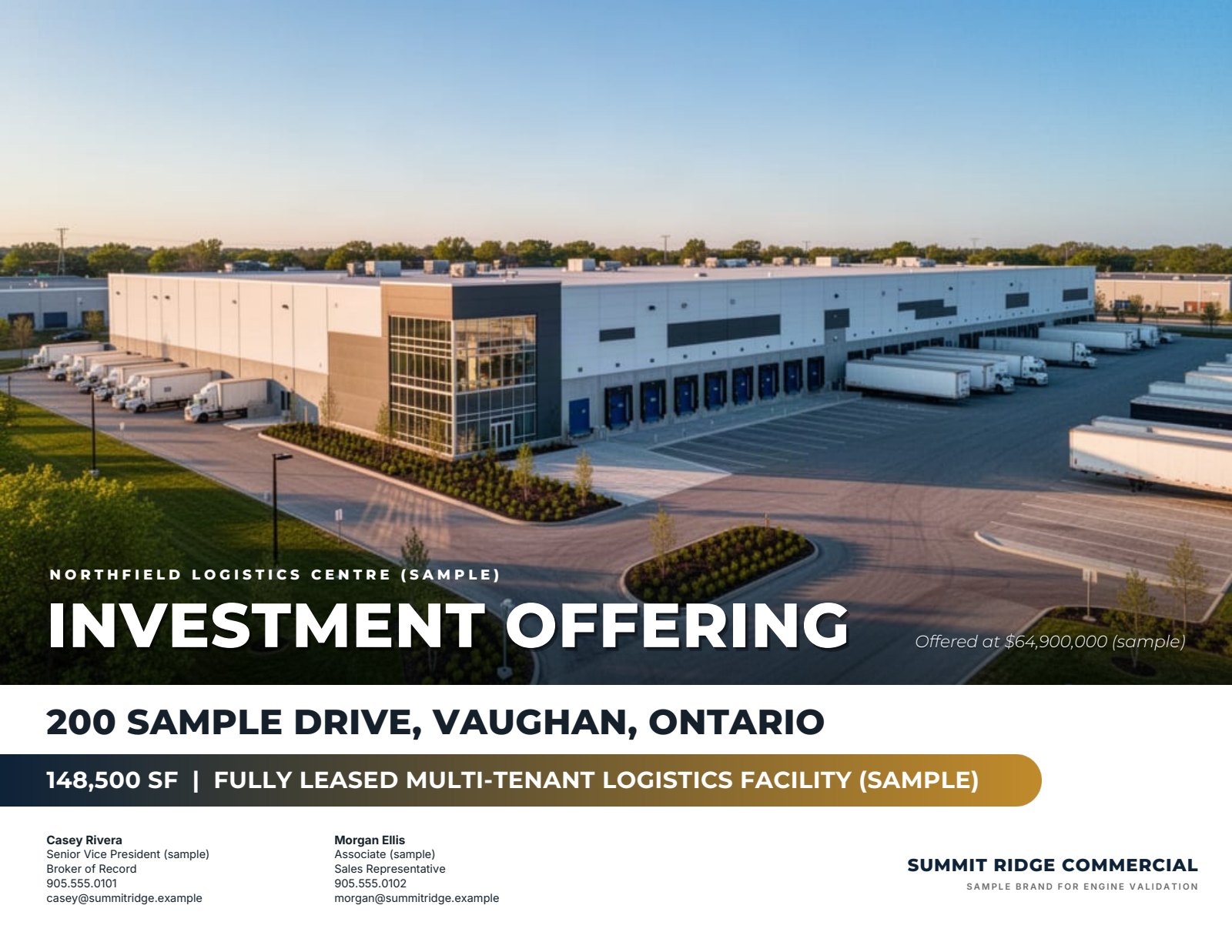
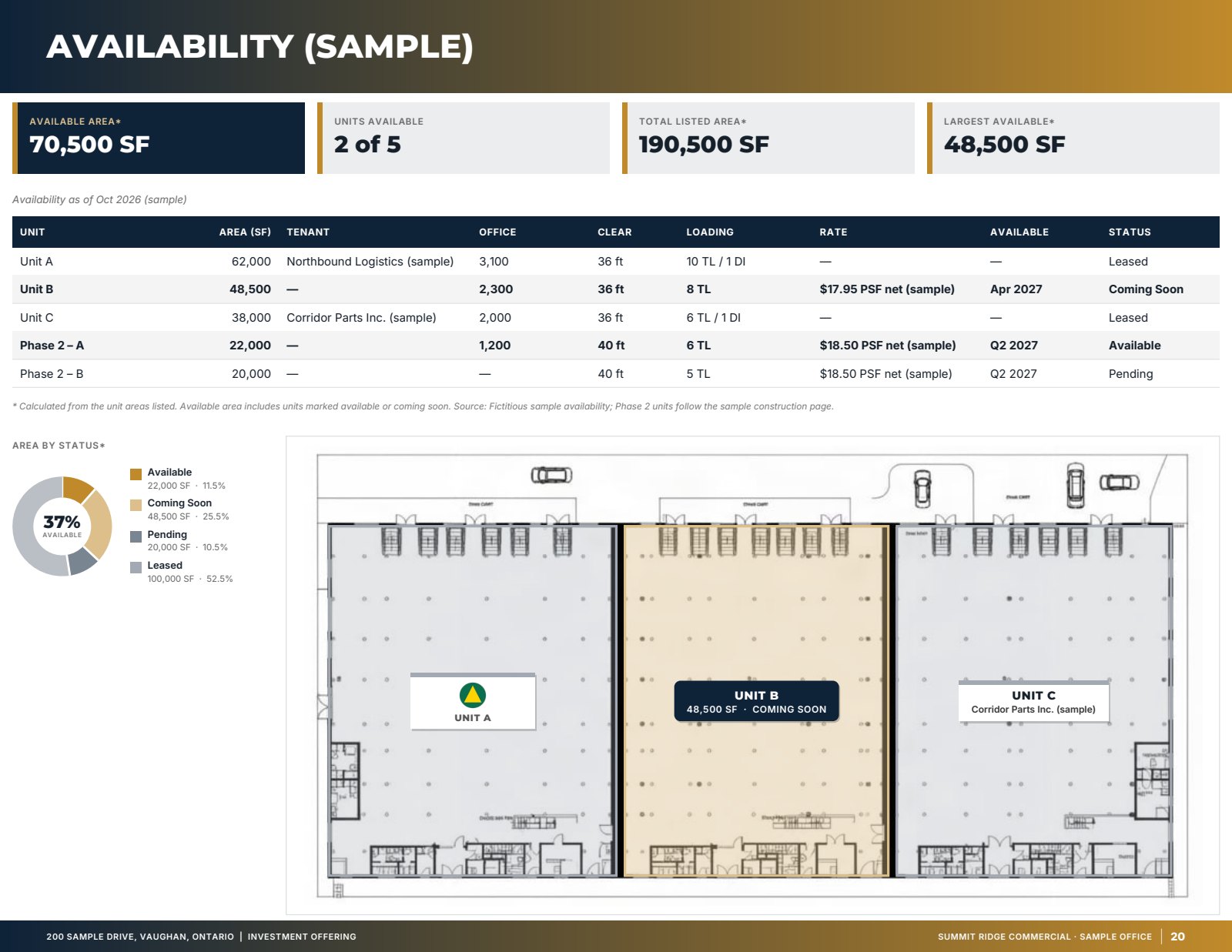
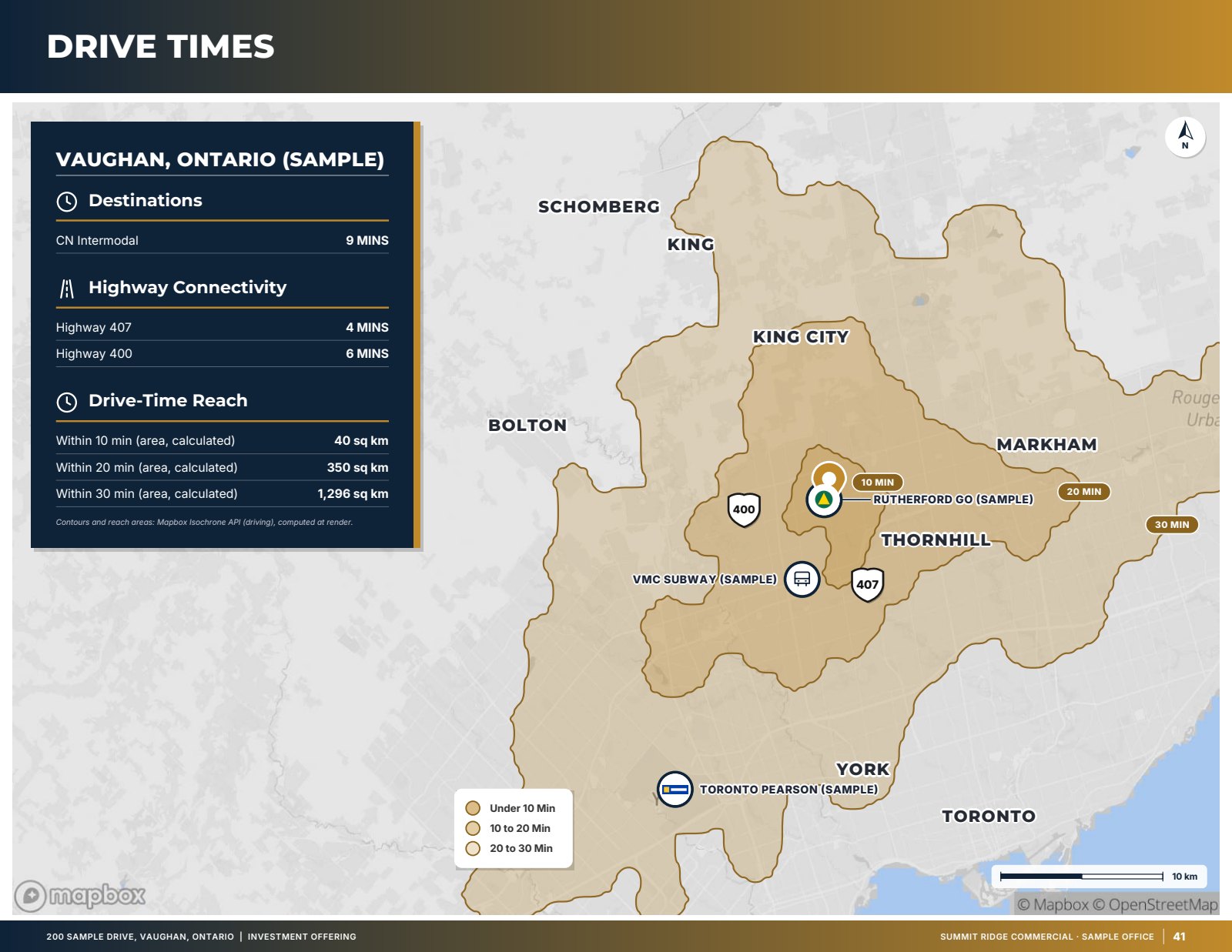
Sample — fictitious property. Pages generated by the product for an invented sample listing with an invented brokerage brand. Figures marked (sample) are not real.
Related
Last updated 2026-10-15. General information for commercial real estate professionals, not legal advice.
Start with the fact sheet you already have.
Upload it, answer only what’s missing for the output you choose, and review a watermarked preview before you buy anything.