Offering memorandum
Single-tenant net lease (STNL) offering memorandums: what buyers check first
How to market a single-tenant net lease property: tenant and guarantee, term remaining, rent steps, landlord duties, and how the OM should present them.
What makes a single-tenant net lease different
A single-tenant net lease property is a building leased in full to one tenant who pays the rent and most or all of the property’s operating costs. Fast-food and quick-service restaurants, pharmacies, banks, auto-parts and convenience stores, dollar stores, medical clinics, daycares and single-user industrial buildings are common examples, in Canada and the United States alike.
Buyers of these properties are largely buying a lease. With one tenant, occupancy is either 100 percent or zero, so the tenant’s ability to pay, the years left on the lease and what the landlord still has to do decide most of the value. The building and the location still matter, mostly as the answer to the question every buyer asks: what happens when the lease ends?
That changes how the offering memorandum should be built. A multi-tenant OM spreads attention across a rent roll; a single-tenant OM puts one lease and one tenant under a microscope, so every term needs to be stated exactly and backed by the lease itself.
The tenant and the guarantee
Name the tenant entity exactly as it appears in the lease, and then say who stands behind it. A lease signed by a national company’s operating subsidiary, a lease guaranteed by the parent, and a lease signed by a local franchisee with a personal guarantee are three very different investments even when the sign on the building is the same.
- Lessee: the legal name of the tenant on the lease.
- Guarantor: whether there is a corporate or personal guarantee, its scope (full term, capped, or burning off after a period) and the guarantor’s legal name.
- Operator: for franchised concepts, who operates the location and how many locations they run, where the seller can disclose it.
- Credit information: for public companies, cite filings and published credit ratings with their date and source. Do not describe a tenant as “investment grade” unless a rating agency rates that entity or its guarantor that way.
- Store performance: sales figures or rent-to-sales ratios only where the lease requires reporting and the tenant permits disclosure, and normally only behind a confidentiality agreement.
Buyers will verify every one of these points, so it is better to state a weaker covenant clearly than to have a buyer discover during due diligence that the guarantee they assumed does not exist.
The lease terms buyers check first
Present the lease as a clean abstract, with each term traceable to a section of the lease. The terms below move value the most:
- Term remaining: the commencement and expiry dates and the years left from the expected closing date, not from today.
- Rent and escalations: current annual and monthly rent, the next increase and the full schedule, whether steps are fixed amounts, percentages or tied to an inflation index, and how often they occur.
- Renewal options: how many, their length, the rent during each option and the notice period. Options belong to the tenant, so present them as possible, not certain, income.
- Expense structure: what the tenant pays directly or reimburses (taxes, insurance, maintenance, utilities) and what the landlord keeps. “Net”, “NN” and “NNN” are used loosely in the market, so describe the actual obligations instead of relying on the label.
- Landlord obligations: the roof, structure, parking lot and building systems are common carve-outs that stay with the landlord even in a lease marketed as triple net.
- Rights that limit the landlord: a right of first refusal or first offer to purchase, early termination or “kick-out” rights, co-tenancy or go-dark provisions, assignment and subletting rights, and any exclusive use clause.
- Estoppel and documents: confirm the tenant will sign an estoppel certificate on the usual timeline and list the documents available in the data room.
If the lease has been amended, abstract the lease as amended and list each amendment with its date. Our guide to rent rolls and lease abstracts covers the abstract format in more detail.
Presenting the numbers
Single-tenant pricing is usually expressed as a cap rate on the current or next year’s rent, because net operating income is close to the rent when the tenant pays the operating costs. Be precise about which it is. If the landlord bears any cost (roof reserves, structural repairs, management, non-recoverable insurance), deduct it to reach NOI and show the line, rather than presenting gross rent as NOI.
- Show the price, the NOI it is based on and the resulting cap rate together, and say which year’s rent the NOI uses.
- Add a rent schedule that runs to the end of the current term, with any option periods shown separately and labelled as options.
- Where the rent steps are material, a simple year-by-year cash flow helps buyers see the income over the remaining term.
- Label every calculated figure, and keep the price per square foot and price per acre visible so buyers can compare the property on its real estate as well as its income.
Our free cap rate calculator and NOI calculator show the arithmetic; neither supplies market cap rates, which vary with the tenant, the term, the location and the interest-rate environment.
The real estate: what happens after the lease
A careful buyer prices the building as if the tenant might leave at expiry. The OM should give them what they need to judge that risk honestly.
- Site and building: land area, building area, year built and any renovations, parking count, access points and signage.
- Location: traffic, visibility, the surrounding retail or industrial uses, and drive times, sourced and dated.
- Market rent context: where the seller has evidence, show how the current rent compares with what similar space leases for, and cite the evidence. A rent well above market increases the risk at renewal; a rent below market can be a strength.
- Alternative uses: zoning and permitted uses that would allow another tenant or a redevelopment, quoting the by-law or ordinance rather than guessing.
- Condition: the age of the roof and major systems, any recent reports, and who is responsible for them.
Sale-leasebacks
In a sale-leaseback, an owner-occupier sells its property and signs a new lease as the tenant at closing. The OM then describes a lease that does not exist yet, so it should present the proposed lease terms as a term sheet, state that the lease will be signed at closing, and give the buyer the occupier’s financial information under a confidentiality agreement. Buyers will look closely at whether the new rent is set at a level the occupier can sustain and the market would support if the occupier left.
Canada and the United States
The single-tenant net lease market is larger and more standardised in the United States, where many investors buy these properties for their predictable income, and some US investors use them in like-kind exchanges under section 1031 of the Internal Revenue Code. A US OM often notes whether the property may suit an exchange buyer; whether it does is a question for the buyer’s own tax adviser.
In Canada the same property types trade, with net rent and additional rent (TMI) language more common than “NNN”, and GST or HST applying to commercial rent and to many commercial sales. State the currency, the tax treatment you are assuming and the source of every figure. Our guide to TMI, additional rent and NNN compares the lease language on both sides of the border.
Building a single-tenant OM with OfferingStack
OfferingStack builds the offering memorandum from the listing facts you enter. For a for-sale listing with the price and income figures, the brochure and the OM include an investment summary page with the price, NOI, cap rate, occupancy and weighted average lease term. The full OM adds the pages the data supports: a tenancy and rent roll page, tenant profiles, a lease abstract with the rent schedule, a financial overview and a cash flow. Pages without data are left out, calculated figures are labelled, and nothing about the tenant is invented: covenant, guarantee and credit details appear only when you enter them.
You can preview your own document for free with a watermark before paying for the clean PDF, and the OM can be shared through a confidentiality-gated deal room.
A checklist before the OM goes out
- Tenant, guarantor and every lease date match the lease and its amendments.
- The rent schedule runs from closing to expiry, with options shown separately.
- NOI deducts every cost the landlord bears; the cap rate states its basis.
- Landlord obligations and tenant rights (ROFR, termination, go-dark, exclusives) are disclosed.
- Credit statements cite a source and date; nothing implies a rating the tenant does not have.
- The tenant has agreed to provide an estoppel certificate, and the data room holds the lease.
- The seller has approved the OM for release.
This guide is general information, not legal, tax or investment advice.
What these pages look like
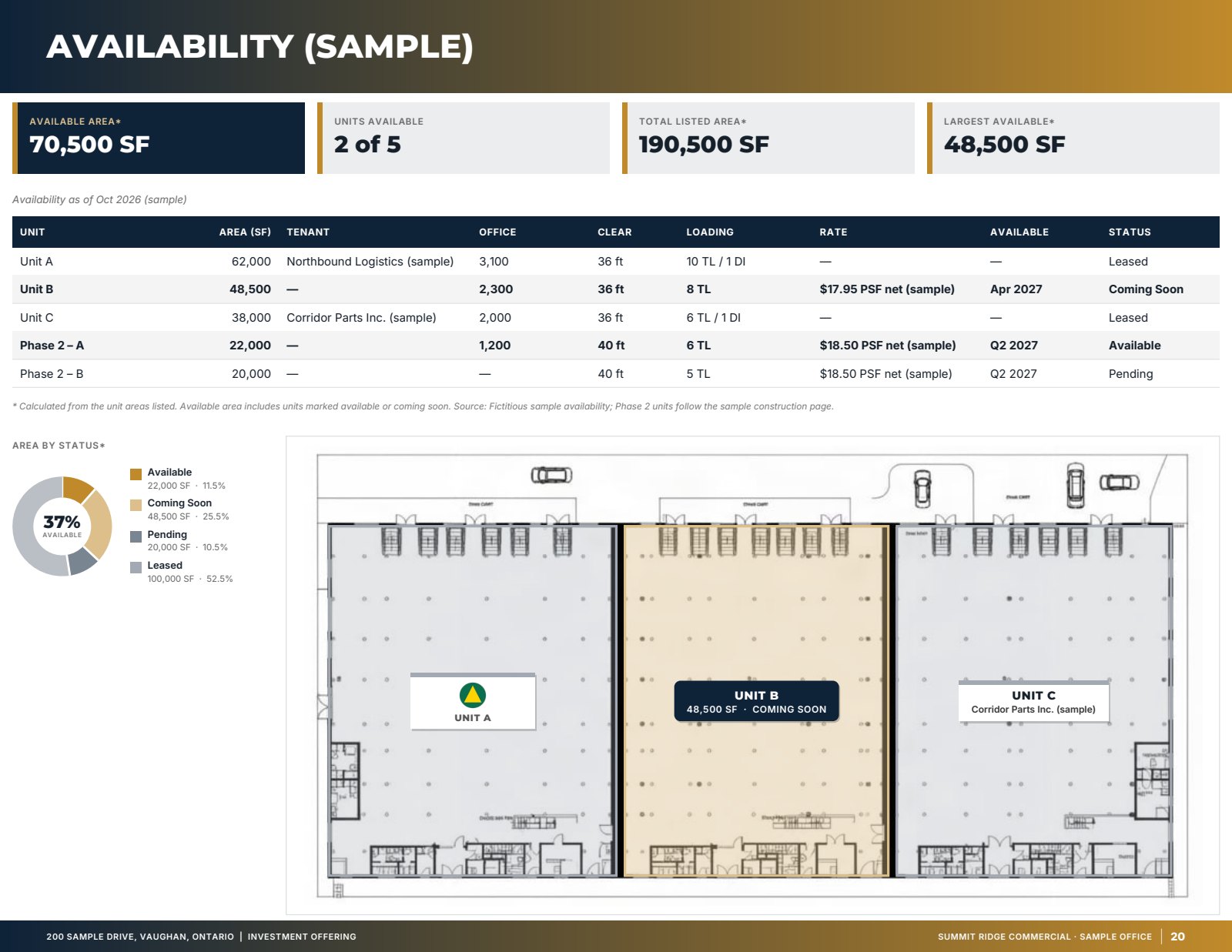
Sample — fictitious property. Pages generated by the product for an invented sample listing with an invented brokerage brand. Figures marked (sample) are not real.

Related
Last updated 2026-10-15. General information for commercial real estate professionals, not legal advice.
Start with the fact sheet you already have.
Upload it, answer only what’s missing for the output you choose, and review a watermarked preview before you buy anything.