CRE marketing guide
Offering memorandum disclaimer and confidentiality notice: what the legal page should cover
What an offering memorandum disclaimer and confidentiality notice usually covers, where it goes and how to keep it accurate. Not legal advice.
What the legal page of an offering memorandum is for
Almost every commercial offering memorandum starts with a page of small print, usually titled Confidentiality and Disclaimer or Important Notice. Most readers skip it. Lawyers and the brokerage’s compliance team do not, because it does three jobs: it reminds the reader that the document is confidential, it says what the information in the document is and is not, and it tells the reader to verify the facts and form their own view before relying on them.
That last job is the one that matters most when something goes wrong. A buyer who relies on an unverified statement in a marketing document and later disputes it will be pointed to this page. A clear, honest notice is not a shield against careless statements, but it sets expectations about what a marketing document can do.
This guide explains what these pages commonly cover and how to handle them as a broker. It is general information. The wording itself belongs to your brokerage, its lawyers and the seller’s advisers, and it varies by province, state and type of transaction.
Who writes it, and who does not
The disclaimer is not marketing copy and should not be improvised by whoever builds the OM. In most firms it is approved text maintained by compliance or legal counsel, applied to every offering memorandum the firm issues, and sometimes adjusted for a specific listing with the seller’s lawyer. Ask for the current approved version at the start of the project, not the end.
If the seller has its own requirements, such as a confidentiality clause for a sensitive sale, an owner-occupier’s concerns about tenants or employees, or a requirement that offers go through a named process, those belong in the notice or in the confidentiality agreement, and the seller’s lawyer should see them.
What these pages commonly say
- Confidentiality: the document is provided on a confidential basis, is for the named recipient only, must not be copied or shared except with advisers who also keep it confidential, and must be returned or destroyed on request. This often refers to the confidentiality agreement the recipient has signed.
- Purpose and status: the document is a summary prepared to help a recipient decide whether to pursue an interest, it is not an offer to sell or lease, and it does not form a contract.
- No guarantee: the information comes from the seller and other sources believed to be reliable, but the broker and seller do not guarantee its accuracy or completeness, and some documents say which parts were supplied by third parties.
- Verification: recipients are told to conduct their own investigations, review the legal, tax, environmental and physical condition of the property, and consult their own advisers.
- Projections: forward-looking figures, such as pro forma income or rent growth, are estimates based on assumptions, may not be achieved and are not promises.
- Seller’s rights: the seller can withdraw or change the property, the price or the process at any time without notice, and is not obliged to accept any offer. Agents’ and sellers’ duties to the recipient end where the notice says they do.
- Process: offers go through the named broker, in writing, by the set procedure, and the recipient should not contact tenants, employees or the owner directly.
- Brokerage disclosures: licensing details, any relationship with the seller or a possible conflict, and the brokerage’s role in the transaction.
Not every document needs every item. Short teasers often carry only a condensed notice that refers to the full text, while a full OM carries the complete page.
Where it goes in the document
The traditional place is immediately after the cover, before the executive summary, so a recipient sees it before the substance. Many firms also put a shorter disclaimer in the footer or on the back page, and a brochure or teaser often has a few lines on the cover or closing page. Whatever your practice, be consistent: the long and short versions should say the same thing, and the text on a website listing should match the PDF.
Keep the notice accurate to the document
A disclaimer cannot repair a document that says something it should not. The most useful habit is to treat the notice as a checklist for the rest of the OM.
- If the notice says information was supplied by the seller, label seller-provided figures and keep a note of where each came from.
- If it says projections are estimates, label pro forma pages as projections, and show the assumptions.
- If it tells the reader to verify, make that easy: put dates and sources on market and demographic data.
- If it refers to a confidentiality agreement, make sure only recipients who signed it receive the full document.
- If it says the property or terms may change, remove old versions from circulation when they do.
Our guide to the offering memorandum covers how to label data, and the confidentiality agreement and data room guides explain how the notice fits into the wider process.
Safe habits for the people building the OM
- Use the firm’s approved text word for word. Do not shorten or paraphrase it to make a page fit.
- Check the spelling of the brokerage and legal entity names, licence numbers and the correct jurisdiction.
- If the OM covers a property in a different province or state than usual, ask whether the approved text still applies.
- Have the final PDF read once by the person responsible for compliance, not just the first draft.
- Do not copy a disclaimer from a competitor’s OM. It may not suit your firm or your jurisdiction, and the text itself is protected.
Canada and the United States
The structure above applies on both sides of the border, but the legal background differs. In Canada, real estate regulation is provincial, and some provinces have rules about what must be disclosed and how a brokerage describes its role. Québec documents may also need a French version and the notice should be provided in both languages where the rest of the document is. In the United States, the text often reflects state licensing law, and some offerings of securities or interests in entities raise separate securities-law questions that go well beyond a property OM. These are matters for counsel.
How OfferingStack handles the legal page
OfferingStack does not write legal text. During setup it asks for your approved disclaimer and confidentiality language and says it is never written by the system. If you provide full legal text for the listing, that text is used as the legal page. If you only provide a brokerage disclaimer in your brand settings, a full OM carries that disclaimer word for word on an Important Notice page with one generic line reminding the reader to verify information independently, and the same disclaimer appears on the cover and closing panels of themes that have a disclaimer line. If you provide neither, the page is left out rather than filled with placeholder text. You review every page before the document is distributed, including the legal one.
Legal page checklist
- Current approved text obtained from the brokerage or its counsel.
- Seller’s specific requirements checked with its lawyer.
- Long notice in the OM; short notice on teasers, brochures and web pages; consistent wording.
- Seller-supplied data and projections labelled in the pages themselves.
- Confidentiality agreement signed before the full OM is released.
- Jurisdiction, licence details and language requirements checked.
- Final PDF reviewed by the person responsible for compliance.
This guide is general information, not legal advice. Your brokerage’s lawyer should approve the text and any changes to it.
What these pages look like
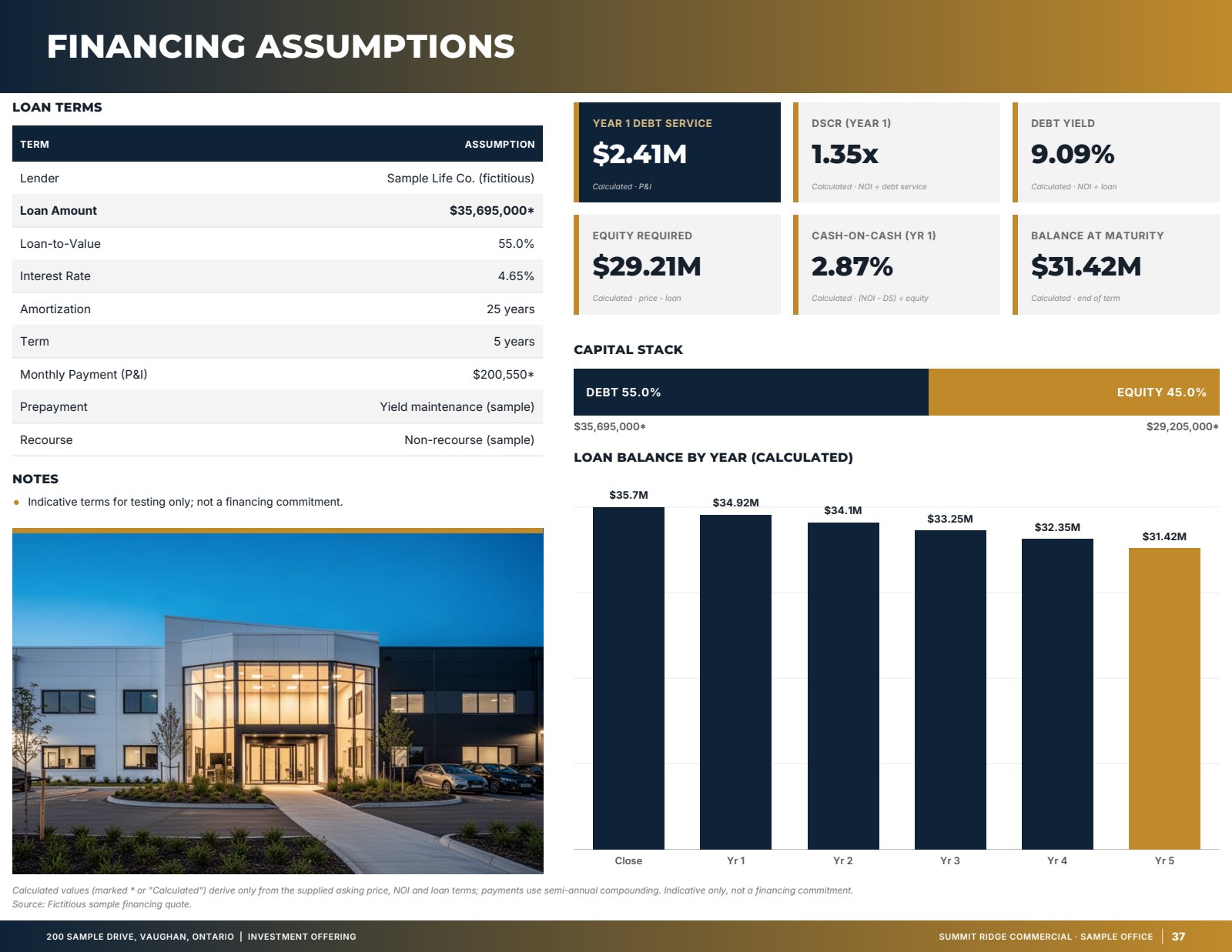
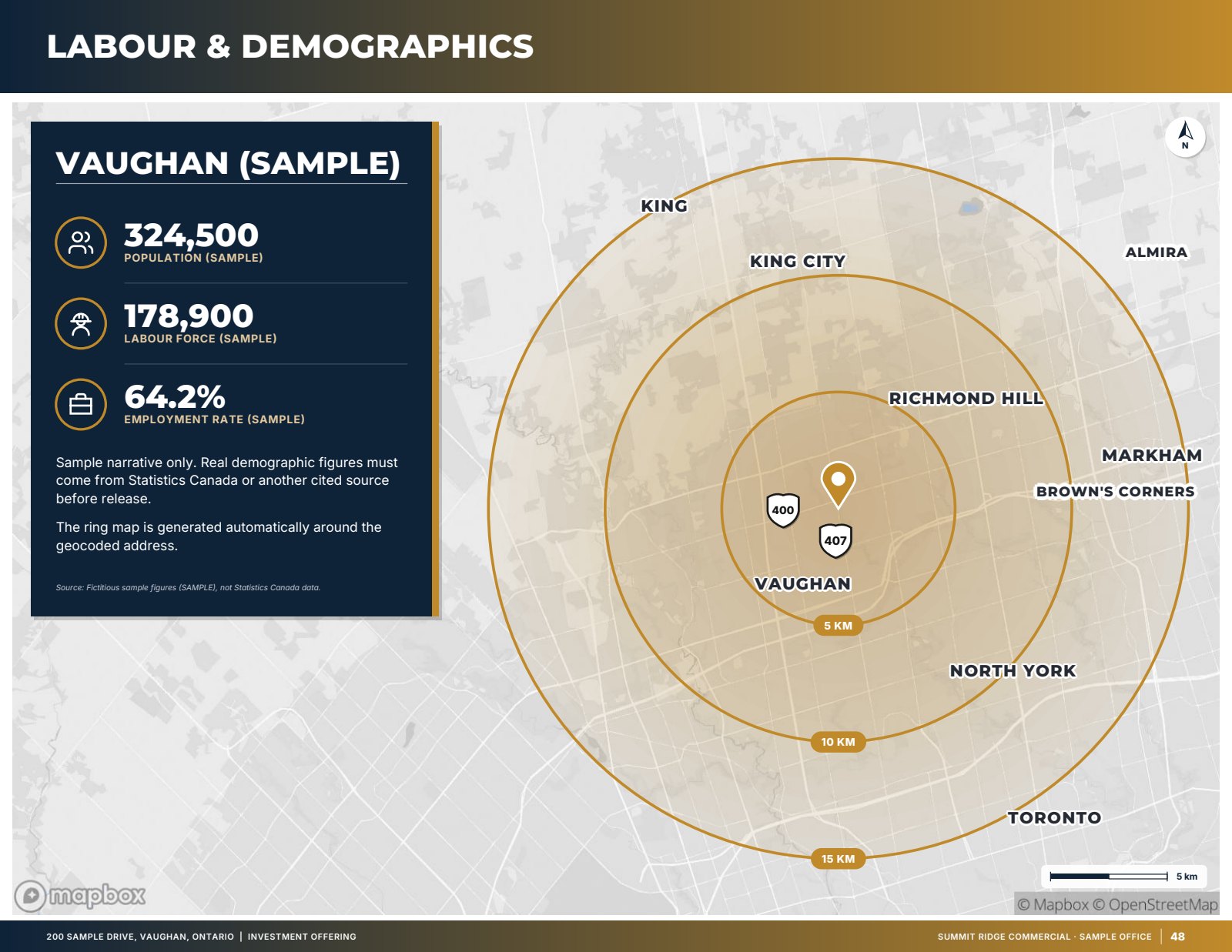
Sample — fictitious property. Pages generated by the product for an invented sample listing with an invented brokerage brand. Figures marked (sample) are not real.

Related
Last updated 2026-10-15. General information for commercial real estate professionals, not legal advice.
Start with the fact sheet you already have.
Upload it, answer only what’s missing for the output you choose, and review a watermarked preview before you buy anything.