CRE marketing guide
Commercial real estate listing agreement basics: what to settle before you start marketing
What a commercial real estate listing agreement usually covers before marketing starts: term, price, fees, materials, access and approvals.
Why the agreement comes before the brochure
A listing agreement is the contract between the owner and the brokerage that sets out who will market the property, for how long, on what terms and for what fee. It is easy to treat it as paperwork that precedes the real work of photographs, brochures and calls. In practice, many of the disputes that sour a listing, such as who approves the marketing, what price to advertise, who may talk to buyers and what happens when the term ends, start with something the agreement did not say clearly.
This guide lists the points a broker and owner usually settle in writing before marketing begins. It is general information, not legal advice. Listing agreements are regulated differently by province and state, many brokerages use their own forms, and the final document should be prepared or reviewed by the brokerage’s counsel and, where the owner wishes, the owner’s lawyer.
The parties and the property
- The exact legal name of the owner and the person with authority to sign for it. For companies, partnerships and estates, confirm who can bind the owner before any marketing begins.
- The legal description and civic address, plus any adjoining parcels that are part of the sale or lease.
- Whether the listing is for sale, lease, sublease or a combination, and what exactly is included: the land and buildings, equipment, a business, inventory or rights.
- Any existing agreements that affect the property, such as a prior listing, an option, a right of first refusal or a purchase offer. If another brokerage claims a right to commission, the owner should say so at the outset.
Type of listing, term and what happens afterwards
The most common arrangements for commercial property are an exclusive listing, where one brokerage has the sole right to market and be paid, and an open listing, where the owner may engage several brokerages and pays only the one that produces the buyer. Some jurisdictions and brokerages call these by different names, and some arrangements add exceptions for buyers the owner introduces directly. Write down which applies, and who is entitled to a fee if the owner finds the buyer.
Fix the start and end dates. For a large or complex property a term of several months is common, because a proper offering process takes time. Agree what happens if the term ends during a negotiation. Many agreements include a holdover or protection period, during which the brokerage is still entitled to a fee if the property is sold to a party it introduced during the term. These clauses vary widely, so the length, the list of protected buyers and the way they are named all matter and should be read closely.
Price, strategy and how offers will be handled
Decide whether the property will be advertised with an asking price, a guidance range or no price at all, and who has the final say. Some sellers prefer to ask for offers by a deadline without a price, as described in our guide on the offering process and call for offers. Others list at a stated price. Whichever approach is chosen, write it down, because it determines what the brochure and offering memorandum will say.
Record how offers will be received, who sees them, who may negotiate on the owner’s behalf and whether the owner will see every offer. If the sale will be done in rounds, note that. If there are conditions the seller expects to apply to every offer, such as a deposit, a financing or due diligence period, or a confidentiality agreement signed before the full OM is released, say so in the agreement and again in the materials.
The brokerage will usually support the price conversation with a broker opinion of value or a comparable analysis. Our broker opinion of value guide shows what that document contains and how it differs from an appraisal.
Fees and expenses
Commission is negotiable, and commercial agreements take many forms: a percentage of the sale price, a sliding scale, a flat fee, or for leases, a percentage of the rent over the term. Whatever the structure, write the rate, the amount it applies to, when it is earned, when it is paid, and whether it is split with a cooperating brokerage. Taxes such as GST or HST in Canada, or any applicable sales tax in the United States, should be addressed explicitly. Our commission calculator shows the arithmetic for a sale or lease with a cooperating split, using numbers you enter; it is an illustration, not advice about what a fee should be.
Also settle who pays for marketing costs such as photography, aerial images, printing, maps and demographic data, whether these are included in the fee or charged separately, and what happens if the listing is withdrawn early. Owners sometimes assume marketing is free. Brokers sometimes assume the owner has agreed to a budget. The agreement should remove the guesswork.
Marketing materials, approvals and disclosure
The agreement, or an addendum, should say what will be produced. A typical package for an income property might include a teaser, a brochure or a full offering memorandum, a property website, an email campaign and a data room. Say who writes the content, who approves it, how long the owner has to review a draft and what happens if the owner changes a number after approval. A short approval step, with a named person and a deadline, saves many rounds of rework.
Settle the confidentiality plan: who may receive the OM, whether a confidentiality agreement is signed first, whether tenants and employees are told, and whether the listing is public or private. For a sensitive sale, such as a business that will continue to operate on the site, the owner may want the address withheld from the public teaser. See our guides on confidentiality agreements and the offering memorandum disclaimer.
Finally, set out what the owner will disclose. A broker marketing a property is generally expected to pass on material facts the owner knows about the property, and the rules differ by jurisdiction. The agreement is a good place to require the owner to provide complete leases, financial records and reports, and to tell the broker about known problems. Our due diligence checklist for sellers lists what to gather.
Access, showings and communication
- Who may show the property, how much notice tenants and the owner need, and who coordinates access.
- Whether buyers may contact tenants or staff directly. The usual answer is no, and all contact goes through the broker.
- Who will answer questions, and how quickly. A defined contact for each side keeps buyers from getting two answers.
- How the broker will report to the owner, such as a weekly summary of inquiries, tours and offers.
Canada and the United States
Both countries regulate real estate brokerage at the provincial or state level, and the required form, mandatory clauses, disclosure obligations and rules about how long fees can be claimed after a listing ends differ. Some provinces and states have a standard form for residential listings but leave commercial agreements largely to the parties, while others apply licensing rules to both. In Québec, written documents may also need to be available in French. Check the rules where the property is located and where the brokerage is licensed.
Where OfferingStack fits
OfferingStack does not draft or store contracts and is not a substitute for a brokerage form. It helps with the materials that follow the agreement: the offering memorandum, brochure, teaser and property website, with the approval step that the agreement requires. Because every page is reviewed by you before the document is distributed, the agreement’s approval clause fits naturally into the workflow.
Listing agreement checklist
- Owner’s legal name and signing authority confirmed.
- Property, inclusions and any competing claims described.
- Listing type, start date, end date and holdover or protection terms written down.
- Price approach and offer-handling process agreed.
- Commission, split, taxes and marketing expenses stated.
- Marketing package, approvers and review deadlines named.
- Confidentiality plan and public or private status set.
- Owner’s disclosure and document delivery obligations listed.
- Showing, access and tenant contact rules agreed.
- Final agreement reviewed by the brokerage’s counsel.
This guide is general information, not legal advice. Listing agreements are legally binding, so have the final text reviewed by a lawyer.
What these pages look like
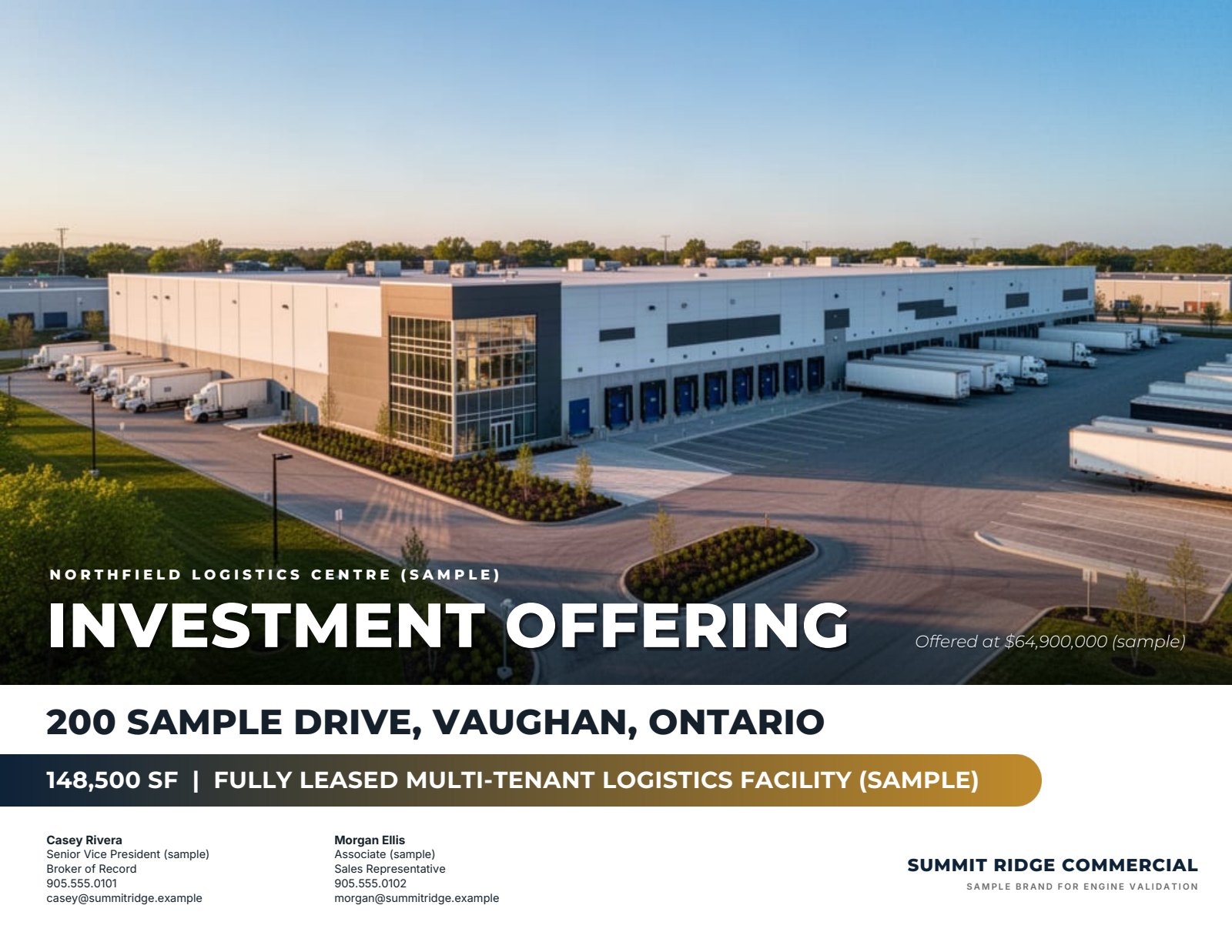
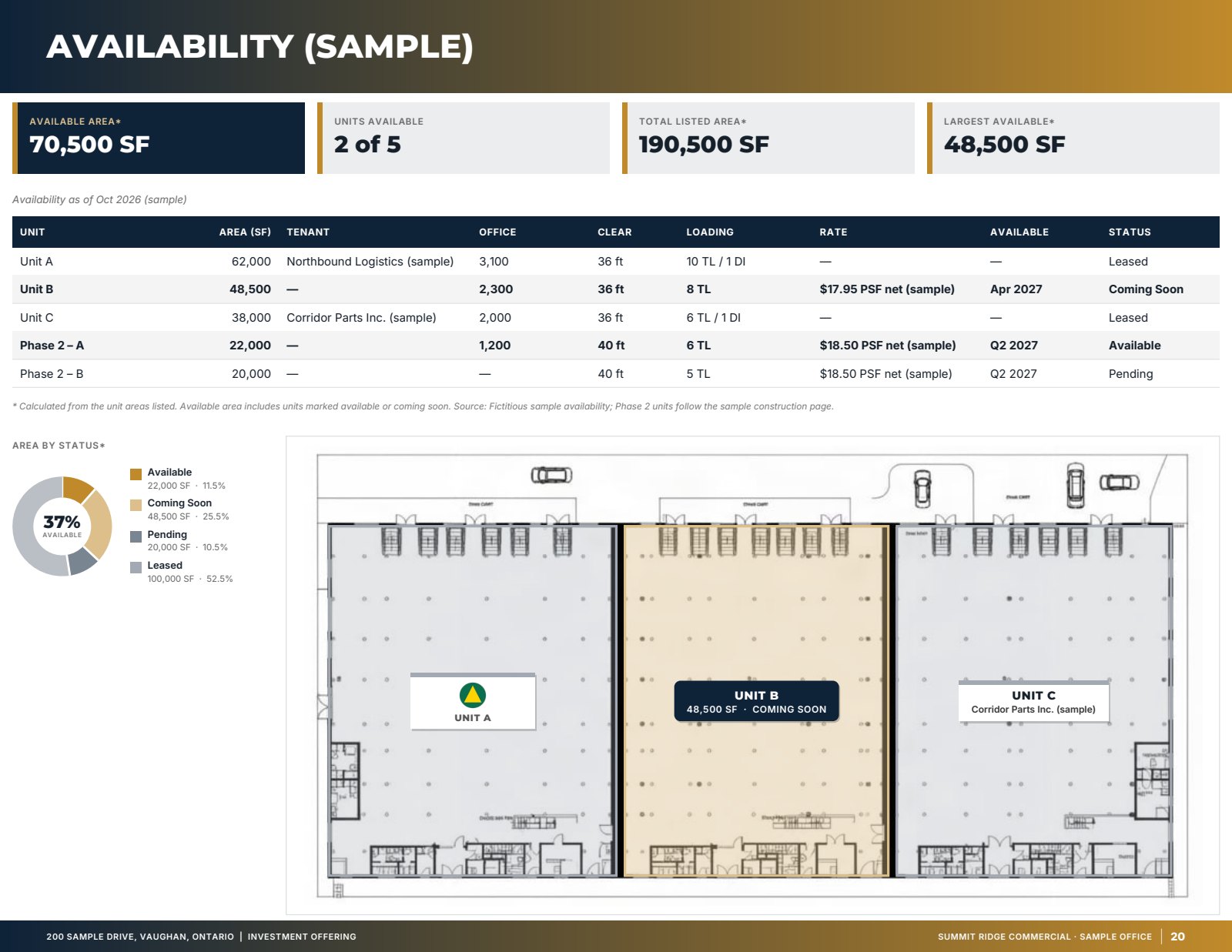
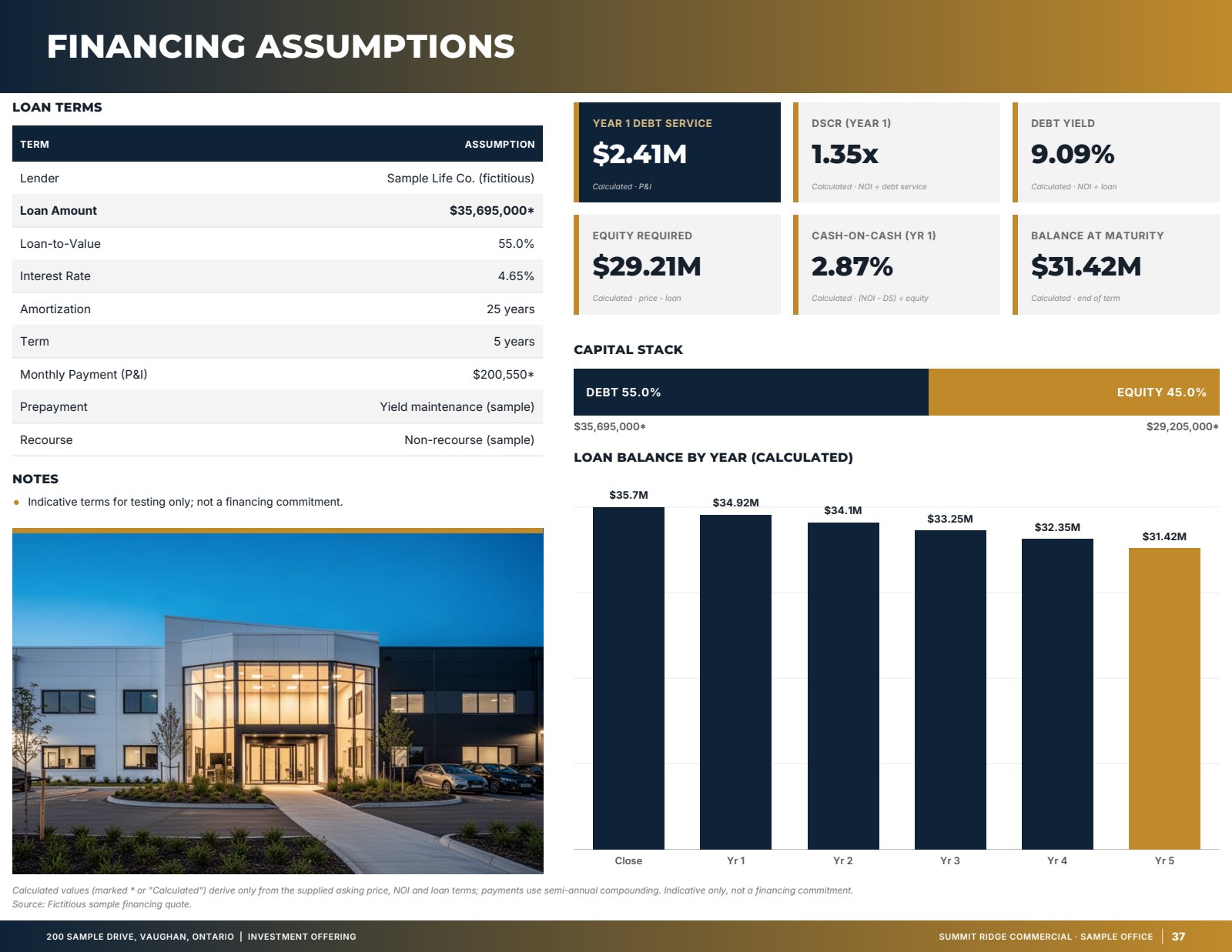
Sample — fictitious property. Pages generated by the product for an invented sample listing with an invented brokerage brand. Figures marked (sample) are not real.
Related
Last updated 2026-10-15. General information for commercial real estate professionals, not legal advice.
Start with the fact sheet you already have.
Upload it, answer only what’s missing for the output you choose, and review a watermarked preview before you buy anything.