CRE marketing guide
Tenant profiles and covenant strength in an offering memorandum: what buyers need to see
How to describe tenants and covenant strength in a commercial offering memorandum: guarantor, financials, lease term and honest sourcing.
Why the tenant page often decides the price
In an income property, the buyer is mostly buying a stream of rent, and the rent is only as good as the tenant who pays it. Two buildings with the same net operating income can trade at very different prices if one is leased to a national operator with a strong balance sheet and the other to a start-up on a short lease. The buyer, the lender and the lender’s underwriter all ask the same question early: who is the tenant, and how likely are they to keep paying?
A tenant profile answers that question in a page. It is not an advertisement for the tenant. It is the seller’s attempt to put in one place the facts that let a buyer judge the risk, so that the buyer does not have to assemble them from search results and rumour. A page that is specific, sourced and honest about what is not known earns more trust than a glowing paragraph copied from the tenant’s own website.
Covenant: the word buyers use for tenant strength
In commercial leasing, covenant means the ability and willingness of the tenant, or whoever stands behind the lease, to meet the obligations in it. A strong covenant is a tenant with a long operating history, stable earnings and the capacity to pay rent through a downturn. A weak covenant is one where a buyer cannot tell, or where the signs point to strain.
Covenant is not the same as brand recognition. A well-known banner can operate through a thinly capitalized local franchisee, and an unfamiliar company can be a financially sound subsidiary of a large group. What counts is the legal entity that signed the lease, whether anyone guarantees it, and what the guarantor is worth. If the tenant on the lease is a numbered company or a single-purpose entity, say so, and show whether a parent or an individual guarantees the lease.
What a useful tenant profile contains
- Legal name of the tenant and of the guarantor, if any, exactly as on the lease, with the trade name beside it.
- What the business does, in one or two plain sentences, and how long it has operated, including at this location.
- Size and footprint: number of locations, headquarters, number of employees where the tenant publishes them.
- Ownership: publicly traded, privately held, franchise, government or a subsidiary of a larger group. Name the parent when it matters to the lease.
- The premises: suite, area leased, share of the building and share of the total rent.
- Lease facts that bear on covenant: start and expiry dates, renewal options, any early termination right, security deposit, and the guarantee. Cross-check each against the lease abstract.
- A short covenant statement: what is known, from where, and what the buyer should confirm. If there is a public credit rating or filed financial statements, cite them with the date. If there is none, say that financial statements are available on request under the confidentiality agreement.
Avoid adjectives that cannot be checked, such as industry-leading or recession-proof. Replace them with the fact that supports the claim, such as the number of years the business has operated, or leave them out.
Where the facts come from, and who is responsible for them
Facts about a tenant should come from the lease, the tenant’s own published material, public filings or a written statement from the tenant or its guarantor. Write the source on the page. A buyer who sees that a figure comes from a named annual report, with a year, will trust the rest of the page more than one who sees an unattributed number.
Be careful about what you are allowed to publish. A lease may restrict disclosure of its terms, and some tenants ask that their financial information be released only to qualified buyers after a confidentiality agreement. Check the lease and ask the tenant before putting its financials in a document that will be widely distributed. Holding the detail back for the data room is a normal practice, and the OM can say what is available there.
The broker is responsible for the accuracy of what goes into the OM. If something cannot be verified, say it is the seller’s information, or leave it out. Never estimate a tenant’s credit quality or invent a rating.
Single tenant, multi-tenant and anchor-supported centres
In a single-tenant net lease, the tenant profile is the centrepiece. Show the full detail above, the lease abstract with rent steps and options, and how long the tenant has operated at this location. See our guide on single-tenant net lease offering memorandums for the surrounding pages.
In a multi-tenant building, a profile for every suite is impractical. Profile the tenants that carry the income: the largest by rent, any anchor, and any tenant that draws traffic for the others. For the rest, the rent roll lists name, area, rent and expiry. A useful rule is to profile enough tenants to cover most of the base rent, and let the rent roll cover the remainder.
In a shopping centre, anchors matter in two ways: the rent they pay and the traffic they bring. Say whether smaller tenants have co-tenancy clauses tied to the anchor, because a buyer will ask. Our retail plaza guide covers the other retail pages.
Canada and the United States
The vocabulary overlaps, but the practice differs. In the United States, buyers of net lease properties often look for a published credit rating on the tenant or its parent and a corporate guarantee, and estoppel certificates from the tenant are standard. In Canada, ratings are less often available for private operators, so personal or corporate guarantees, financial statements and operating history carry more of the weight. In both countries, say whether the guarantee is of the full lease term and whether it is limited in amount or time.
Currency and terminology should be consistent with the property’s location: square feet in the United States, square feet or square metres in Canada depending on the market and the listing, and Canadian or US dollars as appropriate.
How OfferingStack handles tenant profiles
OfferingStack has a tenant profiles page for full offering memorandums. You enter the facts, such as the tenant’s name, industry, headquarters, year founded, number of locations, ownership, covenant statement, website and a short description, along with the suite and area leased. The page lays out up to nine tenants, three to a page, and shows a source line you write. The tenant facts are yours: the system does not research tenants, estimate their credit or fill in missing details, so a field you leave blank is simply not shown. A separate lease abstract page can carry the terms, rent schedule and options for each lease. You review every page before the document is distributed.
Tenant profile checklist
- Legal name of tenant and guarantor match the lease.
- Description of the business is specific and in plain words.
- Operating history and number of locations are stated with a source.
- Share of rent and share of area for the tenant are shown.
- Lease dates, options and any termination right agree with the lease abstract and rent roll.
- Covenant statement says what is known, from where, and what is available on request.
- The lease allows the information to be shared, and the tenant has been asked where needed.
- Nothing on the page is an estimate of credit quality presented as fact.
This guide is general information, not legal or investment advice. Have your brokerage’s counsel review anything that touches tenant confidentiality.
What these pages look like
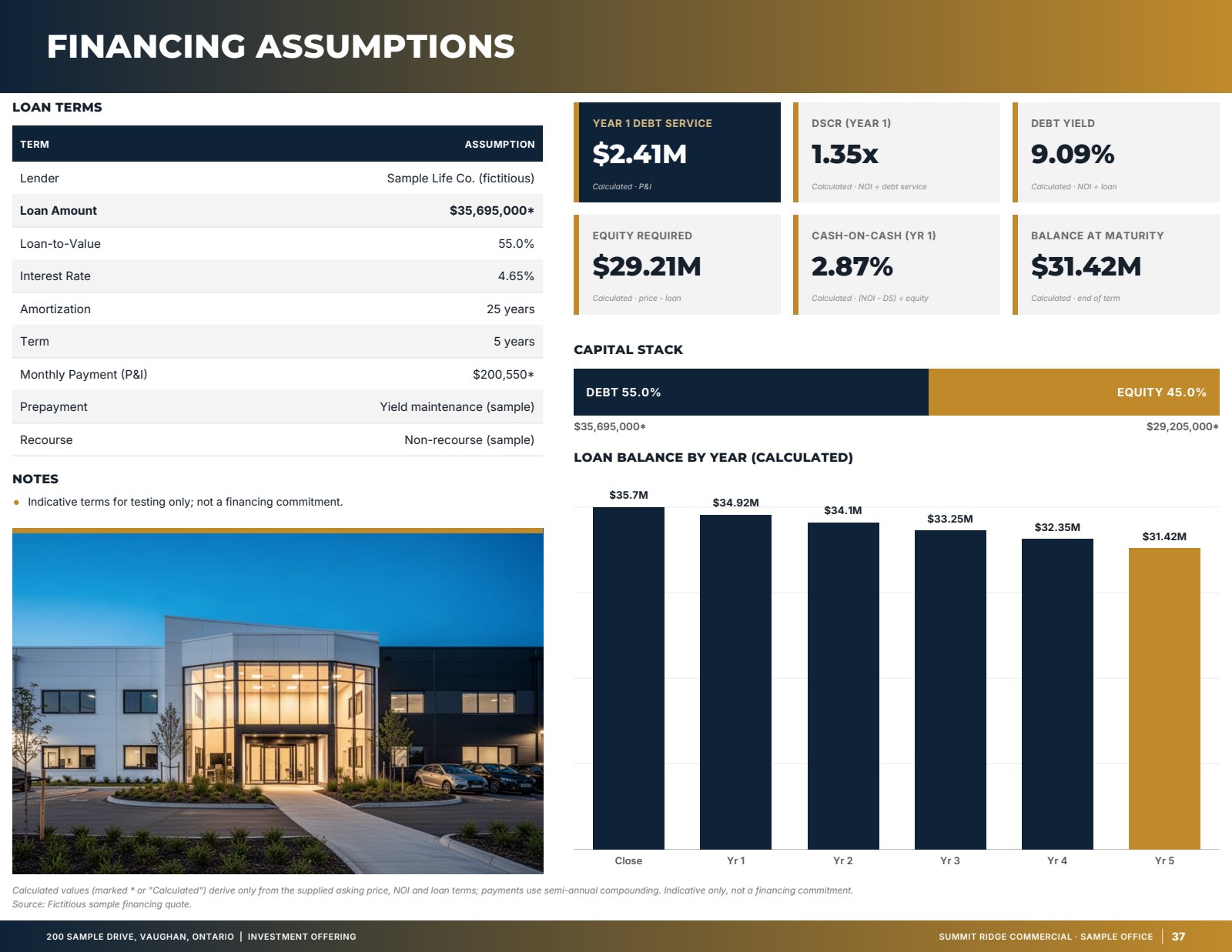
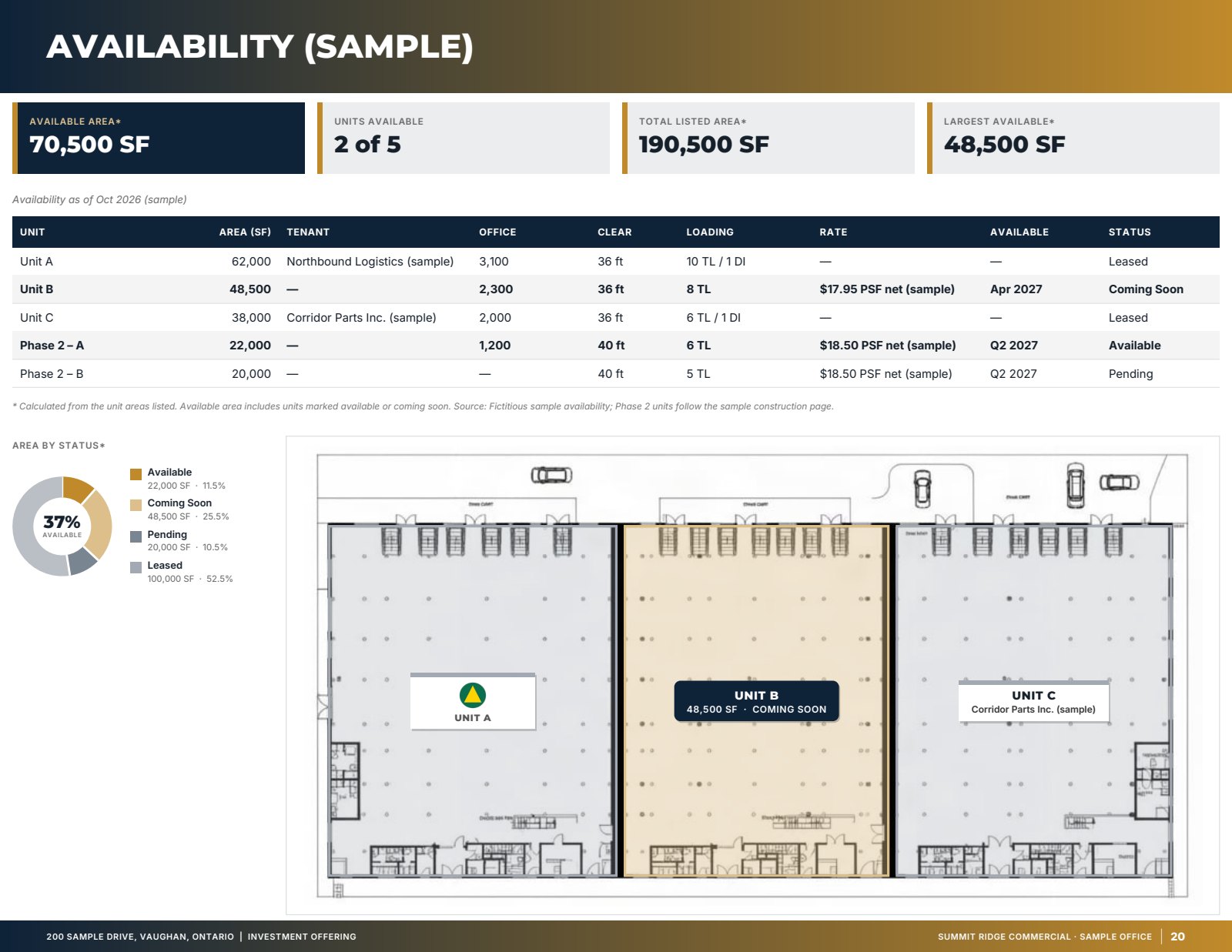
Sample — fictitious property. Pages generated by the product for an invented sample listing with an invented brokerage brand. Figures marked (sample) are not real.

Related
Last updated 2026-10-15. General information for commercial real estate professionals, not legal advice.
Start with the fact sheet you already have.
Upload it, answer only what’s missing for the output you choose, and review a watermarked preview before you buy anything.