CRE marketing guide
How to build and use a commercial real estate buyer list (with email consent)
How brokers build a commercial buyer list, record acquisition criteria and email consent, and match each new listing to the right investors.
Why a buyer list is worth keeping
Most commercial listings are not sold to a stranger who found a sign. They are sold to someone the broker already knew, or someone a colleague knew, who was looking for exactly this kind of property at about this size in about this area. A buyer list turns that memory into something you can search. Instead of trying to recall who mentioned a cold-storage requirement last spring, you open the list, filter by what they are looking for and write to the five or ten people who fit.
A list is only useful if it is current and if you are allowed to email the people on it. Both depend on what you record when someone joins: what they want, and how and when they agreed to hear from you. This guide covers both, with the rules that apply in Canada and the United States. It is general information, not legal advice. Anti-spam rules are strict in some jurisdictions, so confirm your approach with your brokerage’s compliance contact or counsel.
What to record for each buyer
A name and an email address are not enough. A list of addresses can only be broadcast to. A list of buyers with criteria can be matched. For each contact, keep:
- Who they are: name, company, phone and email, and whether they are a principal, an adviser or a broker acting for someone.
- Deal types: whether they buy, lease or both.
- Property types: industrial, office, retail, multifamily, land, hotel, self-storage and so on. Use the same labels you use on your listings so the two can be compared.
- Size and price range: minimum and maximum building area, and the price range they will consider. A minimum cap rate is useful for investors who screen on yield.
- Where: the cities, municipalities or regions they want. “Anywhere in the province” is a valid answer, but it is worth knowing when it is true.
- Consent: the kind of consent you have, the date you received it and a short note of how, such as “signed up on the listing page” or “asked to be kept informed after the tour”.
Keep the criteria honest and short. A buyer who has told you “warehouse, 20,000 to 60,000 square feet, west end” is easy to match. A buyer you have tagged with every property type is not, and will receive messages that do not fit.
Email consent: the Canadian rules in plain terms
Canada’s anti-spam law, usually shortened to CASL, applies to commercial electronic messages sent to people in Canada, including a broker’s email about a property for sale. In general, you need the recipient’s consent before you send, and every message must identify you, give your mailing address and contact details, and include a working way to unsubscribe that you honour promptly.
Consent comes in two broad forms. Express consent means the person has clearly agreed, for example by ticking an unticked box or asking in writing to be on your list. It remains valid until they withdraw it. Implied consent applies in narrower situations that the law defines, such as an existing business relationship or an inquiry the person made to you. Implied consent expires. A common working rule is two years from a transaction or contract, and six months from an inquiry. Because those time limits are the reason lists go stale, record the consent type and date for every contact, and treat anything past its limit as not yet permitted until it is renewed.
Publishing an email address is not the same as consenting to receive offers. Be careful with addresses bought, scraped or copied from a directory. If you cannot say where an address came from and when the person agreed, do not email it.
The United States and Québec
In the United States, the federal CAN-SPAM Act takes an opt-out approach to commercial email: you generally may send, but you must not mislead about who you are, you must include a valid physical postal address, and you must honour an unsubscribe request within the period the law sets. Some states add requirements, and rules for text messages and calls are stricter than for email. Recording how and when each person joined still protects you if anyone questions where an address came from.
In Québec, communications with Québec recipients may also need to be available in French. If your buyers include French-speaking investors, ask which language they prefer and keep that on the record.
If you email people in several countries, apply the strictest rule that fits your list. That usually means recording consent and offering a clear unsubscribe to everyone.
Ways buyers can join the list
- In person or by phone: after a tour or call, ask whether they would like to hear about similar properties, and write down the answer and the date.
- On the listing page: a short form beside the listing, where the buyer chooses what they want and ticks a consent box that starts unticked. A pre-ticked box is not meaningful consent.
- By inquiry: someone who asks about a specific property has made an inquiry, which can support implied consent for a limited time for messages about that property. It is not a lifetime subscription.
- By import: if you bring in a list from another system, bring the consent type, date and source with it. A spreadsheet of addresses with no history is a liability, not an asset.
Matching a new listing to your buyers
The point of recording criteria is to answer one question the day a listing launches: who on my list should hear about this first? A simple match compares the listing’s deal type, property type, size, price and location with each buyer’s criteria, and also checks that the buyer’s consent is still valid. The result should show why each buyer was chosen so that you can judge the fit yourself.
Two rules keep matching trustworthy. First, a buyer with no stated criteria should not match every listing, because that is how a list turns into a broadcast. Second, buyers who fit but cannot be emailed, because they unsubscribed or their consent has expired, should be shown separately with the reason, so that you can ask them to renew rather than quietly losing them.
Do the match before you write the email. If only six buyers fit, a personal note to six people will outperform a polished message to six hundred. See our guide on listing email blasts for how to write the message once you know who it is going to.
Sending: use a proper email tool and keep the record
Send from an email tool that supports unsubscribe links, bulk sending without exposing every recipient’s address, and reporting. If you must send from your own mailbox, put recipients in BCC, in small batches, and include your mailing address and an unsubscribe line. When someone unsubscribes, record it the same day, remove them from every future send and keep the unsubscribe on file so that they are not re-added by a later import.
Keep records for as long as you rely on the consent. If a recipient or a regulator asks how you obtained an address, a note of the source and date is your answer.
Where OfferingStack fits
On paid plans, OfferingStack gives you a buyer list in your account. Each contact has the criteria above and a consent record with the type (express, inquiry or business relationship), the date and a short note of the source. You can add buyers one at a time or import a CSV that includes the consent columns, and export the list at any time. An unsubscribe is applied immediately and stays applied.
For any saved listing you can open “Matching buyers”. It lists the buyers whose criteria fit and whose consent is still valid, with the reasons, and separately shows those who fit but cannot be emailed and why. A buyer with no criteria is never matched to everything. From there you can copy the addresses in BCC batches of up to 50, download a CSV or carry the recipients into the email blast writer.
If you turn on the listing website, visitors can join your buyer list from the listing page. The card starts with the listing’s type, deal and city filled in, and the consent box is unticked until the visitor ticks it. The consent is recorded with the signup.
OfferingStack does not send email to your buyers. You send from your own email tool, with your mailing address and an unsubscribe link. The list and the match are there to help you keep records and choose recipients, and they do not replace advice from your brokerage’s compliance contact or counsel.
Buyer list checklist
- Every contact has a name, email, company and phone where known.
- Every contact has criteria: deal type, property types, size, price range and locations.
- Every contact has a consent type, a date and a note of the source.
- Implied consent is renewed before it expires, and anything expired is not emailed.
- The listing page form starts with the consent box unticked.
- Imports include consent columns, and addresses of unknown origin stay out.
- Each listing is matched before the email is written, and the recipients are chosen by fit.
- Every message carries your name, mailing address and a working unsubscribe link.
- Unsubscribes are recorded the same day and never re-added.
- Your brokerage’s compliance contact has reviewed the process.
This guide is general information, not legal advice. Anti-spam and privacy rules change and differ by province, state and country.
What these pages look like
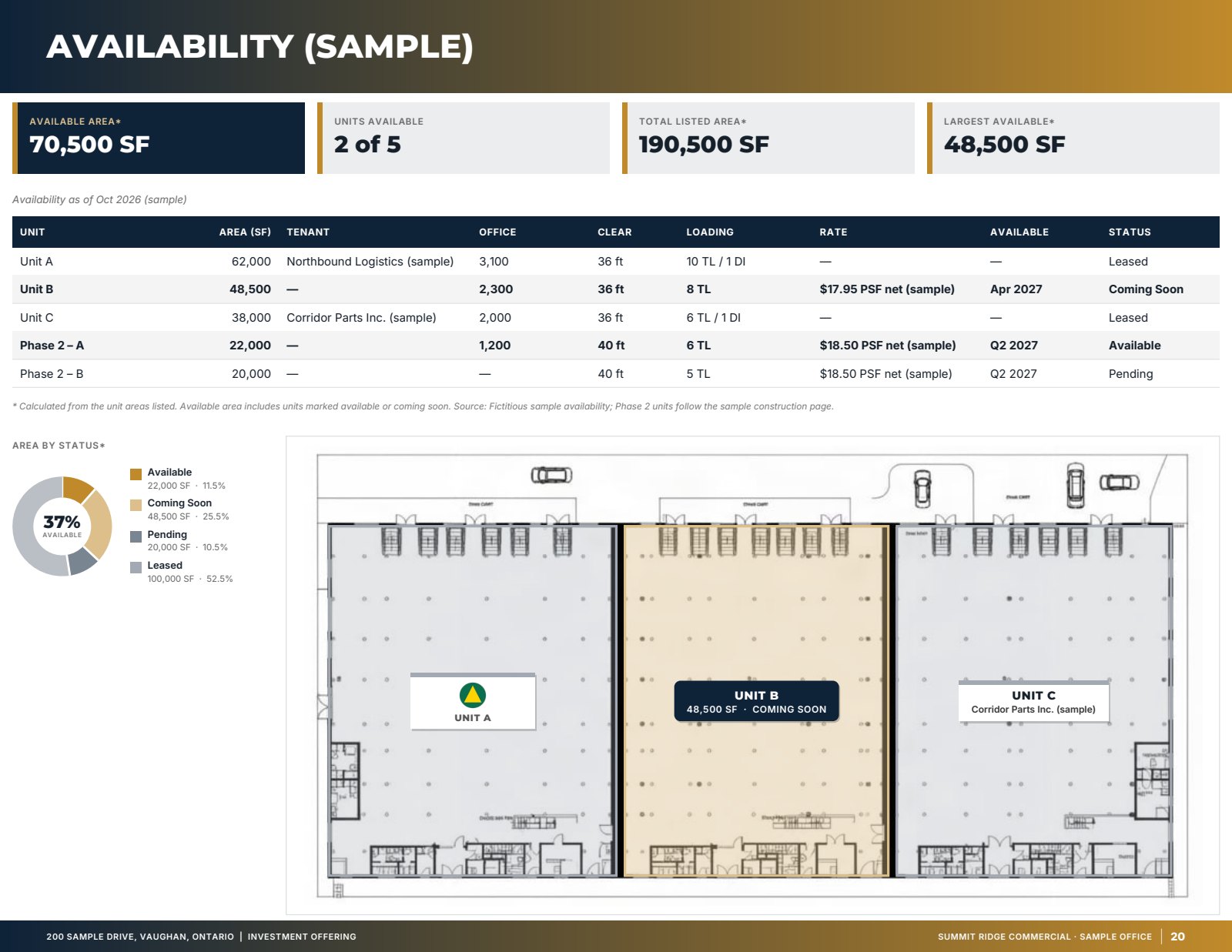
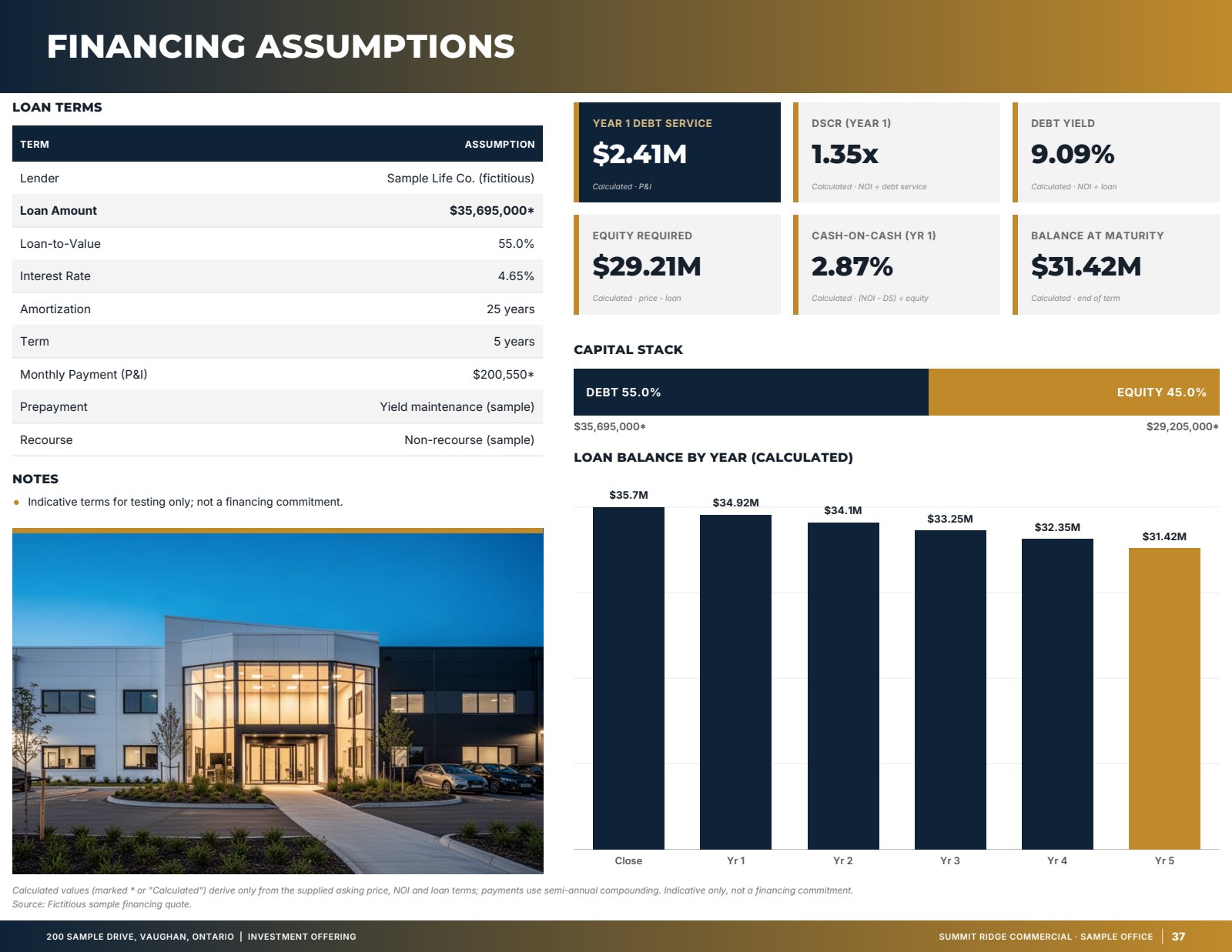
Sample — fictitious property. Pages generated by the product for an invented sample listing with an invented brokerage brand. Figures marked (sample) are not real.

Related
Last updated 2026-10-16. General information for commercial real estate professionals, not legal advice.
Start with the fact sheet you already have.
Upload it, answer only what’s missing for the output you choose, and review a watermarked preview before you buy anything.