CRE marketing guide
Self-storage facility listing checklist: what buyers underwrite before they call
A checklist for marketing a self-storage facility for sale: the unit mix, rates, occupancy and income buyers test, and how to show them clearly.
Who buys a storage facility, and how they read the listing
Self-storage earns its income from many small, mostly month-to-month rentals. That makes it closer to a small operating business than to a leased building, and the people who buy it read a listing that way. Some are experienced operators who own other facilities and will spot a gap in the numbers in minutes. Others are first-time owners or investors from other property types who need the business explained before they can value it.
Both groups start in the same place: the unit mix, what each size rents for, how full the facility is and what it earns after expenses. A listing that makes those four things easy to find gets a second look. A listing that leads with the neighbourhood and a paragraph of adjectives does not.
The unit mix is the centre of the listing
Show the mix as a table with one row per unit type. A unit type is a size plus a style, for example a small interior unit, a drive-up unit, a climate-controlled unit or a vehicle space. For each row give:
- The number of units and the average size of a unit.
- The in-place rent, meaning what existing customers pay on average, per month.
- The current street rate, meaning what a new customer is quoted today, per month.
- The count of units occupied, or the occupancy of the row, with the date it was measured.
The gap between in-place and street rates is one of the first things a buyer looks at, because it shows where rent may have room to move and where past discounting has pulled the average down. Do not hide it. If in-place rents are well below street, say what you know about why, for example older customers on legacy rates or promotional pricing, and let the buyer draw the conclusion.
State units and area on a stated basis. Net rentable area and gross building area are different numbers, and a buyer who finds a ten per cent difference on site will doubt everything else on the page. Say which one each figure is, and keep to it in the brochure, the sign and the email.
Occupancy: physical, economic and the date
There are two ways to say a facility is full. Physical occupancy counts the units that are rented. Economic occupancy compares the rent actually collected with the rent the facility would collect if every unit were rented at the street rate. They are often different, and the better listing gives both when it can.
Whatever you quote, attach a date. Occupancy at the end of the last full month is a fact; occupancy described as high is not. If you quote a trailing average, say over what period. If a figure moves with the season, show a period long enough to include a full year.
Income and expenses on an honest basis
Buyers underwrite from the trailing twelve months of income and expenses, usually with the most recent few months broken out. Present rental income, other income and operating expenses separately, and say whether the figures are actuals, owner-reported or adjusted.
Other income deserves its own lines: tenant insurance or protection plans, retail sales of locks and boxes, late fees, truck rental commissions or vehicle storage. Say which items would continue under new ownership and which belong to the seller’s own programme.
On the expense side, show property taxes, insurance, utilities, payroll, marketing, repairs and management as separate lines. A facility run by its owner with no payroll will look better than it is; if the seller’s own labour is not charged, say so and show what a manager would cost so the buyer sees a normalised figure. For more on presenting the statement, see the guide on operating statements and NOI.
If you show an asking price and a cap rate, state the NOI the cap rate is based on and label it as calculated from the figures shown. A cap rate quoted without its NOI cannot be checked, and an unexplained one invites a lower offer.
The physical facility
Describe the site in the plain terms an operator uses: land area, number and type of buildings, storeys, construction, whether buildings are drive-up, interior or climate-controlled, and any covered or open vehicle parking. Add the access gate, the hours of access, the security (cameras, keypads, lighting), the office and any resident-manager arrangement, and the age and condition of roofs, doors, paving and the climate-control equipment.
Say what capital work has been done recently and what is due. A new roof or repaved driveway is a selling point; a roof that will need work in two years is a number the buyer will subtract from their offer whether or not you mention it, so it is better that you do.
Photograph every building type, including an interior corridor, a drive-up door, the office and the entrance. Buyers want to see that the facility looks clean and maintained, and that the photographs are of this facility.
Expansion land and the zoning
Spare land is often part of the story. If the site has room for another building, give the area available, what has been approved or discussed with the municipality, and what is not yet confirmed. Do not imply approval that you do not have. State the zoning designation with the source, and note any restrictions on storage uses, outside storage or vehicle storage, since these differ widely between municipalities and states.
Competition and the trade area
Buyers assess supply near the site as carefully as they assess the facility. List the competing facilities you consider relevant, with their addresses and, if you can support them, their approximate size or type, and show them on a map with the drive times from the property. Choose the competitors yourself rather than listing every facility in the area; a short, accurate list is more credible than a long one you cannot stand behind. Do not quote competitors’ rates unless you have a source you can name.
Add population and household figures for the trade area, with the source and the year. Avoid statements about demand that you cannot back with a named, dated source.
Common mistakes in storage listings
The most common is an unclear unit mix: a total unit count and a total area with no breakdown, so the buyer cannot tell the share of climate-controlled units or the average rent per square foot. Give the breakdown even when it is long.
The second is mixing time periods. A rent roll as of one date, income for another period and occupancy for a third make the figures look inconsistent even when they are all accurate. Put the as-of date beside every figure.
The third is omitting the management story. Buyers want to know who runs the facility, whether there is a resident manager, which software or processes run billing and access, and how much of the operation transfers. Describe the operation as it is.
The fourth is exaggerating rate upside. An honest statement that street rates are above in-place rates is useful. A claim that the buyer can simply raise everyone’s rent is not, and sophisticated buyers will discount it.
Where to send it
Storage facilities are bought by local and regional operators, investors moving from other property types, and owners of neighbouring facilities, as well as by buyers outside the area. Send a short teaser first and the full memorandum to those who sign your confidentiality agreement, and keep the financials behind that step. Follow your jurisdiction’s anti-spam rules and record how each contact agreed to hear from you.
How OfferingStack helps
The self-storage offering memorandum template builds the memorandum, or a shorter brochure, around these facts: a Unit Mix page with the count, average size, and in-place and street rent per month for each unit type, an operating statement with the period of each figure, an asking price and cap rate with a sensitivity table when you enter the NOI, drive-time areas, a map of the competing facilities you add, and population and household figures from census tables with their source and year. Pages without data are left out instead of showing empty boxes, and you review everything before it is shared. See the template and the sample pages for what it produces.
Self-storage listing checklist
- The unit mix shows count, average size, in-place rent and street rate for every unit type.
- Area is stated on one basis, net rentable or gross, throughout.
- Occupancy is stated as of a date, and physical and economic occupancy are both given where available.
- Income and expenses are shown for a stated period and labelled as actual, owner-reported or adjusted.
- Other income lines say which items continue under new ownership.
- Owner labour and management are normalised or explained.
- Buildings, access, security and the condition of roofs, doors and climate control are described, with recent and upcoming capital work.
- Expansion land, zoning and any approvals are stated with sources and no unconfirmed claims.
- Competing facilities are chosen deliberately, located on a map and not given rates without a source.
- Population figures name their source and year.
- Recipients are chosen by fit and have agreed to receive your email.
This guide is general information, not legal advice. Zoning, consumer-protection rules for storage agreements and anti-spam rules differ by province, state and country.
What these pages look like
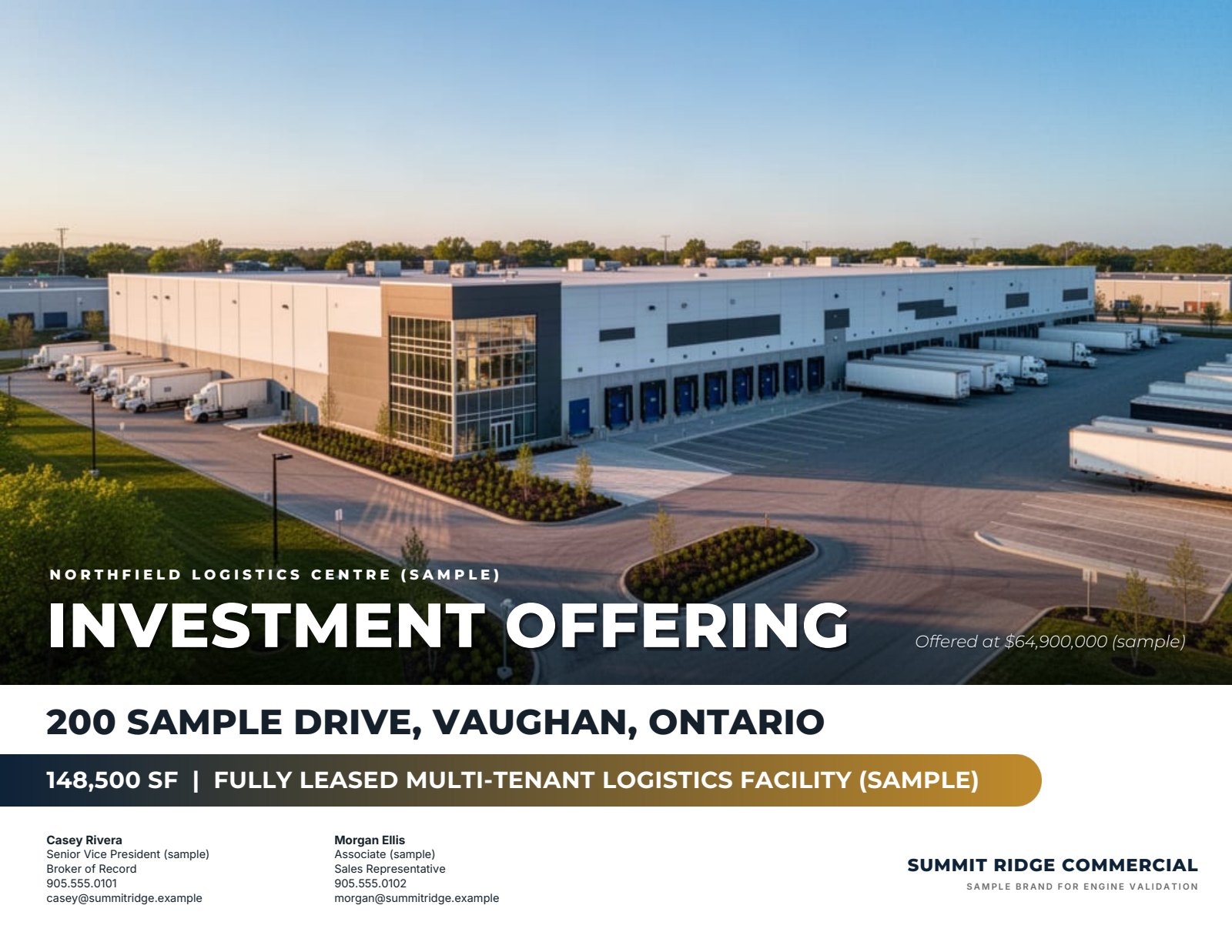
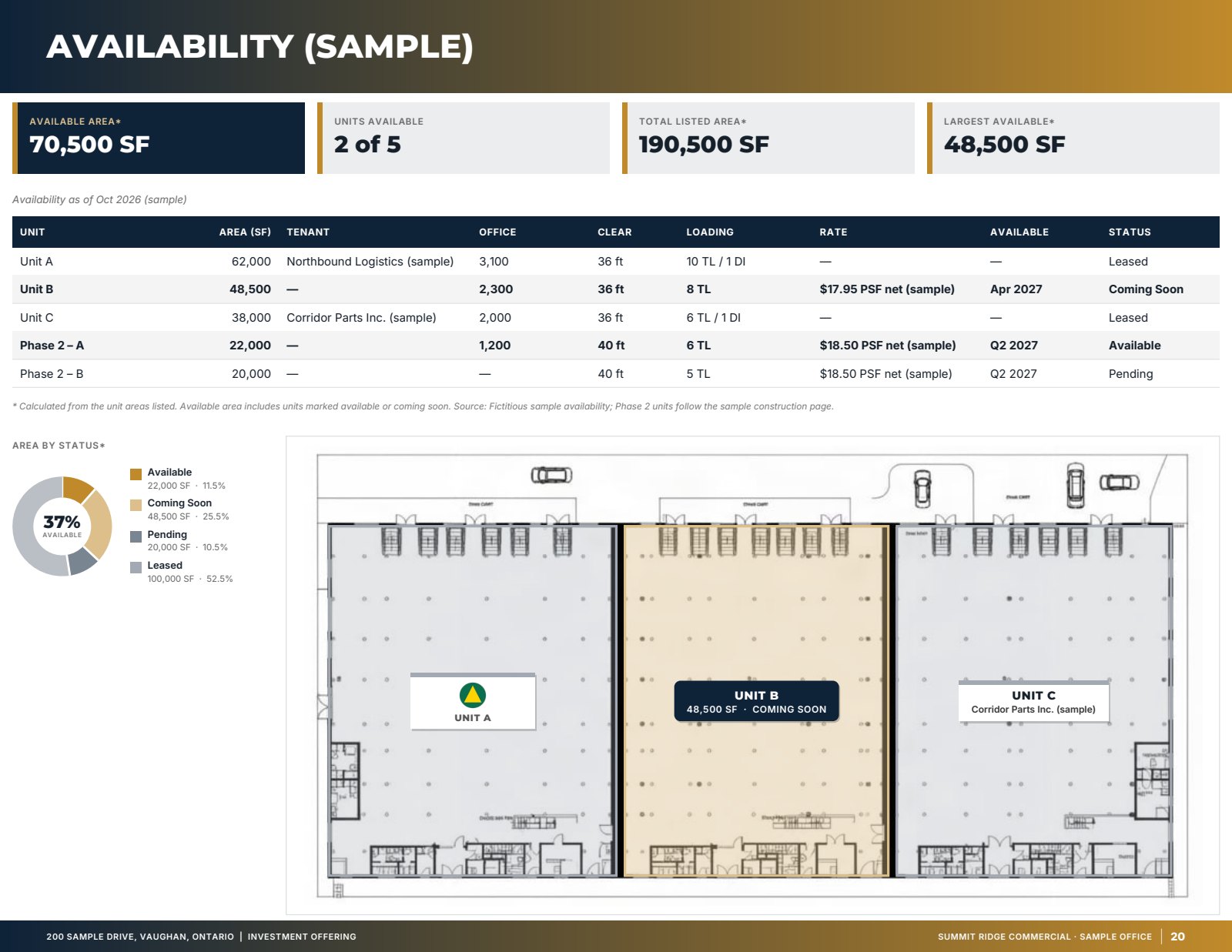
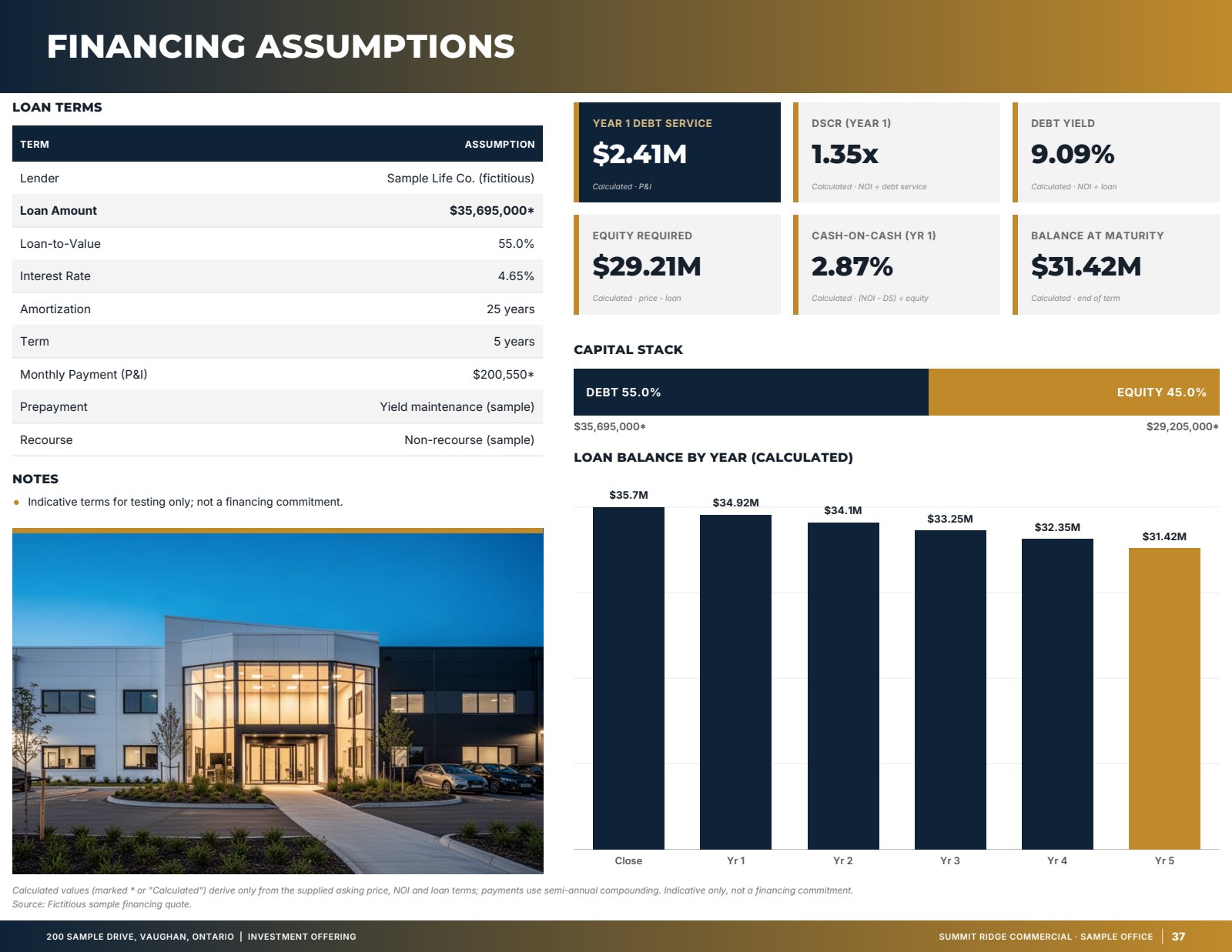
Sample — fictitious property. Pages generated by the product for an invented sample listing with an invented brokerage brand. Figures marked (sample) are not real.
Related
Last updated 2026-10-17. General information for commercial real estate professionals, not legal advice.
Start with the fact sheet you already have.
Upload it, answer only what’s missing for the output you choose, and review a watermarked preview before you buy anything.