CRE marketing guide
The executive summary of an offering memorandum: how to write the page most buyers read first
How to write the executive summary of a commercial real estate OM: what goes in the first paragraph, which figures to show, length, and common mistakes.
What the executive summary is for
The executive summary is the page right after the cover and the confidentiality notice, and for many readers it is the only page they read closely. Buyers, their analysts and lenders receive many offering packages; they use the first page of substance to decide whether the property fits their mandate before they open the rent roll or the financials. If the summary does not answer that question in a minute or two, the rest of the document may never be read.
So the job of the page is narrow: say what is being offered, on what terms, and why it is worth a closer look, using facts the rest of the document backs up. It is not the place for the full story of the building, the market or the neighbourhood. Those have their own pages.
What to put in the first paragraph
Write the opening paragraph so that it would still work if it were the only thing a buyer read. In two to four sentences it should cover:
- What the property is: the asset type, the size in the unit the market uses (square feet, units, keys, acres or hectares) and the number of buildings if more than one.
- Where it is, at the level a buyer needs: the city or municipality, the submarket or node, and the access that matters for this type (a highway interchange for industrial, a transit station for office, an anchor or intersection for retail).
- What is being sold or leased: freehold or fee simple, leasehold, a portfolio, a partial interest, or space for lease.
- The deal terms that decide interest: the asking price or the fact that it is unpriced with a call for offers, and for a lease the rate basis.
- The one or two facts that make it different, stated plainly: fully leased to a national tenant, vacant possession for an owner-user, excess land, a recent major renovation.
Lead with facts, not adjectives. "A 48,000 sq ft multi-tenant industrial building, 92% leased to six tenants, offered unpriced" tells an analyst more than "a rare opportunity to acquire a premier asset".
The figures that belong on the page
Most executive summaries put a small set of headline figures next to the text, as tiles or a short table. Choose them for the deal type and keep them to the ones a buyer screens on:
- Investment sale: price, size, occupancy, net operating income, cap rate, and the weighted average lease term if leases drive the value.
- Owner-user sale: price, building area, site area, price per square foot, clear height or other key spec, and possession date.
- Land: price, site area, price per acre or hectare, zoning, and the permitted or proposed density.
- Lease: available area, asking net rent, additional rent estimate, availability date and term.
- Apartments and hotels: units or keys, price per unit or key, occupancy, and income figures on the basis the market uses.
Every figure here must match the figure on the detailed pages. If the cap rate on the summary is calculated from the asking price and the in-place NOI, say so; if it is based on a projected NOI, say that instead. A buyer who finds two different NOIs in the same document stops trusting the rest of it.
Length and structure
One page is the norm. A useful structure is a short title, a lead paragraph in larger type, two to four short paragraphs, and the figures beside or below them. If the text runs past a page, it usually means the summary is repeating the property description or the market section. Cut it back and move the detail to where it belongs.
Keep the investment highlights separate. The summary describes the offering; the highlights page lists the specific, checkable reasons to buy. Repeating the same five points on both pages wastes the reader’s attention and makes the document feel padded.
An example outline
Here is how the page might read for an invented property, to show the structure rather than the wording to copy. Title: “Executive Summary”. Lead: a single sentence naming the asset type, size, location node, occupancy and the fact that it is offered unpriced by call for offers. Paragraph one: the building and site in plain terms, with the two specifications this buyer type screens on. Paragraph two: the tenancy in one or two sentences, with the rollover profile and the largest tenant’s share of income if it can be disclosed. Paragraph three: the offering process and the date offers are due. Beside the text: price or “unpriced”, building area, site area, occupancy, NOI and the weighted average lease term.
Notice what is missing: no history of the city, no list of nearby restaurants, no repeated highlights. Each of those has its own page later in the document, and the summary points the reader to them instead of duplicating them.
Writing it for Canada and the United States
Use the terms the local market uses. In Canada, buyers expect square feet for buildings in most markets but may see square metres in Quebec documents, acres or hectares for land, and additional rent or TMI for lease costs; HST or GST treatment of the sale is sometimes mentioned. In the United States, NNN lease language, fee simple interest and acres are standard. State the currency when a document may be read across the border.
If the document is also produced in French, write the French summary rather than translating word for word; the lead paragraph in particular should read naturally in both languages.
Common mistakes
- Opening with the market or the city before saying what the property is.
- Superlatives with no fact behind them: "best-in-class", "irreplaceable", "trophy".
- Figures that disagree with the rent roll, the operating statement or the pricing page.
- A cap rate or yield with no basis stated.
- Paragraphs copied from the listing description, the highlights and the location page, so the same sentence appears three times.
- Tenant names or lease details that the leases or the seller do not allow you to disclose in this document.
- No mention of how to make an offer when the property is offered by call for offers.
A simple checklist before it goes out
- The first paragraph says what, where, what interest and on what terms.
- The headline figures are the ones this buyer type screens on, and each matches the detailed pages.
- Calculated figures are identified as calculated, with their basis.
- The page fits on one page without shrinking the type.
- Nothing on it is repeated word for word on the highlights page.
- A colleague who has not seen the property can explain the deal after reading it once.
Building the executive summary with OfferingStack
In the OfferingStack builder the executive summary has a title, a lead paragraph and up to six paragraphs, with an optional headline and photo. Beside the text, the page shows up to six metric tiles taken from the listing’s headline figures; a tile whose figure was calculated from other figures you entered is captioned as calculated. If you don’t choose a photo, one of the listing’s own photos is used, and the text is sized to fit the page. The page only appears when you have written a lead or at least one paragraph, so an empty summary is never printed.
If you want a first draft, the AI writer can suggest a lead and two or three paragraphs written only from the facts already in your document: it does not search the web or add numbers. Figures in the draft are checked against your document and sentences with figures it cannot match are dropped. The draft is a suggestion: nothing goes into the document until you accept it, and you can edit every word afterwards.
What these pages look like
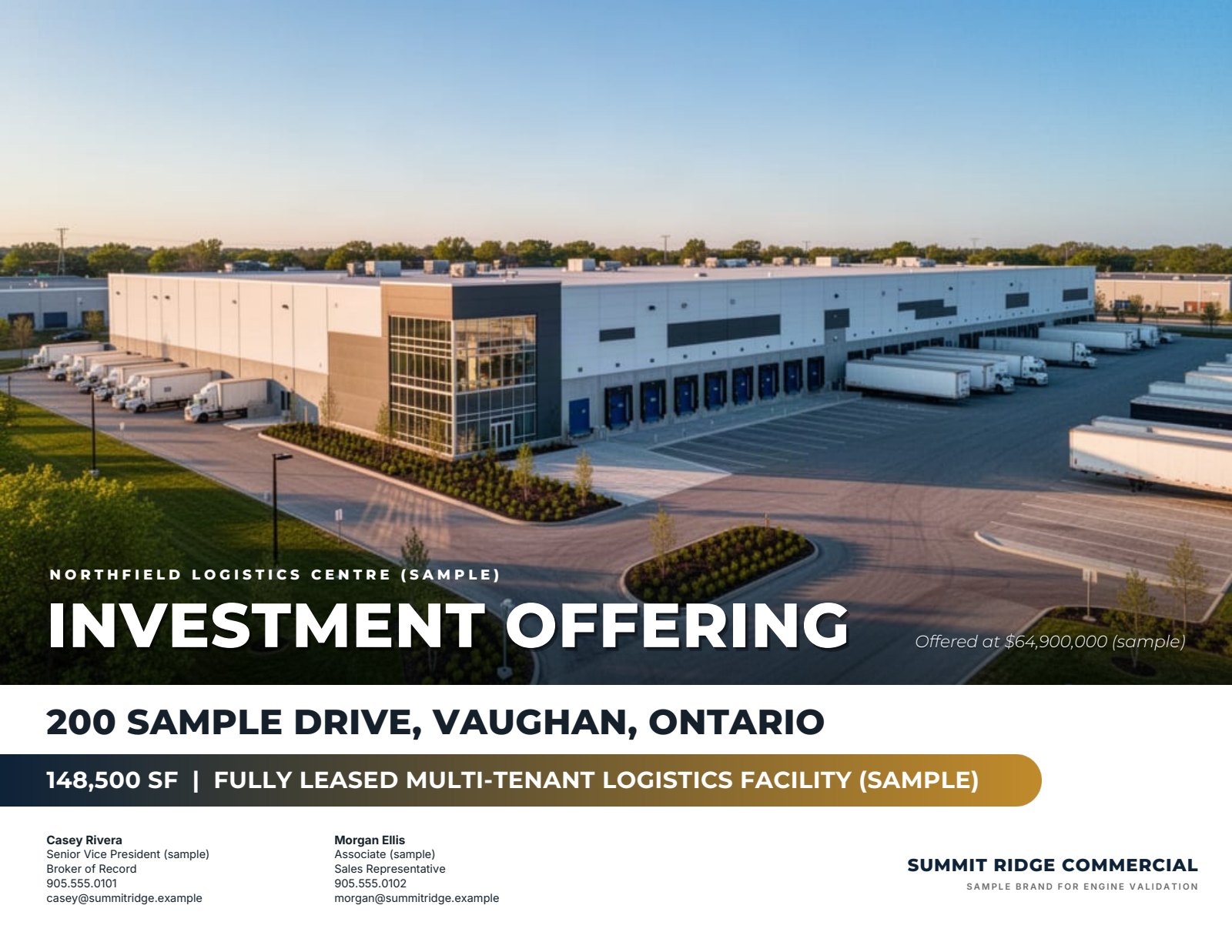
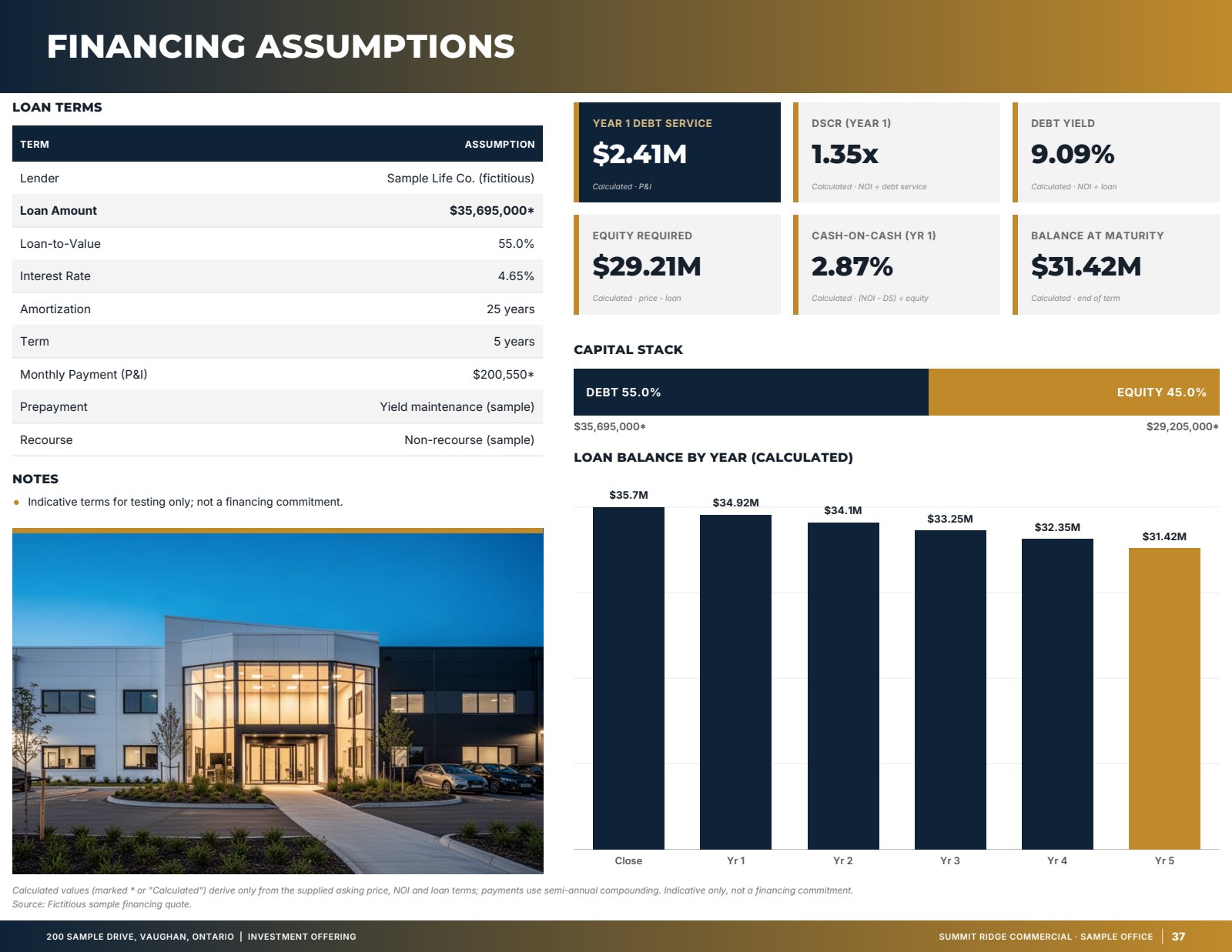
Sample — fictitious property. Pages generated by the product for an invented sample listing with an invented brokerage brand. Figures marked (sample) are not real.
Related
Last updated 2026-10-17. General information for commercial real estate professionals, not legal advice.
Start with the fact sheet you already have.
Upload it, answer only what’s missing for the output you choose, and review a watermarked preview before you buy anything.