CRE marketing guide
Capital expenditures in an offering memorandum: how to present past and planned capital work
How to present capital expenditures in a commercial real estate OM: completed and planned projects, costs, reserves, sources and the mistakes buyers find.
Why buyers look for the capital page
Every buyer of an income property asks two questions about the building itself: what has the owner spent on it, and what will I have to spend after closing. The answers change the price. A roof replaced three years ago, a new rooftop unit on every suite and a repaved truck court are reasons to pay more; a fifty-year-old electrical service or a roof at the end of its life is money the buyer will deduct from their offer, often with a margin for uncertainty on top.
A clear capital expenditures page answers those questions before the buyer’s engineer does. It will not hide a problem, and it should not try to. What it does is put the facts in order, show that the building has been looked after, and stop a buyer from assuming the worst about items nobody mentioned.
Capital expenditures versus operating expenses
Capital expenditures are spending that replaces or improves a major component of the property or extends its life: a roof, a boiler, an HVAC unit, an elevator modernisation, paving, windows, a new loading door, a structural repair. Operating expenses are the recurring costs of running the building: utilities, insurance, property taxes, cleaning, routine repairs and maintenance.
The distinction matters in an OM because capital spending is usually shown below net operating income. If a large repair was run through the operating statement in one year, NOI for that year looks lower than the building’s real earning power; if capital items are hidden in repairs and maintenance every year, NOI looks lower than it should and buyers cannot tell why. Say how the seller has treated these costs, and keep the treatment the same across every year you show. Accounting and tax treatment (capital cost allowance in Canada, depreciation in the United States) is a matter for the seller’s accountant, not the marketing document.
What to show: three kinds of project
Group the projects by status, because buyers read each group differently:
- Completed: work already done and paid for, with the year and, where the seller agrees to disclose it, the cost. This is the evidence that the building has been maintained.
- In progress: work under way at the time of marketing. Say who pays for the rest of it: the seller before closing, or the buyer by a credit or price adjustment.
- Planned or recommended: work the seller has budgeted or that a building condition report recommends. These are future costs the buyer will carry, so state the basis of each figure: a contractor quote, a consultant’s estimate or the owner’s budget.
For each project give the year, a short name, one line of detail that a buyer cares about (the scope, the warranty, the area covered) and the cost. Five to twelve projects is typical for a single building; list the material items rather than every invoice.
Sourcing every figure
Capital figures are among the first things a buyer verifies, so each one needs a source the seller can back up in the data room: invoices, contracts, warranties, the capital budget, or a third-party report. Two types of report are common. In Canada, a building condition assessment (BCA) by an engineering firm reviews each major system and estimates its remaining life and the cost to repair or replace it; condominium corporations also have a reserve fund study. In the United States, a property condition assessment (PCA), often prepared to the ASTM E2018 standard, plays the same role, and lenders usually require one.
If the seller has a recent report, say so on the page and make it available in the data room after the confidentiality agreement is signed. If the figures come from the owner’s own records, say that instead. Never round a planned cost down, never present an estimate as a quote, and never drop an item from a consultant’s list because it is inconvenient. A buyer who later finds the full report will price in everything you left out, and will trust nothing else in the document.
Replacement reserves
Many buyers and lenders deduct a replacement reserve from NOI when they underwrite: an annual allowance for capital items that will come due over the hold. If your cash flow projection includes a reserve, show it as its own line below NOI and say how it was set (for example, a figure per square foot, per unit or from a condition report’s schedule). If the projection has no reserve, say that too, so that a buyer comparing your cash flow with their own model is comparing like with like.
Avoid quoting a market-standard reserve. Reserves vary by asset type, age, construction and lender, and an invented benchmark is exactly the kind of figure an analyst will challenge.
What matters by property type
The items buyers ask about first differ by asset type:
- Industrial: roof membrane and its warranty, rooftop HVAC units, dock levellers and doors, the electrical service and sprinkler system, and the paving of the truck court and trailer parking.
- Office: elevators, central plant (boilers, chillers, cooling towers), building automation, the curtain wall or windows, washroom and lobby upgrades, and accessibility work.
- Retail: roofs and parking lots (often recoverable from tenants under the leases, so say whether they are), façade and signage work, and the storefront systems.
- Apartments: in-suite renovations by unit, balconies and building envelope, elevators, boilers and domestic hot water, and garage repairs. Separate the cost of suite renovations, which may support higher rents, from building systems.
- Hotels: the property improvement plan required by the brand, and the furniture, fixtures and equipment reserve.
Recoverable capital and the leases
Under many net leases in Canada and the United States, some capital costs can be recovered from tenants, often amortised over the useful life of the item and charged as additional rent. Whether a particular item is recoverable depends on the wording of each lease. If the seller expects to recover part of a planned project, say which leases allow it and on what basis, and let the buyer’s lawyer confirm it. Do not describe a cost as fully recoverable unless every relevant lease supports that.
Where the page goes in the document
In a full offering memorandum, the capital page usually sits in the financial section, after the operating statement and before or beside the multi-year cash flow, so that the reader sees income, then the spending that sits below it, then the projection that combines them. Completed capital work worth highlighting can also appear in one line of the investment highlights or the property description, for example the year of the last roof replacement. A brochure for a lease rarely needs the full page; a teaser never does.
Common mistakes
- Listing only completed work and saying nothing about what is coming due.
- Planned costs with no basis, or estimates presented as quotes.
- Totals that do not match the figures in the table or the cash flow.
- Capital costs mixed into operating expenses in some years and not others.
- Claiming a cost is recoverable from tenants without checking the leases.
- Vague project names ("building upgrades") with no year, scope or cost.
- A capital page that contradicts the building condition report in the data room.
A short checklist
- Every project has a year, a name and a status.
- Each cost has a source: invoice, contract, quote, budget or report.
- Planned work recommended by a condition report is included.
- The treatment of capital versus operating costs is stated and consistent.
- Any reserve in the cash flow is shown below NOI with its basis.
- Totals are labelled as calculated and match the table.
The capital expenditures page in OfferingStack
In the OfferingStack builder you list capital projects one per row, up to fourteen, each with a year, a project name, an optional cost, a status (completed, in progress or planned) and a short line of detail. The page appears in the full OM once you have entered at least two projects; for an investment offering the guided intake asks for them. Projects are ordered by year and drawn as a bar chart coloured by status, with “Cost n/a” shown for any project you entered without a cost, above a table of every project.
Beside the chart, the page shows the total of completed work and the total of work in progress and planned. Those totals are calculated sums of the costs you entered, and the page says so in a footnote. You can add a note and a source line, and figures print in the document’s currency. OfferingStack does not estimate repair or replacement costs: every figure on the page is one you typed, and you review the page before anything is sent.
What these pages look like
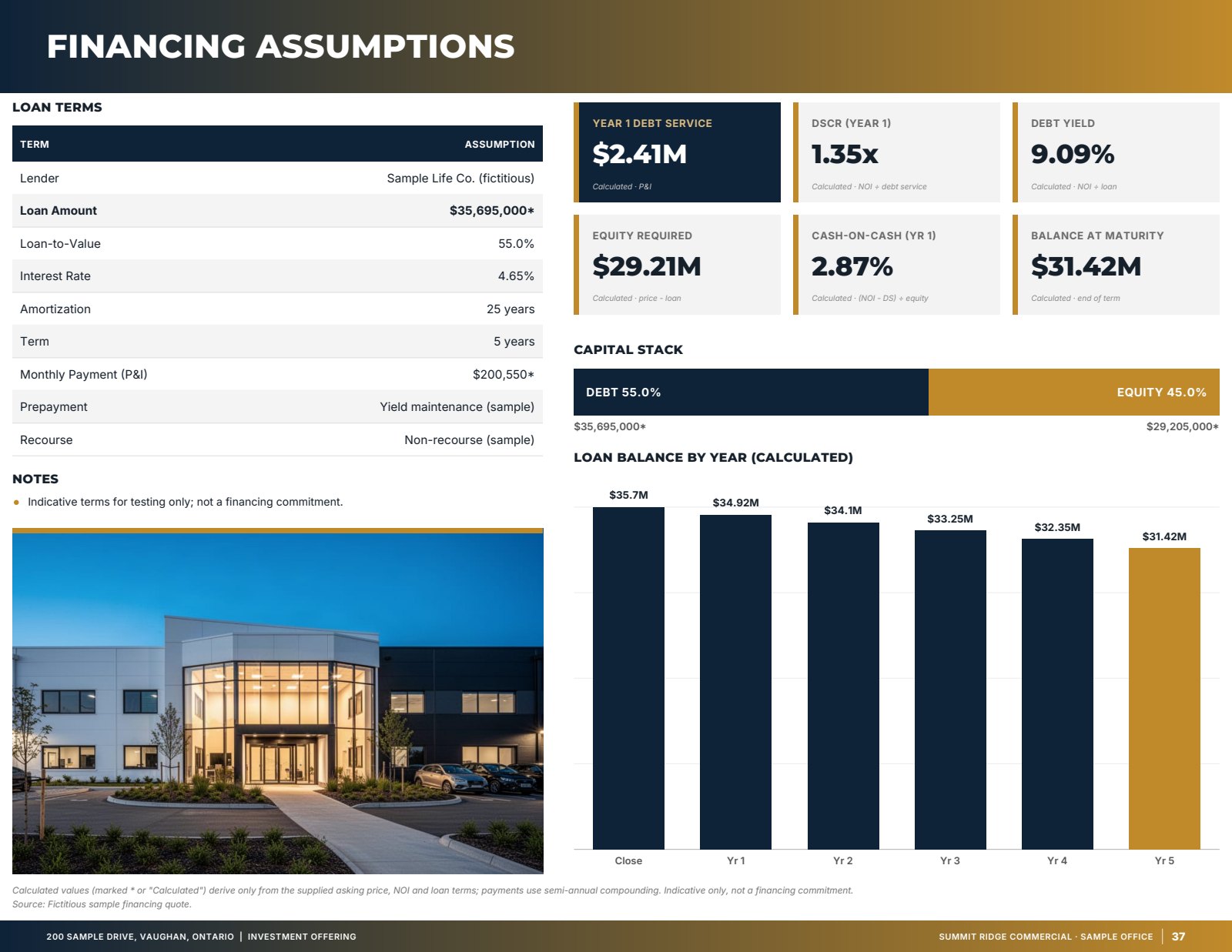
Sample — fictitious property. Pages generated by the product for an invented sample listing with an invented brokerage brand. Figures marked (sample) are not real.

Related
Last updated 2026-10-18. General information for commercial real estate professionals, not legal advice.
Start with the fact sheet you already have.
Upload it, answer only what’s missing for the output you choose, and review a watermarked preview before you buy anything.