CRE tax table
Real estate transfer tax by state: commercial property rates and local add-ons
State real estate transfer tax rates for commercial property, each from an official state page with the date read, plus local add-ons and listing wording.
Read this first
Not tax or legal advice — confirm with a lawyer/accountant. This page is a plain-language reference for brokers marketing commercial property in the United States. Each state row in the table below was read on an official state government page, either the state revenue department or the state’s published statute, linked in the row with the date it was read. Transfer taxes are full of exemptions, local add-ons and special rules, and who pays is often a matter of contract, so the parties should always have their closing attorney or title company confirm the amount.
We started from the states with the most commercial real estate activity and only printed a state where we could confirm its rate on an official page on the date shown. A state missing from the table is not a state without a transfer tax; it is one we have not yet confirmed, and we would rather leave it out than print a number we have not checked.
| Jurisdiction | Tax | State rate | Charged on | Notes | Source |
|---|---|---|---|---|---|
| California | County documentary transfer tax | 55¢ for each $500 or fractional part (as stated by Los Angeles County) | Consideration or value of the property conveyed, excluding any lien or encumbrance remaining at the time of sale | Read on the Los Angeles County Registrar-Recorder page, so it shows Los Angeles County practice. That page lists special rates for Culver City, Los Angeles, Pomona, Redondo Beach and Santa Monica. Confirm with the county recorder where the property sits. | Los Angeles County Registrar-Recorder/County Clerk — Documentary transfer taxesAccessed 2026-11-05 |
| Colorado | Documentary fee | 1¢ per $100 of consideration (0.01%) | Consideration, where the consideration for the real property is over $500 | State statute § 39-13-102, C.R.S., as quoted by the Division of Property Taxation. | Colorado Division of Property Taxation — Assessors’ Reference Library, ch. 4Accessed 2026-11-05 |
| Florida | Documentary stamp tax on deeds | 70¢ per $100 or portion (0.70%); Miami-Dade County 60¢ per $100 | Total consideration | Miami-Dade also has a 45¢ per $100 surtax (not on single-family dwellings). Parties are liable regardless of which one agrees to pay. | Florida Department of Revenue — Documentary stamp taxAccessed 2026-11-05 |
| Georgia | Real estate transfer tax | $1 for the first $1,000 plus 10¢ per additional $100 (about 0.10%) | Sale price | Paid to the clerk of the superior court before the deed is recorded. | Georgia Department of Revenue — Real estate transfer taxAccessed 2026-11-05 |
| Illinois | Real estate transfer tax | 50¢ per $500 of value or fraction (0.10%) | Value of the property transferred | Rate as listed by the Illinois Department of Revenue (35 ILCS 200/31-10). Any local transfer tax is not shown. | Illinois Department of Revenue — Other taxes, fees and surchargesAccessed 2026-11-05 |
| Massachusetts | Deeds excise | $2 per $500 or fraction (0.40%); Barnstable County $1.50 per $500 | Consideration, excluding liens or encumbrances remaining on the property | State statute (M.G.L. c. 64D, s. 1). | Massachusetts General Laws c. 64D, s. 1Accessed 2026-11-05 |
| New Jersey | Realty transfer fee + Graduated Percent Fee | Realty transfer fee graduated per $500 of consideration (where total consideration is over $350,000: $2.90 up to $150,000 rising to $6.05 over $1,000,000); Graduated Percent Fee 1% to 3.5% of total consideration over $1,000,000 | Consideration (the Graduated Percent Fee applies to the total consideration, not only the excess) | Graduated Percent Fee applies to Class 2 residential, qualifying Class 3A farm, Class 4A commercial (other than industrial or apartment) and Class 4C cooperative units. The seller is statutorily responsible for both. | New Jersey Division of Taxation — Realty transfer feeAccessed 2026-11-05 |
| New York | Real estate transfer tax | $2 per $500 or fraction (0.40%) | Consideration (when over $500) | New York City: additional base tax of $1.25 per $500 when consideration for property other than residential is $2 million or more. The base tax is paid by the seller (grantor) unless the contract between seller and buyer provides otherwise. | New York State Department of Taxation and Finance — Real estate transfer taxAccessed 2026-11-05 |
| North Carolina | Excise tax on conveyances | $1 per $500 or fraction (0.20%) | Consideration or value of the interest conveyed | Paid by the transferor to the county register of deeds (G.S. 105-228.30). | North Carolina General Statutes ch. 105, art. 8EAccessed 2026-11-05 |
| Ohio | Real property conveyance fee (state portion) | 10¢ per $100 or fraction (0.10%), minimum $1 | Value of the real property transferred | Ohio Revised Code 319.54(G)(3), statewide portion only. Any county add-on is not shown. | Ohio Revised Code § 319.54Accessed 2026-11-05 |
| Pennsylvania | Realty transfer tax | 1% (state) | Value of the real estate, including contracted-for improvements | An additional local realty transfer tax is often collected with it by the county recorder of deeds. Grantor and grantee are jointly liable. | Pennsylvania Department of Revenue — Realty transfer taxAccessed 2026-11-05 |
| Virginia | State recordation tax (deeds) | 25¢ per $100 or fraction (0.25%) | The greater of the consideration and the actual value of the property | Cities and counties may add their own recordation tax. Grantor tax is a separate row. | Code of Virginia § 58.1-801Accessed 2026-11-05 |
| Virginia | Grantor tax | 50¢ per $500 or fraction (0.10%) | The greater of the consideration and the value of the interest, excluding liens remaining | Applies when the consideration or value exceeds $100. | Code of Virginia § 58.1-802Accessed 2026-11-05 |
| Washington | Real estate excise tax (state portion, graduated) | 1.10% up to $525,000; 1.28% to $1,525,000; 2.75% to $3,025,000; 3.00% above | Selling price | Thresholds rise on January 1, 2027 ($551,000 / $1,551,000 / $3,051,000). Local REET is added on top of the state rate. | Washington Department of Revenue — Real estate excise taxAccessed 2026-11-05 |
Rates as published on each official page on the date shown. Not tax or legal advice — confirm with a lawyer/accountant before relying on any figure.
What a real estate transfer tax is
A real estate transfer tax is a one-time tax charged when title to real property passes from one owner to another, usually collected when the deed is recorded. Different states call it different things: a documentary stamp tax, a deeds excise, an excise tax on conveyances, a recordation tax, a realty transfer tax or a real estate excise tax. They all work the same basic way: a rate applied to the price or value of what is conveyed.
Rates are often written as dollars per $100 or per $500 of consideration rather than as percentages. The table shows both where the conversion is exact, so “$2 per $500” is 0.40% and “$1 per $500” is 0.20%. When the rate is per $500 “or fractional part”, the price is rounded up to the next $500 before the rate is applied.
State rate versus local add-ons
The state rate is only part of the story. In many states counties, cities or both add their own transfer tax on top, and in a few the local tax is larger than the state’s. The table notes where the state’s own page mentions a local tax, such as the local real estate excise tax in Washington, the local realty transfer tax collected with Pennsylvania’s, local recordation tax in Virginia and the additional New York City tax on larger non-residential conveyances. We do not print local rates: there are too many, and they change with local votes.
For a listing, that means the rate in the table is a floor for that state, not the total. The closing attorney or title company will calculate the total for the specific parcel and price.
A fictitious worked example
A fictitious example using only the North Carolina row: an industrial building sells for $3,000,000. The excise tax on conveyances is $1 per $500, so $3,000,000 ÷ $500 = 6,000 units × $1 = $6,000, paid by the transferor to the county register of deeds. The same price in Washington would be taxed on the graduated state schedule, plus the local rate, which shows how much the location matters. The example is arithmetic, not advice; exemptions, entity transfers and local taxes can change the result.
Who pays: custom and contract
Who bears the transfer tax is often a matter of local custom and, above all, of the purchase agreement. Some statutes name the party that must pay. New York’s state page, for example, says the base tax is paid by the seller unless the contract provides otherwise, and North Carolina’s statute says the transferor pays. Pennsylvania’s page says the grantor and grantee are jointly liable. Others leave it to the parties.
A broker’s job is not to settle it but to make sure the letter of intent and the purchase agreement say who pays, in the same words as the listing.
Entity transfers
Commercial property is often owned by a company or LLC, and buyers sometimes buy the entity rather than the property. Several states tax a transfer of a controlling interest in an entity that owns real estate in the same way as a deed; Washington’s revenue page, for example, describes controlling interest transfers under its real estate excise tax. If a deal may be structured as an entity sale, flag it to the parties’ attorneys early.
The same caution applies to long-term ground leases, partial interests, portfolio sales across several counties and transfers between related companies. Statutes treat these cases differently from state to state, so the broker’s job is to spot the question, keep the listing wording neutral and let the closing attorney or title company work out the tax.
How to treat transfer tax in a listing
- Quote the price before transfer taxes and closing costs, and never fold a transfer tax into the price per square foot or cap rate. Calculate metrics on the price and label them as calculated.
- If you mention transfer tax at all, use one neutral line, for example: “Transfer taxes and closing costs to be allocated per the purchase agreement and local custom.”
- Never print an estimated tax amount in an offering memorandum.
- Keep the wording identical across the teaser, brochure, OM, web page and listing services.
- Where a state or city taxes commercial rent, that is a different tax from the transfer tax; our HST guide has a section on US sales tax on commercial rent.
Canada and the US
Canadian brokers will recognise the idea: provinces charge land transfer tax on registration, set out in our land transfer tax by province guide. The big difference is sales tax. In Canada a commercial sale is generally subject to GST/HST, and listings say “plus HST, if applicable”; there is no equivalent national sales tax on a US property sale, so a US listing has no “plus tax” line on the price.
How OfferingStack helps
OfferingStack never calculates tax and never prints a tax amount in your documents. You record the price and any closing-cost wording once in the property file, and the teaser, brochure and offering memorandum all use it, so the package does not contradict itself. Calculated metrics such as price per square foot and cap rate are worked out on the price before tax and labelled, and you review every page before it goes out.
Frequently asked questions
Which states have a real estate transfer tax?
Many do, under different names. The table lists the states we confirmed on an official page on the date shown; a missing state has not been confirmed yet, which does not mean it has no tax.
Does the state rate include county and city transfer taxes?
No. Many counties and cities add their own. Ask the closing attorney or title company for the total for the parcel.
Who pays the transfer tax on a commercial sale?
It depends on the state, local custom and the purchase agreement. Some statutes name a party; the contract usually decides.
Is transfer tax charged when an LLC that owns the building is sold?
In some states, yes: a controlling interest transfer can be taxed like a deed. Ask the attorneys before choosing a structure.
How current is this table?
Each row shows the date it was read on the official page. Check the linked page before relying on a rate. Not tax or legal advice — confirm with a lawyer/accountant.
What these pages look like
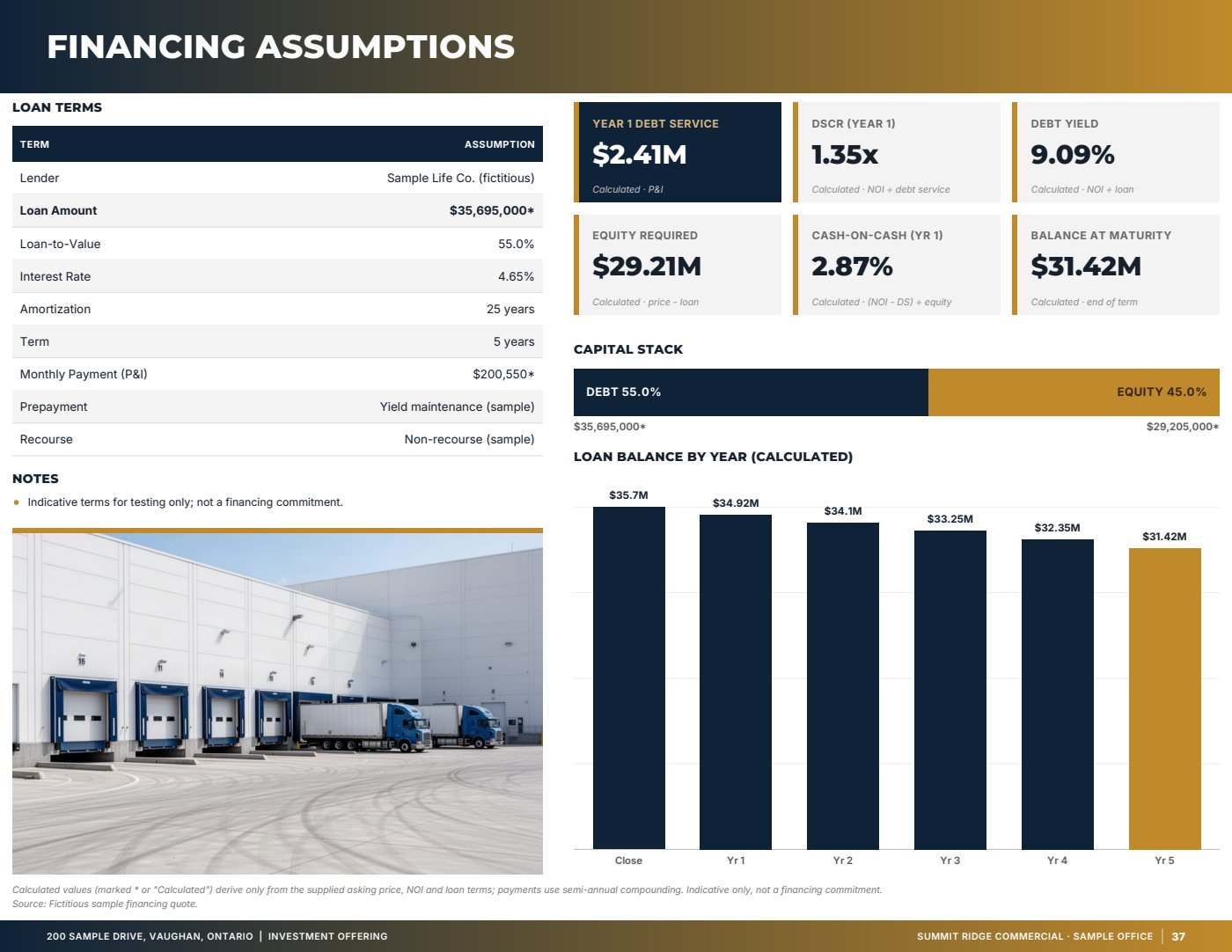
Sample — fictitious property. Pages generated by the product for an invented sample listing with an invented brokerage brand. Figures marked (sample) are not real.

Related
Last updated 2026-11-05. General information for commercial real estate professionals, not legal advice.
Start with the fact sheet you already have.
Upload it, answer only what’s missing for the output you choose, and review a watermarked preview before you buy anything.