CRE marketing guide
How to write a broker opinion of value, step by step
A step-by-step method for writing a commercial BOV: the owner’s question, documents, comparables, the value range, the marketing plan and the final check.
Before you start
This guide is the working method: what to do, in what order, to turn a request for a broker opinion of value into a document an owner can act on. For what a BOV is and how it differs from an appraisal, read the complete BOV guide first. One rule runs through every step: the BOV is your opinion, so every fact in it should be one you can source and every figure one you can reproduce.
Step 1: Pin down the owner’s question
Start with a short conversation, not a spreadsheet. Ask what decision the owner is facing: sell now, sell later, refinance, buy out a partner, lease up a vacancy, or simply understand the market. Ask about timing, any price they have in mind, any offers they have received, and what would make them hold instead of sell.
The answer shapes the whole document. A hold-or-sell BOV needs a clear view of what the owner gives up by selling. A lease BOV is an opinion of rent and leads with lease comparables. A BOV for an estate or a partner buyout must be especially clear that it is not an appraisal, because those situations often end up needing one. Write the question down in one sentence; it becomes the first paragraph of your letter to the owner.
Step 2: Gather the documents
Ask the owner early, in one list, for what you need. For most commercial property that means:
- A survey or reference plan, and any site plan or floor plans.
- The latest property tax bill or assessment notice.
- For investment property: the current rent roll, copies of the leases and amendments, and operating statements for the last two years.
- Any building condition, environmental or engineering reports.
- A list of capital work done, with dates and costs, and any work the owner knows is coming.
- Anything that affects use or value: pending lease deals, planning applications, easements, encroachments.
Then walk the property. Take your own photos, check what the documents say against what you see, and note anything they do not mention. Where the owner tells you something you cannot confirm, record it as information provided by the owner.
Step 3: Confirm the facts from public sources
Check the zoning and permitted uses in the municipality’s zoning by-law or code and its official plan or comprehensive plan. Check the assessment and the legal description. Confirm site area and building area from the survey or reliable records rather than from an old listing. Keep a simple source log: each fact, where it came from and the date you checked it. It takes minutes and saves hours when the owner, a buyer or your manager asks “where did this come from?”.
Step 4: Choose the comparables
Pick comparable sales that a buyer of this property would also look at: similar use, size, age, quality and location, and recent enough to reflect today’s market. For a leased investment, add comparables with similar tenancy and lease term. For land, look at land sales with similar zoning and servicing.
Build three separate lists: completed sales, active listings, and lease comparables where rent matters. Record the date, price or rent, areas, the source, and anything unusual about the deal. If the evidence is thin, use fewer, closer comparables and explain the gaps rather than padding the table with weak ones. If your comparable data comes from a paid service, check its licence before putting it in a document that the owner may forward.
Step 5: Adjust and reconcile
For each comparable, decide whether the subject should trade above or below it and why: a larger site, better clear height, a shorter remaining lease, weaker exposure, newer roof. Write the reasons in plain language; buyers will make the same comparisons.
Then reconcile. For owner-user buildings and land, direct comparison usually leads. For leased investment property, the income approach usually leads: net operating income divided by a capitalization rate range supported by the comparable sales. If you use both, show both indications and say which you weight more heavily. The calculators linked below help check the arithmetic; label every calculated figure as calculated.
Step 6: Set the range and the recommendation
State a low-to-high range, where in it you expect the property to trade, and a recommended pricing approach: a list price, or an unpriced process with an offer date. Explain what would move the result up or down and what the owner can influence, such as renewing a lease before launch or completing a repair.
Resist the temptation to stretch the top of the range to win the listing. Owners compare BOVs, and the one with reasoning they can follow is more persuasive than the one that is simply highest. If you do recommend asking above your expected value, say why and what the risk is.
Step 7: Write the go-to-market plan
Turn the evidence into a plan. Name the likely buyer groups and how you will reach each one. Say which materials you would produce (teaser, brochure, offering memorandum, data room), how long marketing should take, and the decisions the owner will face along the way. List what must happen before launch: documents to gather, repairs, lease renewals, an environmental update. A realistic timeline is more convincing than a promise of a quick sale.
Step 8: Assemble the document
Put the pieces in the order the owner reads them:
- Cover, prepared for the owner, with the date.
- A one-page letter: the question, the value range, the recommendation.
- The opinion page: range, approach, reconciliation.
- The property: summary, specifications, zoning, condition, photos.
- Income, where it applies: tenancy summary and operating statement.
- Comparables: sales, listings and leases in separate tables, with a map.
- Market and location context, each figure with its source and date.
- The go-to-market plan and timeline.
- Your team, your contact details, and the disclaimer.
Keep units, currency and terms consistent throughout: square feet or square metres, USD or CAD, and the lease terms used in that market (for example, additional rent or TMI in Canada, NNN and CAM in the US).
Step 9: Add the disclaimer and check everything
Include a clear statement that the document is a broker opinion of value, not an appraisal; that it is prepared for the owner’s information; and that it should not be relied on for financing, legal or tax purposes. Use your brokerage’s approved wording, and mark the document confidential.
Then check it as a buyer would. Does every comparable have a date and a source? Are asking prices labelled as asking? Can each calculated figure be reproduced from the numbers shown? Do the areas, rents and dates match across every page? Is the owner’s question answered on the first page?
Step 10: Present it and follow up
Walk the owner through the BOV in person or on a call rather than sending it cold. Start with their question, show the evidence, then the range and the plan. Note their objections; they often point to facts you did not have. Follow up with any corrections in writing, and keep a dated copy of what you sent. If the owner waits months before deciding, refresh the comparables and the market section before relying on the old range, because the effective date matters. When the owner signs, the same facts, photos and comparables carry straight into the listing materials.
Doing it in OfferingStack
In OfferingStack, steps 2 to 9 happen in one property file. You add the facts, photos, comparables and your opinion; the BOV template lays out the cover, opinion page, property, comparables with a map, sourced location pages, strategy and team, and leaves out any page with nothing to show while telling you what to add. Calculated indications are labelled, the opinion is yours to enter and approve, and your brokerage’s disclaimer goes on the document. Compare your draft against the example BOV, and see the pricing page for plans.
Frequently asked questions
How long should a broker opinion of value be?
Long enough to answer the owner’s question with evidence, and no longer. A short BOV for a simple property can be a handful of pages; an investment property with several tenants needs more room for income and comparables.
What is the most important part of a BOV?
The comparables and the reasoning that connects them to the value range. Owners and other brokers test those first.
Should a BOV give one number or a range?
A range, with a clear statement of where you expect the property to trade and why. A single number suggests more precision than a broker’s opinion can support.
What disclaimer should a BOV include?
A statement that it is a broker opinion of value and not an appraisal, prepared for the owner’s information and not to be relied on for financing, legal or tax purposes. Use your brokerage’s approved wording.
Start with your fact sheet
We’ll build your teaser, brochure, OM and BOV preview from it. You upload it in the builder; nothing is sent from this page. One listing per free preview.
Upload your fact sheet — free previewWhat these pages look like
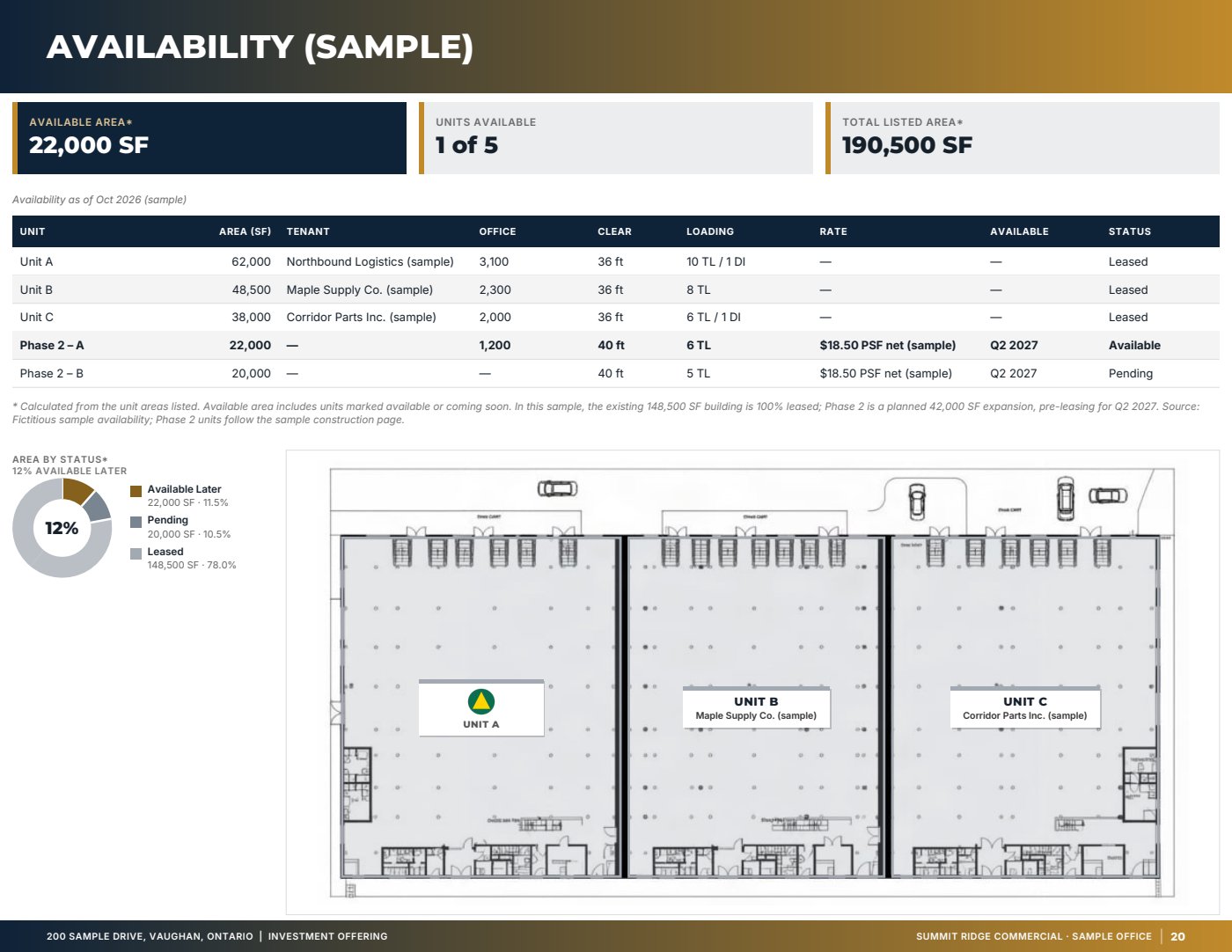
Sample — fictitious property. Pages generated by the product for an invented sample listing with an invented brokerage brand. Figures marked (sample) are not real.

Related
Last updated 2026-11-05. General information for commercial real estate professionals, not legal advice.
Start with the fact sheet you already have.
Upload it, answer only what’s missing for the output you choose, and review a watermarked preview before you buy anything.