CRE tax table
Land transfer tax on commercial property in Canada, by province
Provincial land and property transfer tax rates for commercial property in Canada, each from an official page with the date read, and how to word them.
Read this first
Not tax or legal advice — confirm with a lawyer/accountant. This page is a plain-language reference for brokers who prepare commercial listings and offering memorandums. Every rate in the table below was read on the provincial government page linked in its row, on the date shown in that row. Rates, thresholds, exemptions and rebates change, and the right answer for a transaction depends on its facts, so a buyer and seller should always have their lawyer confirm the tax before closing.
We only print a figure we could confirm on an official page on the date shown. A province or territory that is not in the table has not been left out because it has no tax; it is left out because we did not confirm its figure on that date, and we would rather show nothing than a number we have not checked.
| Jurisdiction | Tax | Rate | Charged on | Notes | Source |
|---|---|---|---|---|---|
| Alberta | Land titles registration fee (transfer of land) | $50 + $5 per $5,000 of value of land | Value of the land | A registration fee under the land titles fee schedule, not a percentage transfer tax. Fees as updated for submissions received on or after October 1, 2026; each additional title $25. | Government of Alberta — Land Titles and Surveys common document fee scheduleAccessed 2026-11-05 |
| British Columbia | Property transfer tax (general rate) | 1% up to $200,000; 2% over $200,000 up to $2,000,000; 3% over $2,000,000 | Fair market value | A further 2% applies only to the residential part of a property worth over $3,000,000 (mixed-class property: residential part only). | Government of British Columbia — Property transfer taxAccessed 2026-11-05 |
| Manitoba | Land transfer tax | 0% on the first $30,000; 0.5% on $30,001–$90,000; 1.0% on $90,001–$150,000; 1.5% on $150,001–$200,000; 2.0% over $200,000 | Fair market value on the date the transfer is registered | Paid by the transferee, with a separate registration fee, at the land titles office. | Manitoba Finance — Land transfer taxAccessed 2026-11-05 |
| New Brunswick | Real property transfer tax | 1% | The greater of the consideration and the assessed value | Paid before the deed is registered (Real Property Transfer Tax Act, s. 2(1.03), deeds tendered on or after April 1, 2016). | New Brunswick Acts and Regulations — Real Property Transfer Tax ActAccessed 2026-11-05 |
| Nova Scotia | Municipal deed transfer tax | Set by each municipality: 1.0% to 1.5% on the Service Nova Scotia list (Halifax Regional Municipality 1.5%) | Set by the municipality — confirm with it | Municipal, not provincial: payable at the Land Registration Office. SNS list dated July 2026 says rates may change without notice — confirm with the municipality. A separate non-resident deed transfer tax is not covered here. | Service Nova Scotia — Municipal deed transfer tax ratesAccessed 2026-11-05 |
| Newfoundland and Labrador | Deed registration fee (not a percentage transfer tax) | $100.00 plus 40¢ for each additional $100 or part of $100 above $500 | Value of the conveyance | A registration fee under the Minister’s fee schedule, not a land transfer tax; the schedule as published is dated May 1, 2007, so confirm the current fee with Service NL. | Government of Newfoundland and Labrador — Schedule of fees prescribed by the Minister (deeds)Accessed 2026-11-05 |
| Ontario | Land transfer tax | 0.5% up to $55,000; 1.0% over $55,000 up to $250,000; 1.5% over $250,000 up to $400,000; 2.0% over $400,000 | Value of the consideration | The 2.5% rate over $2,000,000 applies only where the land contains one or two single family residences. | Ontario — Land transfer tax: calculating the taxAccessed 2026-11-05 |
| Prince Edward Island | Real property transfer tax | 1% | The greater of the purchase price and the assessed value of the real property | The page says the governing statutes take precedence over its summary; check the Real Property Transfer Tax Act for exemptions. | Government of Prince Edward Island — Real property transfer tax rateAccessed 2026-11-05 |
| Quebec | Duties on transfers of immovables (“welcome tax”) | 0.5% up to $62,900; 1% over $62,900 up to $315,000; 1.5% over $315,000 | Basis of imposition | A municipality may set a higher rate on the part over $500,000 (capped at 3% except for Ville de Montréal). The bracket amounts are indexed annually. Statute current to October 15, 2026. | Légis Québec — Act respecting duties on transfers of immovables, s. 2Accessed 2026-11-05 |
Rates as published on each official page on the date shown. Not tax or legal advice — confirm with a lawyer/accountant before relying on any figure.
What a land transfer tax is
A land transfer tax (called a property transfer tax in British Columbia and a real property transfer tax in New Brunswick) is a one-time provincial tax charged when ownership of land changes hands, usually at the time the transfer is registered. It is separate from annual property tax, which the municipality charges every year, and from GST/HST, which is a sales tax on the supply itself.
In most provinces the buyer (the transferee) pays it on closing. The base is usually the consideration paid or the fair market value of the property, and in some provinces the greater of the price and the assessed value. Commercial property is generally taxed on the same schedule as other land; the special higher rates that some provinces apply to expensive homes usually do not apply to a commercial building, a plaza or an industrial site.
Because the tax is paid at registration, it is a closing cost, not part of the price. That is why it rarely appears in marketing materials, and why a buyer’s analyst will add it to their own model as an acquisition cost.
How the rates are structured
Two structures appear in the table. Ontario, British Columbia and Manitoba use marginal brackets: each slice of the value is taxed at its own rate, like income tax, so the effective rate on a large commercial deal sits a little below the top bracket. New Brunswick uses a single flat rate on the greater of the consideration and the assessed value. Two rows are not provincial percentage taxes: in Nova Scotia the deed transfer tax is set by each municipality, and Alberta’s row is the land titles registration fee for a transfer of land.
A fictitious worked example shows how brackets work. Take an Ontario commercial building that sells for $2,000,000, using only the Ontario row of the table:
- 0.5% on the first $55,000 = $275.
- 1.0% on the next $195,000 (to $250,000) = $1,950.
- 1.5% on the next $150,000 (to $400,000) = $2,250.
- 2.0% on the remaining $1,600,000 = $32,000.
- Total provincial land transfer tax = $36,475, an effective rate of about 1.8%.
The example is arithmetic, not advice. A real transaction may involve a different value for tax purposes, a municipal tax in some cities, a non-resident rule, an exemption or a deferral that only the parties’ lawyer can confirm.
Provinces and territories without a land transfer tax
Some provinces and territories do not charge a land transfer tax at all, and instead charge registration fees at the land titles office or registry when a transfer is recorded. Those fees can be calculated on value, so they still belong in a buyer’s closing budget. We have not printed any of those fees or named the jurisdictions here, because we did not confirm their current figures on an official page on the date of this table. If your listing is in one of them, ask the vendor’s lawyer for the current fee schedule and quote it from there.
Who usually pays, and where it shows up
In Canadian commercial practice the buyer usually pays the land transfer tax, and the agreement of purchase and sale rarely shifts it. It is paid through the buyer’s lawyer on closing and appears on the statement of adjustments or the lawyer’s reporting letter, not on the listing.
For brokers the practical points are simple: the tax affects the buyer’s cash needed to close, it is calculated on the full price (not the equity), and it is the buyer’s advisors who confirm the amount. In a share sale, where the shares of the company that owns the property are sold instead of the property itself, the tax treatment can differ; that is a question for the lawyers, not the brochure.
How to treat land transfer tax in a listing
- Do not show land transfer tax in the asking price, the price per square foot or the cap rate. Calculate every metric on the price before tax and closing costs, and label calculated figures as calculated.
- If you mention it at all, use one neutral line, for example: “Land transfer tax and registration costs are the buyer’s responsibility; buyers should confirm the amount with their lawyer.”
- Never quote a buyer’s tax amount in an offering memorandum. You do not know their structure, and a figure in the OM can look like a representation.
- Use the same wording in the teaser, brochure, OM and listing web page so the package does not contradict itself.
- For mixed-use property with apartments, flag that residential rules may differ for that part of the property and leave the detail to the advisors.
Land transfer tax and HST on the same deal
Land transfer tax and GST/HST are different taxes with different rules, and both can apply to one commercial sale. HST is a sales tax on the supply; land transfer tax is a provincial tax on registering the transfer. A registered buyer of commercial property often self-assesses the HST, while the land transfer tax is paid on registration. Our guide to HST on commercial real estate in Ontario explains the self-assessment rule, and the GST/HST/QST guide has the rates for every province and territory.
Keep the two separate in your wording. “Plus HST, if applicable” describes the price; land transfer tax is a closing cost the buyer budgets for on top.
Canada and the US
If you also list south of the border, the idea is similar but the mechanics differ. US transfer taxes are set by states and often by counties and cities as well, and who pays is a matter of local custom and contract. Our real estate transfer tax by state guide covers the state rates we could confirm, each with its source and date.
How OfferingStack helps
OfferingStack never calculates tax and never prints a tax amount in your documents. You record the price and how taxes are described once in the property file (for example “plus HST, if applicable”), and the teaser, brochure and offering memorandum all use the same wording. Calculated metrics such as price per square foot and cap rate are always worked out on the price before tax and labelled as calculated, and you review every page before anything is sent.
Frequently asked questions
Is land transfer tax charged on commercial property?
Yes, in the provinces that have one, a transfer of commercial land is generally taxed on the same schedule as other land. The special higher rates for expensive homes that some provinces use do not usually apply to commercial buildings.
Who pays land transfer tax on a commercial sale?
Usually the buyer, through its lawyer, on registration of the transfer. The agreement of purchase and sale can say otherwise, which is rare.
Should the land transfer tax be in the OM?
No figure should be. At most, one neutral line saying the buyer is responsible for land transfer tax and registration costs and should confirm them with its lawyer.
Is land transfer tax the same as HST?
No. HST is a sales tax on the supply; land transfer tax is charged on registering the transfer. Both can apply to the same sale.
How current are these rates?
Each row shows the date it was read on the official page. Check the linked page before relying on a rate. Not tax or legal advice — confirm with a lawyer/accountant.
What these pages look like
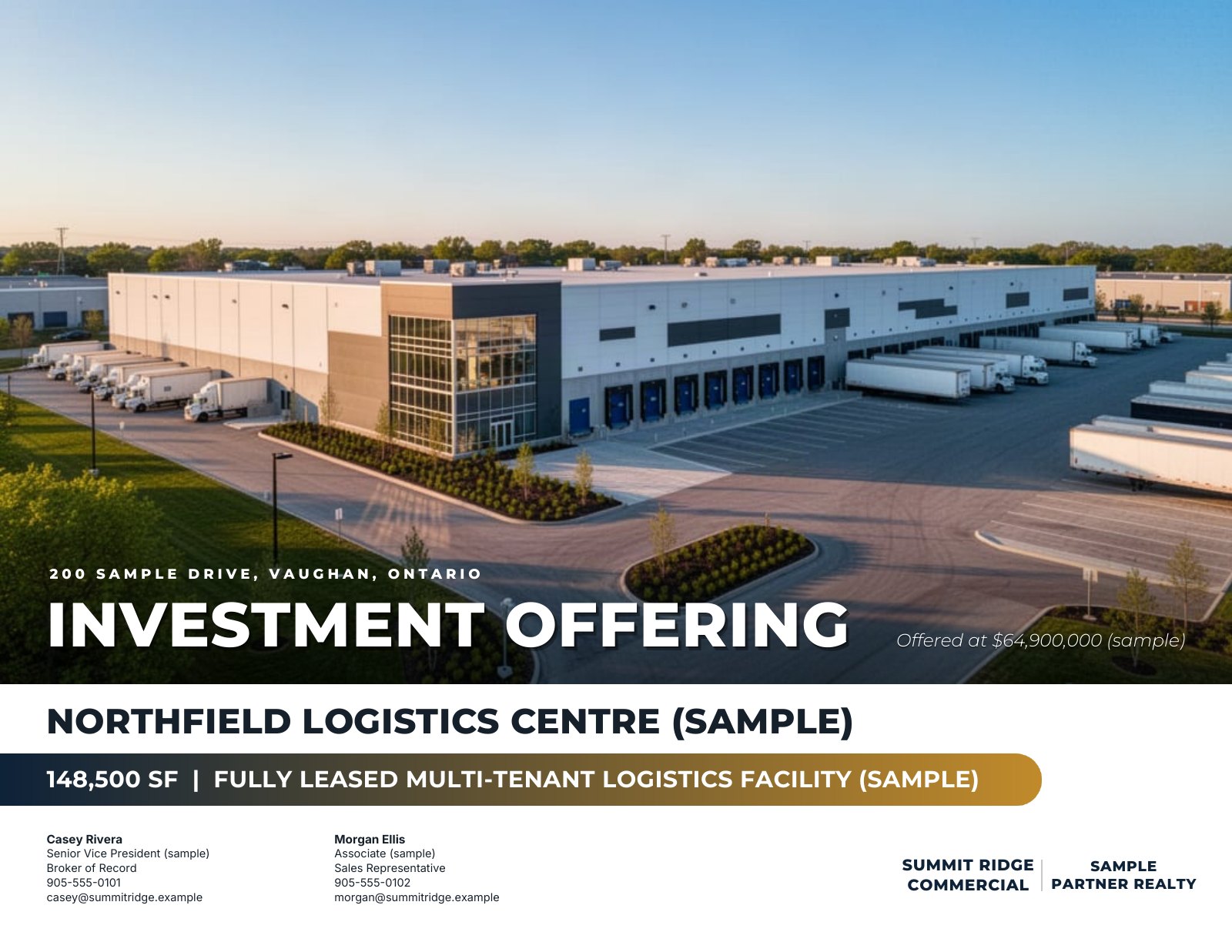
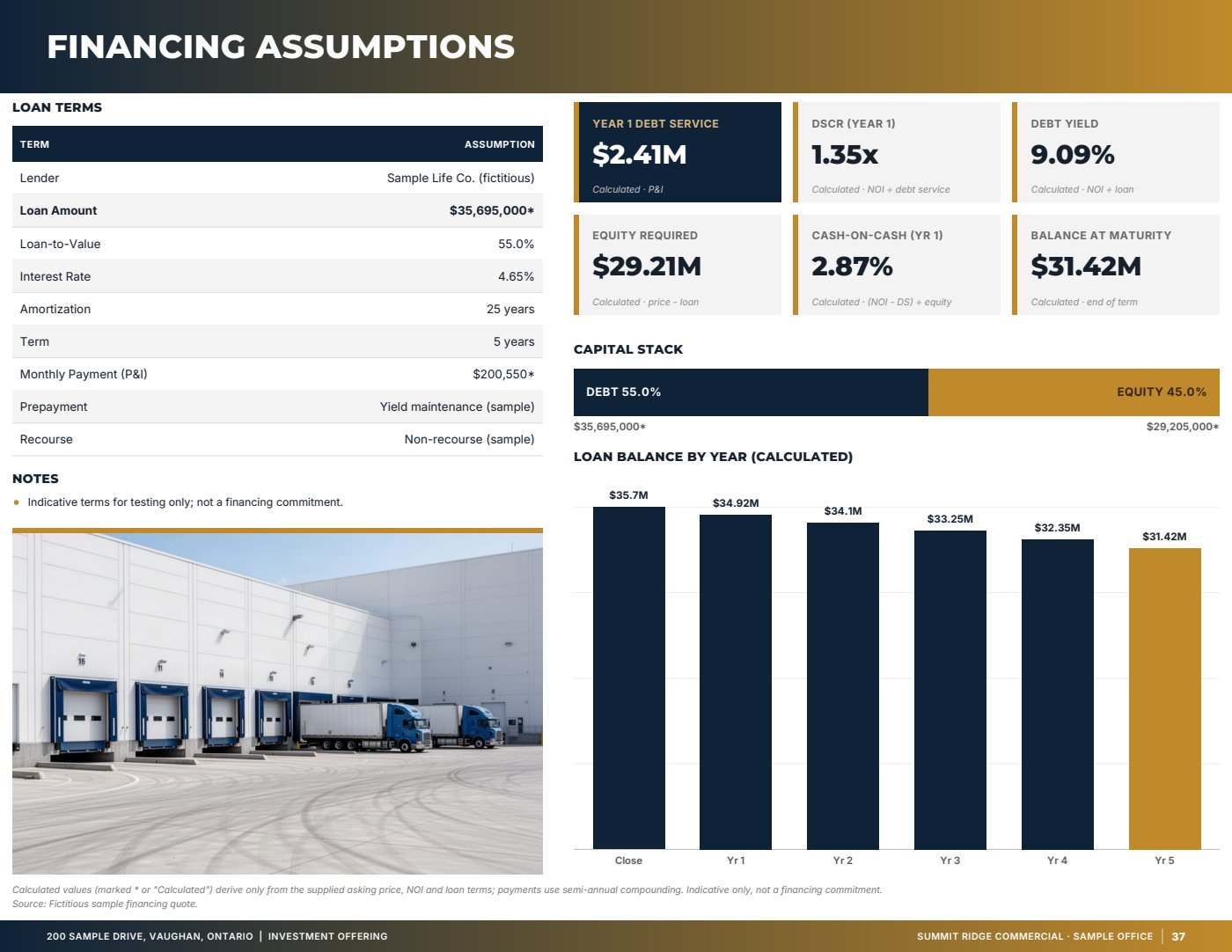
Sample — fictitious property. Pages generated by the product for an invented sample listing with an invented brokerage brand. Figures marked (sample) are not real.
Related
Last updated 2026-11-05. General information for commercial real estate professionals, not legal advice.
Start with the fact sheet you already have.
Upload it, answer only what’s missing for the output you choose, and review a watermarked preview before you buy anything.