CRE tax table
GST, HST and QST on commercial real estate in Canada: rates by province
GST, HST and QST rates by province and territory for commercial property sales and rent, sourced from the CRA with the date read, plus listing wording.
Read this first
Not tax or legal advice — confirm with a lawyer/accountant. This page is a plain-language reference for brokers who write commercial listings, brochures and offering memorandums in Canada. The rate table below was read on the Canada Revenue Agency (CRA) rates page linked in each row, on the date shown. The rate is only the start: whether a particular sale or lease is taxable, who accounts for the tax and whether an exemption or election applies all depend on the facts, so the vendor, landlord, buyer and tenant should each get advice from their own accountant or lawyer.
| Jurisdiction | Tax | Rate | Charged on | Notes | Source |
|---|---|---|---|---|---|
| Alberta | GST | 5% GST | Taxable supplies, including most sales and leases of commercial real property | No provincial sales tax. | Canada Revenue Agency — GST/HST ratesAccessed 2026-11-05 |
| British Columbia | GST | 5% GST | Taxable supplies, including most sales and leases of commercial real property | Province also has a separate provincial sales tax (PST); PST is not part of GST and is not covered here. | Canada Revenue Agency — GST/HST ratesAccessed 2026-11-05 |
| Manitoba | GST | 5% GST | Taxable supplies, including most sales and leases of commercial real property | Province also has a separate provincial sales tax (PST); PST is not part of GST and is not covered here. | Canada Revenue Agency — GST/HST ratesAccessed 2026-11-05 |
| New Brunswick | HST | 15% HST | Taxable supplies, including most sales and leases of commercial real property | Harmonized rate (federal + provincial). | Canada Revenue Agency — GST/HST ratesAccessed 2026-11-05 |
| Newfoundland and Labrador | HST | 15% HST | Taxable supplies, including most sales and leases of commercial real property | Harmonized rate (federal + provincial). | Canada Revenue Agency — GST/HST ratesAccessed 2026-11-05 |
| Northwest Territories | GST | 5% GST | Taxable supplies, including most sales and leases of commercial real property | No territorial sales tax. | Canada Revenue Agency — GST/HST ratesAccessed 2026-11-05 |
| Nova Scotia | HST | 14% HST | Taxable supplies, including most sales and leases of commercial real property | HST fell to 14% on April 1, 2025; transition rules apply to supplies straddling that date. | Canada Revenue Agency — GST/HST ratesAccessed 2026-11-05 |
| Nunavut | GST | 5% GST | Taxable supplies, including most sales and leases of commercial real property | No territorial sales tax. | Canada Revenue Agency — GST/HST ratesAccessed 2026-11-05 |
| Ontario | HST | 13% HST | Taxable supplies, including most sales and leases of commercial real property | Harmonized rate (federal + provincial). | Canada Revenue Agency — GST/HST ratesAccessed 2026-11-05 |
| Prince Edward Island | HST | 15% HST | Taxable supplies, including most sales and leases of commercial real property | Harmonized rate (federal + provincial). | Canada Revenue Agency — GST/HST ratesAccessed 2026-11-05 |
| Quebec | GST + QST | 5% GST + 9.975% QST | Taxable supplies, including most sales and leases of commercial real property | QST is administered by Revenu Québec; GST and QST are calculated separately on the price before tax. | Canada Revenue Agency — GST/HST ratesAccessed 2026-11-05 |
| Saskatchewan | GST | 5% GST | Taxable supplies, including most sales and leases of commercial real property | Province also has a separate provincial sales tax (PST); PST is not part of GST and is not covered here. | Canada Revenue Agency — GST/HST ratesAccessed 2026-11-05 |
| Yukon | GST | 5% GST | Taxable supplies, including most sales and leases of commercial real property | No territorial sales tax. | Canada Revenue Agency — GST/HST ratesAccessed 2026-11-05 |
Rates as published on each official page on the date shown. Not tax or legal advice — confirm with a lawyer/accountant before relying on any figure.
GST, HST and QST in one paragraph
Canada has a federal Goods and Services Tax (GST). Five provinces have merged their provincial sales tax with the GST into a single Harmonized Sales Tax (HST), which the CRA administers. Quebec charges its own Quebec Sales Tax (QST) alongside the GST, administered by Revenu Québec. The other provinces and the territories charge only the GST on real property; some of those provinces have a separate provincial sales tax (PST) on goods and certain services, which is a different tax and is not covered by this table.
Is a commercial property sale taxable?
As a general rule, a sale of commercial real property, such as an industrial building, a retail plaza, an office building or land held for business, is a taxable supply for GST/HST and QST purposes. That is why commercial listings in Canada usually say the price is “plus HST, if applicable” or “plus GST/QST, if applicable”.
Residential property follows different rules, and many sales of used residential property are exempt. Mixed-use buildings, farmland, land sold by an individual that was never used in a business, and property sold together with a business all have their own rules. A listing should not call a property “tax-exempt” without written confirmation from the vendor’s advisor.
Who pays and who remits on a sale
For most taxable sales of commercial real property, the tax is borne by the buyer. How it is accounted for depends largely on whether the buyer is registered:
- A registered buyer generally self-assesses the tax and reports it directly to the tax authority instead of paying it to the vendor, and may be able to claim an offsetting input tax credit if it uses the property in commercial activities.
- If the buyer is not registered, the vendor generally collects the tax on closing and remits it.
A fictitious example using the Ontario row: a $4,000,000 sale of an industrial building, taxable, to a registered buyer. The HST at 13% would be $520,000, which the buyer would generally self-assess rather than pay to the vendor. The arithmetic is simple; whether and how it applies is for the advisors.
Is there GST/HST or QST on commercial rent?
Commercial rent is generally a taxable supply. Registered landlords charge GST/HST (and QST in Quebec) on base rent and on additional rent such as the tenant’s share of property taxes, maintenance and insurance. Leasing brochures normally quote rent before tax, with a line saying tax is extra.
When you show a gross or total occupancy cost per square foot, say whether it includes tax. Most commercial tenants recover the tax through input tax credits, so the before-tax number is usually the useful one, but the wording should leave no doubt.
Nova Scotia’s rate change
The CRA rates page notes that the HST rate in Nova Scotia decreased to 14% on April 1, 2025. Older Nova Scotia brochures, leases and templates may still show the previous rate. If you reuse wording, check that it does not print an old rate, and where a lease or sale straddles the change, the transition rules decide which rate applies; that is a question for the advisors.
Quebec: GST and QST are separate
In Quebec the GST and the QST are two separate taxes, each calculated on the price before tax, and the QST is administered by Revenu Québec rather than the CRA. Write “plus GST and QST, if applicable” rather than adding the two rates together in a listing, and do not describe the combined figure as HST; Quebec is not an HST province.
What to write in marketing materials
- Quote prices and rents before tax, with one neutral line: “plus HST, if applicable” in an HST province, “plus GST, if applicable” in a GST-only province or territory, and “plus GST and QST, if applicable” in Quebec.
- Never write “no HST” or “tax included” without written instruction from the vendor’s or landlord’s advisor.
- Do not include sales tax in calculated metrics such as price per square foot, cap rate or net effective rent; calculate them before tax and label them as calculated.
- Keep the wording identical across the teaser, brochure, offering memorandum, web page and listing services.
- In a rent roll, say whether rents are before tax, and never mix before-tax and after-tax figures.
- For mixed-use buildings, flag that treatment may differ for the residential part and leave the detail to the advisors.
Questions to ask the vendor or landlord early
- Is the vendor or landlord registered for GST/HST (and QST in Quebec)?
- Is any part of the property residential, or has its use changed recently?
- Has the advisor confirmed how tax should be described in the listing?
- Are the rents in the rent roll stated before or after tax?
Asking at listing time avoids a correction after the brochure has gone out. The land transfer tax is a separate question with its own table in our land transfer tax by province guide.
Across the border
The US has no national sales tax or VAT on property, so a US price is normally quoted with no “plus tax” line. The closest US question is usually “who pays the transfer tax?”, covered in our real estate transfer tax by state guide.
How OfferingStack helps
In OfferingStack you record once, in the property file, how tax applies to the price or rent (plus HST, plus GST and QST, included, exempt, or “consult your advisor”), as a label your client’s advisor has confirmed. OfferingStack never calculates tax. Because every document is built from the same file, the teaser, brochure and offering memorandum use the same wording, and calculated metrics are worked out before tax and labelled.
Frequently asked questions
What is the HST rate on commercial property in Ontario?
The CRA rates page lists 13% HST for Ontario. Whether a particular sale or lease is taxable depends on its facts.
Does a buyer pay HST to the vendor on a commercial sale?
Usually not if the buyer is registered: a registered buyer generally self-assesses. An unregistered buyer generally pays it to the vendor on closing.
Is commercial rent subject to GST/HST?
Generally yes, on base rent and additional rent, when the landlord is registered.
Is the QST part of the HST?
No. Quebec charges the GST and the QST separately; Quebec is not an HST province.
How current is this table?
Each row shows the date it was read on the CRA page. Check the linked page before relying on a rate. Not tax or legal advice — confirm with a lawyer/accountant.
What these pages look like
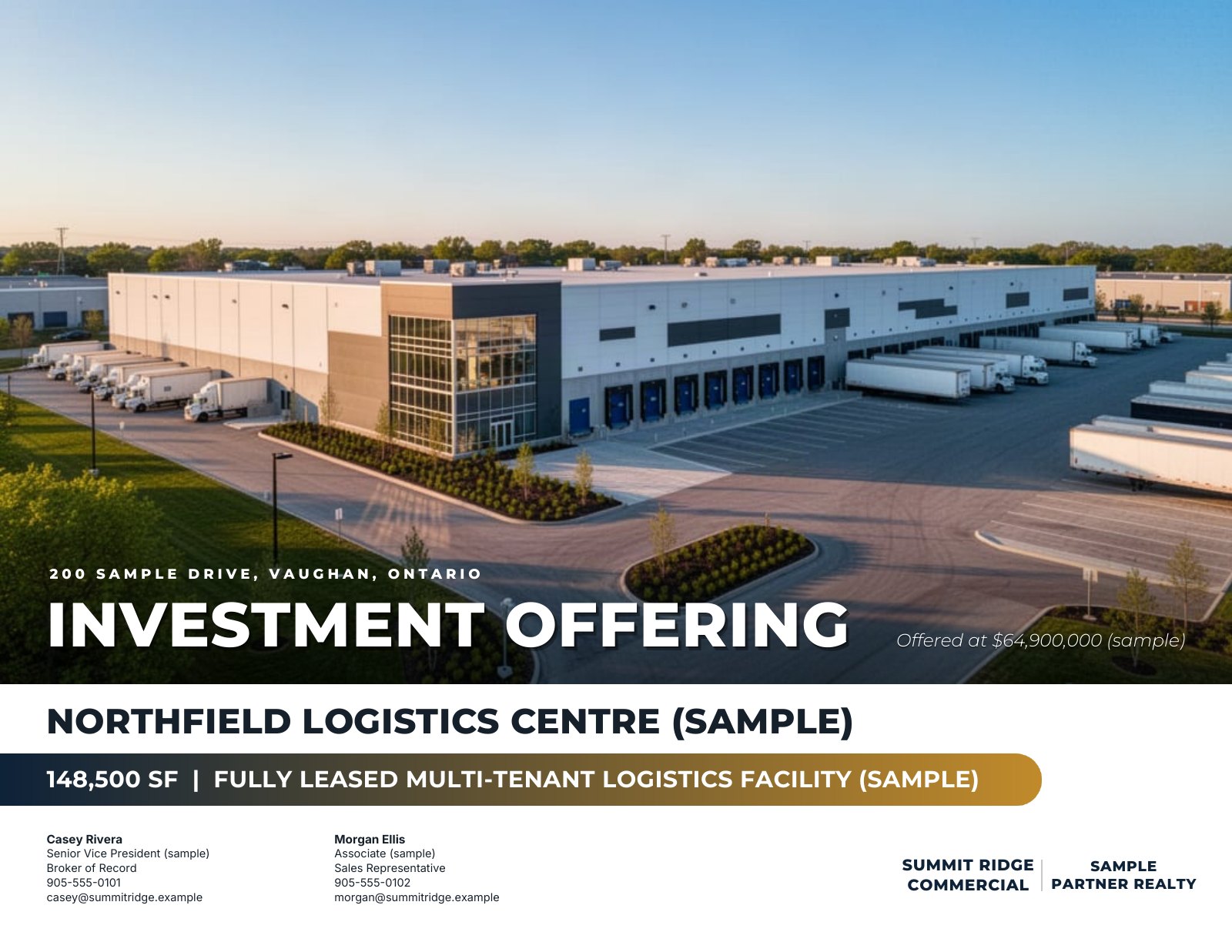
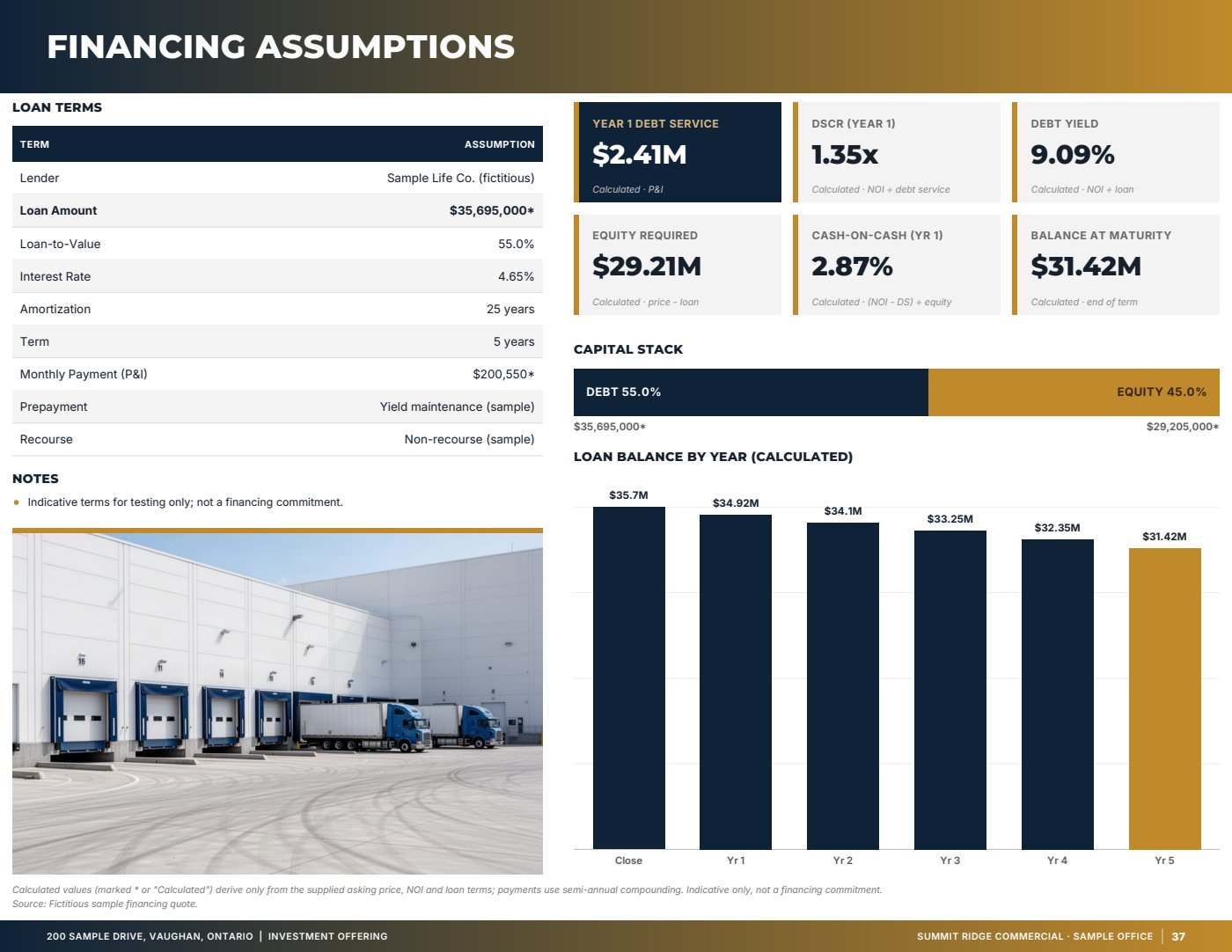
Sample — fictitious property. Pages generated by the product for an invented sample listing with an invented brokerage brand. Figures marked (sample) are not real.
Related
Last updated 2026-11-05. General information for commercial real estate professionals, not legal advice.
Start with the fact sheet you already have.
Upload it, answer only what’s missing for the output you choose, and review a watermarked preview before you buy anything.